


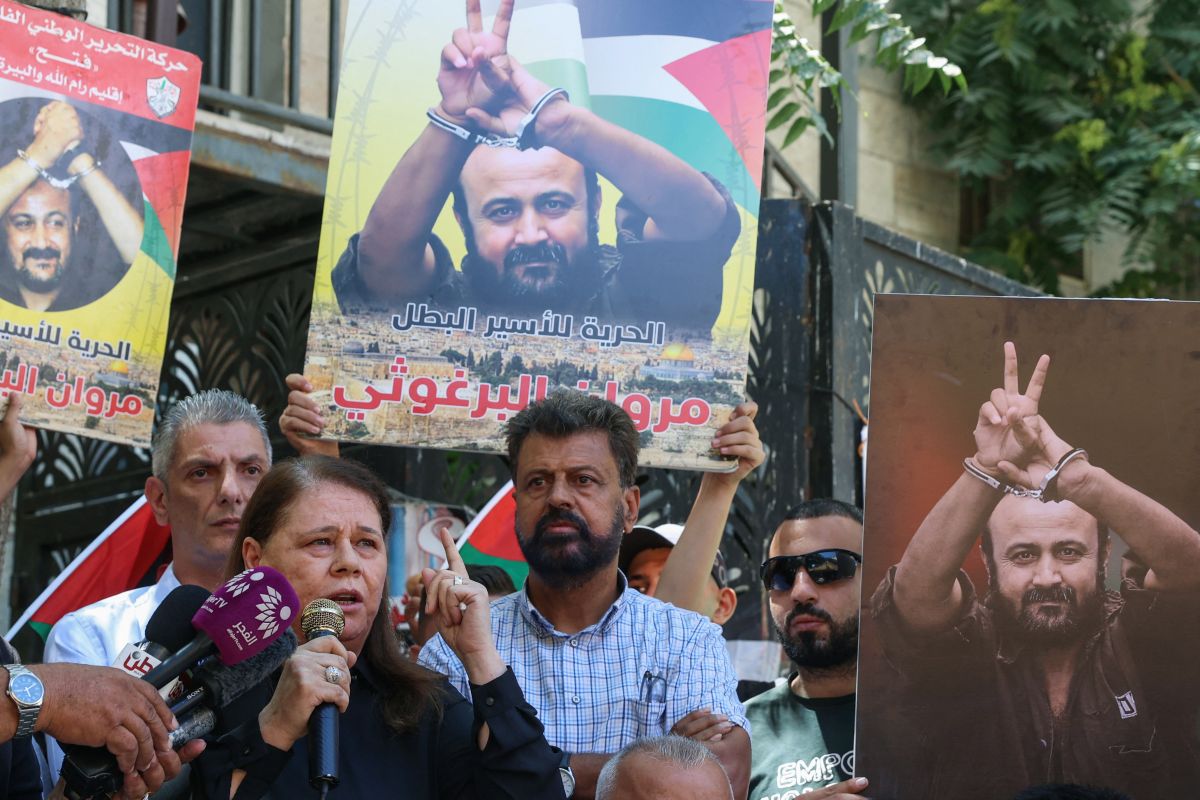
Fadwa Barghouti addresses a rally in support of her husband Marwan Barghouti, a senior leader of the Palestinian Fatah movement and the most wanted political prisoner held by Israel. Ramallah, the occupied West Bank, Aug. 19, 2025. (Photo: Zain Jaafar/AFP)






President Donald Trump's plan to ostensibly end the war in Gaza does not take Palestinian public opinion into account, according to a survey conducted in the last week of October by the Palestinian Center for Policy and Survey Research (PCPSR), a public opinion research organization based in Ramallah.
From the West Bank to Gaza, Palestinians are “deeply divided, skeptical and distrustful,” and “their priorities and red lines are largely ignored by the plan,” reports the organization's latest analysis, published this month. Notably, one finding is the renewed popularity of Hamas among the Gaza population. While the group had gained credit with Palestinians in the West Bank since Oct. 7, it had also been the target of some resentment in in Gaza over the devastation wrought by the war.
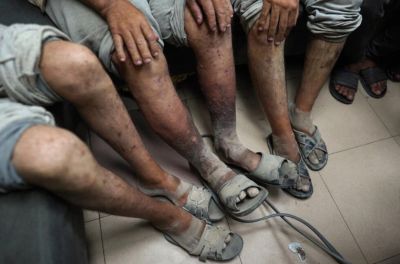
While 44 percent of Gazans support Hamas’s decision to attack Israel on Oct. 7, 2023, the number reaches 59 percent amongst Palestinians in the West Bank, though with a declining majority compared to previous surveys.
According to the survey results, 60 percent of respondents are satisfied with Hamas’s performance during the war, while Fatah garners only 30 percent of positive respondents, slightly more than the Palestinian Authority (PA) at 29 percent. This is three points higher than in May, when a similar survey was conducted in the midst of the war. In Gaza specifically, satisfaction with Hamas rose to 51 percent, up from 43 percent six months ago. This shift may be explained by Hamas regaining control of security of the enclave, including through initiating campaigns against alleged collaborators.
In this context, with nearly 80 percent of Palestinians viewing Ramallah's institutions as corrupt and wanting its president, Mahmoud Abbas, to resign, two alternative centers of power are emerging according to the survey.
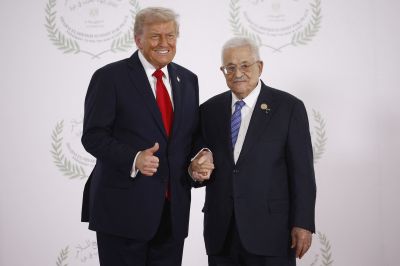
Another trajectory for postwar governance
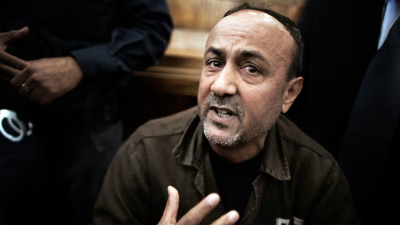
The first is Fatah's Marwan Barghouti, nicknamed the Palestinian Nelson Mandela and imprisoned by Israel for over two decades. Israel refused to release him during the latest prisoner exchange last month for hostages still alive in Gaza. Seen as capable of uniting Palestinians of all stripes around a common project, he is credited with 49 percent of the vote if pitted against Khaled Meshaal, a founding figure of Hamas, who would receive 36 percent, and Abbas, far behind with 13 percent.
In a presidential runoff between just the top two, the most famous Palestinian prisoner would win 58 percent of the ballots. Another player on the political scene, Hamas, would win with 44 percent against Fatah's 30 percent in parliamentary elections, with 35 percent of the public identifying with the Islamist movement and 24 percent with Abbas's faction. When asked which party deserves to lead Palestine today, 31 percent of respondents chose neither.
Nearly two-thirds want elections within twelve months of a cease-fire, though 60 percent doubt that the PA shares this intent and believe they will not take place. Regarding postwar governance in Gaza, nearly 67 percent of respondents, in both the enclave and the West Bank, support a Palestinian committee of experts to oversee reconstruction “under international auspices and with international support.”
But this figure falls to 51 percent in Gaza and 41 percent in the West Bank when it comes to an unaffiliated Palestinian professionals’ committee tasked with governing Gaza under an international organization, as outlined in the Trump plan. The plan calls for the creation of a Peace Council chaired by Donald Trump himself, which would oversee a “technocratic and apolitical Palestinian committee to manage public services and municipalities for the population of Gaza.”
This prospect raises concerns among those most affected about foreign control of Palestinians’ future. In this framework, 68 percent of respondents oppose the entry of an Arab armed force to “maintain security and disarm Hamas” (78 percent in the West Bank and 52 percent in Gaza), but support for such a presence increases, especially in the West Bank, if the force is solely responsible for border security and coordination with local police and committees.
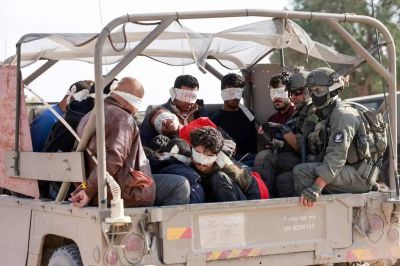
The contours of the International Stabilization Force (ISF) in the Trump plan remain the subject of intense debate, with Arab countries reluctant to participate if there is a risk of confrontation with Hamas.
In any case, a majority of Palestinians oppose the disarmament of Hamas: 55 percent in Gaza and 78 percent in the Israeli-occupied West Bank.
62 percent of respondents doubt that the Trump plan will end the war in Gaza, where Israel has killed by modest estimates at least 69,000 Palestinians and destroyed or damaged nearly all buildings since the start of the war. Moreover, nearly 70 percent of respondents don't believe the cease-fire will lead to the creation of a Palestinian state within the next five years.

 1 p.m. recap: Salam in Nabatieh; up to 10,000 more US troops heading to Middle East