



A Lebanese flag flying above the village of Shebaa, in southern Lebanon, facing the Israeli military position known as the "Radar," near the Israeli-occupied Shebaa farms, on July 23, 2025. (Credit: Matthieu Karam/L'Orient Today)






SOUTH LEBANON — The United Nations Interim Force in Lebanon (UNIFIL) released a statement on Friday saying it had observed that a concrete wall erected by the Israeli army extends well north of the internationally recognized U.N.-drawn border between southern Lebanon and Israel known as the Blue Line.
The peacekeeping force stated that the new concrete barrier encroaches on "more than 4,000 square meters" of Lebanese territory in the central sector of the border area, in the Bint Jbeil district.
UNIFIL added that the section of this wall that extends on the Lebanese side of the border is south of Yaroun, and is different from the section that has been erected by the Israeli army between Aitaroun and Maroun al-Ras, which some media had reported this week was inside Lebanon.
Any construction in the area of the Blue Line is a violation of U.N. Resolution 1701, a UNIFIL source told L'Orient Today earlier this week.

At least 4,000 m² made inaccessible to Lebanese
"In October, a UNIFIL geospatial study confirmed that the wall erected by the Israeli army crosses the Blue Line southwest of Yaroun, making more than 4,000 square meters of Lebanese territory inaccessible to the Lebanese population," the U.N. force explained in its statement.
More recent observations by the peacekeepers subsequently revealed that another section of this wall, southeast of Yaroun, also crosses the Blue Line. "We will officially inform the army of these findings," the statement added.
On Thursday, L'Orient Today conducted a fact-check that revealed another part of this wall, visible from Aitaroun and Maroun al-Ras (also in the Bint Jbeil district), is on the Israeli side of the border, between the northern Israeli village of Avivim and the site illegally occupied by Israeli soldiers, known as "Jal al-Deir."
"The new wall between Aitaroun and Maroun al-Ras is south of the Blue Line," UNIFIL confirmed.
"We will officially inform the Israeli army of these findings and ask them to move these walls," UNIFIL continued, denouncing "violations of [U.N.] Resolution 1701 as well as the sovereignty and territorial integrity of Lebanon."
The U.N. force reiterated its call for the Israeli army to "fully respect the Blue Line and withdraw from all areas located north of it."
Despite a cease-fire that ended a war with Hezbollah nearly a year ago, the Israeli army continues to occupy at least six points in southern Lebanon, from which its soldiers regularly fire on southern Lebanese villages and residents tending to their agricultural lands in the area.
Soldiers stationed at these illegal sites also regularly conduct incursions into Lebanese villages, where they often destroy homes and buildings. In October, Israeli soldiers invaded the village of Blida, in Marjayoun district, laid siege to a municipal building there and shot dead an employee sleeping inside.
The November 2024 cease-fire, which Israel violates on a regular basis, killing more than 340 people, is based on U.N. Security Council Resolution 1701, which ended a previous war between Hezbollah and Israel in 2006.

Israeli denial
For its part, Israel denied having built any wall on Lebanese territory, though it acknowledged erecting a "reinforced barrier" along the demarcation line with Lebanon.
"This wall is part of a broader army plan whose construction began in 2022," an Israeli military spokesperson told AFP. Since the start of fighting between Israel and Hezbollah on Oct. 8, 2023, the Israeli army "has implemented a series of measures, including strengthening the physical barrier along the northern border," the spokesperson stated.
Some 10,800 peacekeepers have been serving as a buffer between Israel and Lebanon since March 1978, but UNIFIL's mandate is set to expire in December 2026, as Israel and the United States have blocked its renewal.
In 2012, Israel began building a wall along parts of its border with Lebanon, following the route of the "Blue Line" established by the U.N. in 2000 to serve as an armistice line between the two countries after the Israeli army's withdrawal from southern Lebanon.
Relative calm in southern Lebanon
Prior to this development, the day had been relatively calm in southern Lebanon, as had the previous night.
However, around 4 p.m. Israeli soldiers stationed at the occupied site of Rweisat al-Alam, targeted the outskirts of Kfar Shuba, in Hasbaya district, with machine gun fire, L'Orient Today's correspondent in the South reported.
The Israeli army has accelerated its attacks in Lebanon in recent weeks, claiming to be countering Hezbollah's attempts to rebuild its "infrastructure."
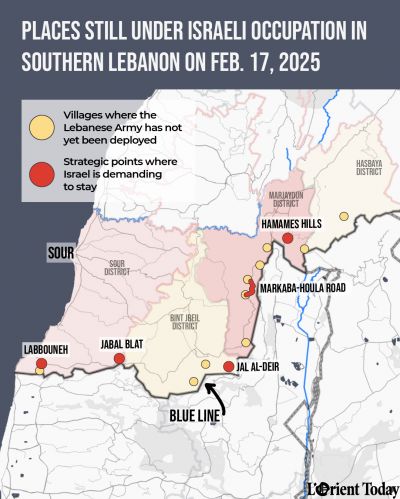
Since agreeing to a cease-fire with Hezbollah, Israel has remained in at least six illegally occupied positions in southern Lebanon, in violation of the same agreement.
These positions are at Hamames Hill south of Khiam, the main Markaba-Houla road (Marjayoun district), Jal al-Deir in Aitaroun, Jabal Blat east of Ramieh (Bint Jbeil), and Labbouneh (Sour).
A sixth position is also reportedly occupied between the border villages of Houla and Markaba (Marjayoun). These positions are in addition to three other areas already contested by Lebanon and Israel: the Shebaa Farms, the Kfar Shuba hills, and the village of Ghajar.
 2 p.m. recap: Iran says, 'No military solution' to conflict; 2 Israeli soldiers wounded in south Lebanon; Houthis claim attack on Aramco