


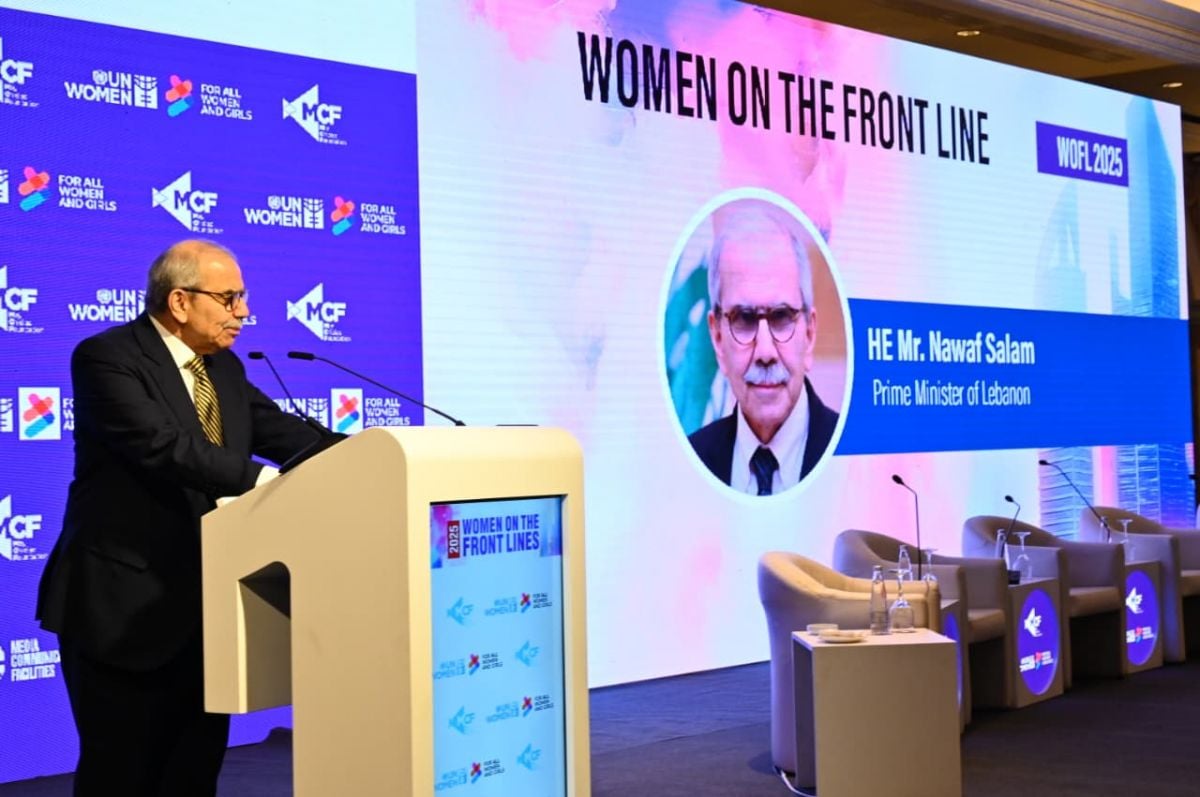
Lebanon's Prime Minister Nawaf Salam speaking at the Women on the Front Lines Conference on Nov. 12 2025. (Credit: Mohammad Yassine/L'Orient Today)






BEIRUT — Prime Minister Nawaf Salam warned Wednesday that women’s representation in Lebanon “remains low due to a political and social system still governed by patriarchal mentalities,” and urged them to participate “massively” in the 2026 parliamentary elections as both "candidates and voters."
Salam warned that Lebanon continues to lag far behind global standards in women’s political representation, noting that “despite Lebanon’s long history of women’s activism, only eight female MPs serve in a 128-member parliament, about 6.3 percent, compared to a global average of 26 percent," during his opening remarks at the conference organized by the May Chidiac Foundation at Beirut’s Phoenicia Hotel, according to the state-run National News Agency.
While praising the five women ministers currently serving in his Cabinet, in the fields of environment, education, tourism, youth and sports, and social development, Salam stressed that this progress remains insufficient. “They are all women of vision and great competence,” he said. “But that is not enough.”
He pointed out that many female candidates in the 2022 parliamentary elections faced digital harassment and gender-based attacks targeting their appearance and speech, sometimes escalating to sexualized incitement. “The real challenge lies not only in reaching positions of power,” he said, “but in how society and some political figures treat women before and after they get there.”
“Yet this is not enough,” he admitted. “We need policies and legislation that open wider doors for women and actively encourage them to engage in public life. Empowering women is not a symbolic gesture; it is an essential condition for Lebanon’s renaissance and the creation of a modern state built on equality and the rule of law.”
'Women constitute only 27.5% of Lebanon’s workforce, compared to 51% globally'
Salam stressed that gender inequality extends far beyond the political arena. Women constitute only 27.5 percent of Lebanon’s workforce, compared to 51 percent globally, and hold less than 10 percent of business ownership.
Even more alarming, he said, is the growing prevalence of gender-based violence: “Women represent over 80 percent of digital violence victims in Lebanon, in addition to those abused within their own homes due to entrenched patriarchal attitudes. There can be no leniency toward any abuser or harasser, whoever they may be, husband, relative, or stranger.”

Despite these challenges, Salam praised the growing number of Lebanese women excelling in fields such as e-commerce, artificial intelligence, medicine, and science, calling them “the hope and promise of a brighter future.”
“To all women of Lebanon, I urge you to participate actively in the upcoming elections, as candidates and voters alike. This is our collective rendezvous with history, to create together a different scene and a promising future," Salam concluded.

 7 p.m. recap: Netanyahu seeks mastermind behind Flydubai incident; Washington sanctions 2 French nationals; Ben Gvir's 'I want to kill you' threat