






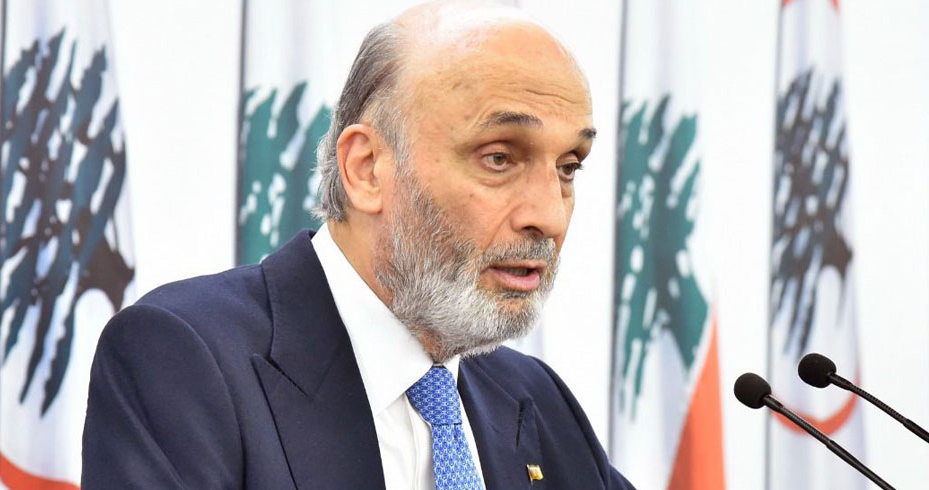
The leader of the Lebanese Forces, Samir Geagea. (Credit: NNA)






BEIRUT — Head of the Lebanese Forces Samir Geagea said that Hezbollah, through its "stances and actions since the ceasefire agreement, continues to drag Lebanon, and particularly its own base, into further disaster, death, and destruction," according to remarks he made during the annual retreat of the Northern Bekaa region, as reported Monday by the state-run National News Agency.
"Hezbollah miscalculated and acted wrongly during the years 2023 and 2024, leading to devastation and destruction in various Lebanese regions," Geagea said.
On Oct. 8, 2023, Hezbollah opened a “support front” for Gaza from southern Lebanon, engaging in cross-border fire with Israel for nearly a year before the conflict escalated into a full-scale war in September 2024. A cease-fire was declared in November 2024.
Geagea considered that “all of this stems from Hezbollah’s refusal to dissolve its military and security wings, as stipulated by the Taif Agreement first, U.N. Resolution 1701 second, the 2024 cease-fire agreement third, and the Presidential Oath and Ministerial Statement fourth, among others. Instead, it refuses to engage in political life through legitimate means, like all other Lebanese parties.”
Despite the cease-fire implemented in Lebanon, the Israeli army continues striking the South and occupies at least six positions in Lebanese territory. Israel claims to target Hezbollah fighters and infrastructures, as it presses, alongside the United States, for the party's disarmament. Hezbollah refuses to fully disarm while Lebanon is under Israeli fire.
Geagea explained: “Even if we assume that Hezbollah disregarded the Taif Agreement over the past decades and ignored the will of the majority of Lebanese due to miscalculations, believing it could maintain a kind of military balance with Israel, that assumption has completely collapsed after the events of 2024.”
Hezbollah was severely weakened by Israel's war last year, which killed hundreds of fighters and longtime leader Hassan Nasrallah. The Israeli war on Lebanon killed over 4,000 people, including 1,100 women and children, and destroyed swathes of Lebanon's south and east.
Geagea continued: “The key question remains: Why does Hezbollah insist on keeping weapons that have proven, beyond any doubt, incapable of confronting Israel? More than that, these weapons have become a magnet that attracts Israeli attacks into Lebanon. So why insist on holding onto arms that have no value and only bring calamities and destruction upon the country?”
He concluded: “We raise these essential questions at this critical juncture not out of political rivalry, but to alert all officials who hold decision-making power to take firm stances and appropriate decisions before Lebanon reaches total collapse especially since it is already largely in ruin.”
The United States, via its emissaries Tom Barrack and Morgan Ortagus, has exhorted the Lebanese authorities to accelerate the disarmament of Hezbollah and start negotiating with Israel. On Saturday, Barrack urged Lebanese leaders to negotiate with Israel over their shared border and to ensure that the state alone holds the monopoly on weapons, warning that Lebanon “has no more time.”
