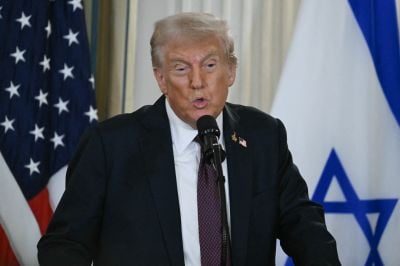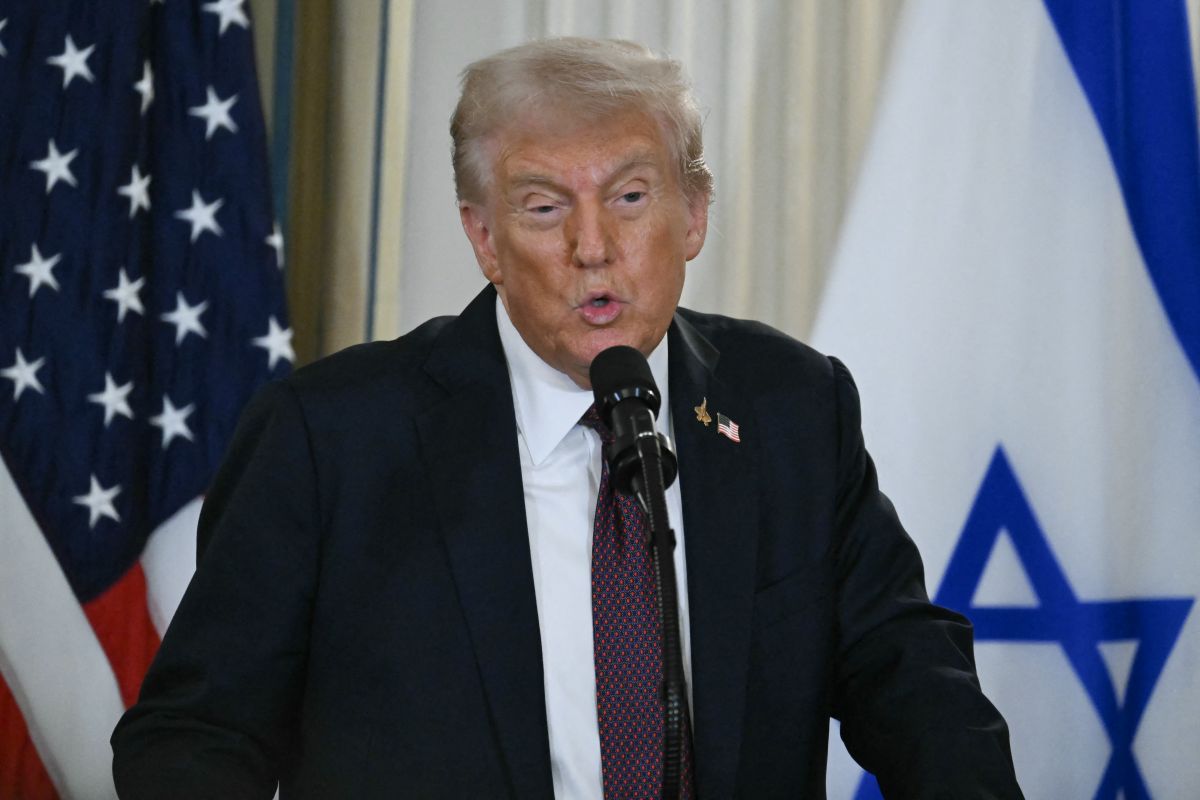
U.S. President Donald Trump speaks at a press conference with Israeli Prime Minister Benjamin Netanyahu at the White House in Washington, on Sept. 29, 2025. (Credit: Andrew Caballero/AFP)






Just days after he visited Jerusalem, where he was welcomed as a hero and credited with the return of hostages still held by Hamas, U.S. President Donald Trump presented himself, in a lengthy interview with Time Magazine published Thursday, as the real mastermind behind Israeli "attacks" in the Middle East, including the explosion of Hezbollah's rigged pagers.
This operation, during which thousands of communication devices booby-trapped by Mossad exploded nearly simultaneously in Lebanon, was carried out "directly" under his "leadership," he claimed — even though the American president had not yet been re-elected on Sept. 17, 2024, the date of the attack.
Asked about the "upheavals" in the region, and the fact that the "Hezbollah leadership had been decimated," Trump replied, "All those attacks were carried out under my leadership, in fact, directly with me. You know, with Israel carrying out the strikes, with the pagers, all of that. They... look, Israel was very respectful [of the United States]. They informed me of everything. And sometimes I said no, and they respected that."
The explosion of Hezbollah's communication devices — the pagers, then the walkie-talkies the next day — killed at least 40 people, including a child, and injured more than 2,900.
In the wake of the explosions, U.S. Secretary of State under Joe Biden (2021-2025), Antony Blinken, denied reports that the then-U.S. administration was involved or had prior knowledge of the attack.
Israel's Defense Minister at the time, Yoav Gallant, reportedly called U.S. Defense Secretary Lloyd Austin to warn him "a few minutes" ahead of an "operation in Lebanon," while "refusing to give specific details," according to Axios on Sept. 18, 2024.
Trump made this revelation to Time from the White House on Oct. 15, two days after his last Middle East trip. The interview was published as the current U.S. administration is pressuring Beirut to enter direct negotiations with Israel and to disarm Hezbollah throughout the country, or else Israel may launch a new offensive, as recently suggested by U.S. envoy Tom Barrack.
The Israeli army, meanwhile, is ramping up military pressure — through daily bombings in Lebanon, in the South and the Bekaa — to force the disarmament of the party, which refuses to negotiate as long as Israel occupies at least six positions in Lebanon near the border.
Trump was elected president on Nov. 5, 2024, and officially took office on Jan. 20, 2025, for a second term after his previous tenure (2017-2021).
On Oct. 23, 2024 — a month to the day after the launch of the massive air offensive across Lebanon, codenamed "Northern Arrows," and two weeks before his election — he boasted of his almost daily conversations with the Israeli Prime Minister Benjamin Netanyahu.
"Do what you have to do" in Gaza and Lebanon, he reportedly said during one of them in October.
In February 2025, Netanyahu offered Trump a golden pager during his trip to Washington.
'Iranian threat no longer exists': Trump
More broadly, the U.S. president said, five days after the cease-fire took effect in Gaza, that "peace reigns in the Middle East," adding that "Saudi Arabia will pave the way toward the Abraham Accords," referring to the peace agreements between Israel and Arab countries, thanks to the fact that "the Iranian threat no longer exists."
He lingered on this "terrible threat," which he no longer considers "imminent." "We have created a different Middle East ... You see, if Iran had been there, strong and tyrannical, it would have been impossible to reach such an agreement [in Gaza], because the threat would have hung over the region.
Today, it is no longer an imminent threat," he reiterated, echoing his speech before the Knesset on Oct. 13, congratulating himself in this context for the American strikes on Iranian nuclear facilities last June.
"[Iranian leaders] are literally fighting for their survival. They are not fighting for nuclear [capabilities]. They are fighting for their survival. Believe me, they are very weak. So, that threat no longer exists. Now ... everyone is open to peace," the president emphasized.
The pro-Iran axis in the Middle East has been severely weakened over the past two years, particularly following the fall of the Assad regime in Syria last December. "The Soleimani affair, I think, was important. That's where it all started, during the first term," the American president also said.
On Jan. 3, 2020, at Trump's orders, a drone destroyed a vehicle in Baghdad, Iraq, carrying General Qassem Soleimani, the architect of Iran's strategy in the Middle East and its influence over four Arab capitals: Sanaa, Damascus, Baghdad and Beirut.
In addition to weakening Iran, Trump also argued that the Israeli strike in early September on a Hamas delegation in Doha indirectly helped reach a cease-fire in the devastated enclave.
"You see, the world had had enough of watching us attack — I say 'us,' you know, Israel and us. You know, I stopped [Benjamin Netanyahu], because he would have gone on endlessly ... And when he made that tactical mistake, the one involving Qatar — it was terrible — but in fact, I told the emir [of Qatar] that it was actually one of the elements that brought us all together, because it was so out of step that, in a way, it pushed everyone to do what needed to be done."
Trump forced Netanyahu in late September, from the White House, to apologize during a phone call to his Qatari counterpart, Sheikh Mohammed bin Abdulrahman al-Thani, for the Israeli attack in Doha. The Gaza cease-fire agreement took effect on Oct. 10.
This article was translated from L'Orient-Le Jour.