


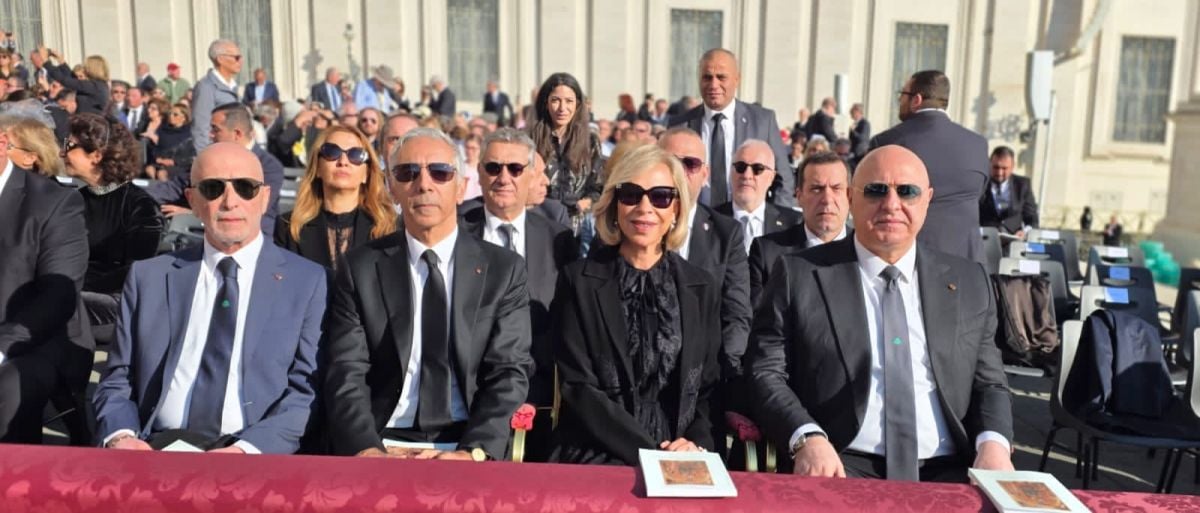
The presidential couple (on the right) attend the canonization ceremony of Archbishop Ignatius Maloyan in Rome, on Oct. 19, 2025. (Credit: Photo taken from the presidency’s X account)






Lebanese President Joseph Aoun and his wife Neemat attended the canonization ceremony of Bishop Ignace Maloyan on Sunday at St. Peter’s Square in the Vatican.
The bells rang across St. Peter’s Square as Pope Leo XIV canonized seven new saints of the Catholic Church, including the first from Papua New Guinea, an archbishop executed during the Armenian genocide, and the Venezuelan “doctor of the poor.” During the solemn mass, three nuns who had dedicated their lives to the poor and sick were also canonized, as well as the former Satanist priest Bartolo Longo, born in 1841. Longo converted to the Catholic faith and founded the Pontifical Shrine of the Holy Virgin of the Rosary of Pompeii.
“Benefactors of humanity”
Among the newly canonized is Peter To Rot (1912–1945), the first saint born in Papua New Guinea, executed by the Japanese at the end of World War II. Also canonized was Ignazio Choukrallah Maloyan, an Armenian bishop and martyr killed in 1915 by Ottoman forces for refusing to convert to Islam.
The Venezuelan layman José Gregorio Hernandez Cisneros (1864–1919), described by Pope Francis as “a doctor close to the weakest,” was also canonized; he is already venerated in his country. Another Venezuelan, Maria Carmen Elena Rendiles Martinez, a nun born without a left arm, overcame her disability to found the Congregation of the Servants of Jesus before her death in 1977, becoming the first female saint from Venezuela.
“Today, before us, we have seven witnesses, the new Saints, who, with the grace of God, kept the lamp of faith burning,” said Pope Leo to an audience estimated at 70,000 people.
“May their intercession assist us in our trials, and may their example inspire us in our common vocation to holiness.”
The pope also described the new saints as either “martyrs for their faith,” “evangelizers and missionaries,” “charismatic founders” of congregations, or “benefactors of humanity.”
Rai: Lebanon, “a land of peace and coexistence”
Before going to the Vatican, Joseph Aoun received Maronite Patriarch Bechara Rai at his residence in Rome, accompanied by MP Farid al-Khazen, Mgr Georges Abi Saad, new patriarchal prosecutor and rector of the Maronite Institute of Rome, and Mgr Joseph Sfeir, patriarchal vicar in Rome, according to the official Agence nationale d’information (NNA).
During their meeting, Patriarch Rai informed the president of “the content of his discussion the day before with Pope Leo XIV, particularly regarding his planned pastoral visit to Lebanon at the end of next month.” Their exchange also touched on “the current situation in Lebanon and recent developments in the region.” President Aoun also met with Lebanon’s ambassador to the Holy See, Fadi Assaf, and the ambassador of Lebanon to Rome, Carla Jazzar.
From the Vatican, the Maronite Patriarch stated that: “Lebanon remains and will remain a land of peace and coexistence, as everyone desires.”
In mid-July, the Patriarch of Cilicia of the Armenian Catholics, Raphael Bedros XXI Minassian, had sent Joseph Aoun an official invitation to attend the canonization ceremony.
Former Armenian Catholic Archbishop of Mardin (Turkey), Mgr Ignace Chekrallah Maloyan was killed by Ottoman forces in Istanbul on June 11, 1915, during the Armenian genocide, along with other religious figures. He is considered one of the most important personalities of the Eastern Armenian Church.
His canonization had been approved by Pope Francis following an ordinary session of cardinals and bishops held in late March. Bishop Maloyan spent the early years of his priesthood in Lebanon, sent at age 14 to the Bzemmar Monastery in Kesrouan, where he stayed for nearly fifteen years, eventually joining the Institute of Bzemmar, before being appointed in 1897 as priest of the parishes of Alexandria and Cairo.
Canonization, the final step toward sainthood in the Catholic Church, following beatification, is the result of a long process and can only be approved by the pope. It requires three conditions: The person must have been dead for at least five years, they must have led an exemplary Christian life, and they must have performed at least two miracles.
 Israeli army carries out demolition at Jabal Amel School in Houla as strikes continue