





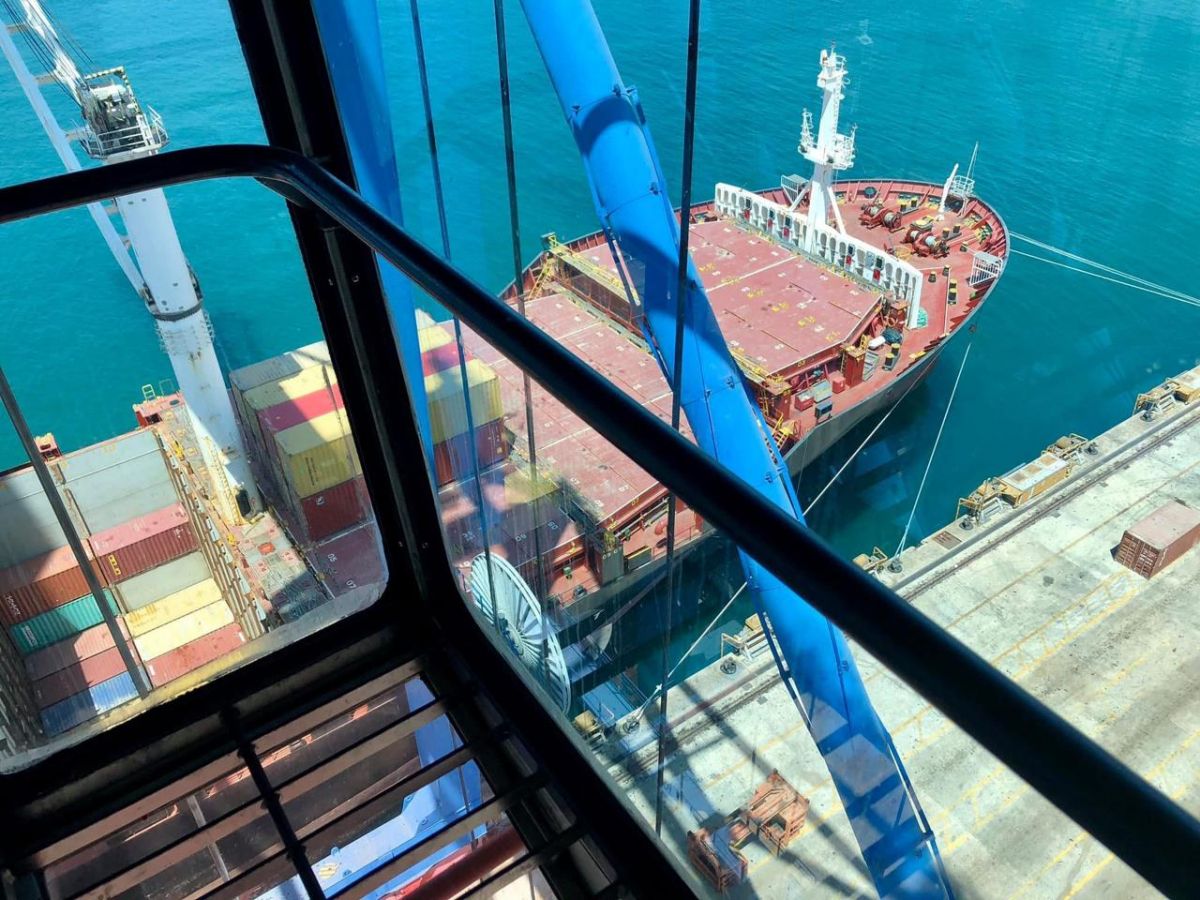
The container terminal quay as seen from the cockpit of one of the giant cranes at the Port of Beirut on July 30, 2025. (Credit: Philippe Hage Boutros/L’Orient-Le Jour)






The president of the Food Importers Syndicate, Hani Bohsali, called on authorities to adopt sustainable solutions involving “full digitalization” and “artificial intelligence” to speed up customs clearance operations at the Port of Beirut, according to a statement relayed by the state-run National News Agency (NNA). He denounced the “makeshift solutions” currently in place.
The statement was issued in response to another breakdown in the customs IT system known as Najm, which was installed in 1990.
In Beirut, a malfunction in Najm can also disrupt the operation of CAMA (Cargo Management System), the centralized IT platform that connects all stakeholders — port authorities, customs, the terminal operator and shipping companies — and enables the issuance of invoices and other documents required to process goods, collectively known as the Port Community System. CAMA was deployed in 2005, when the container terminal at the Port of Beirut became operational.
Temporary remedies and “superficial” improvement
“Following our previous positions, the latest dating from last Friday, regarding problems and delays recorded in customs clearance at the Port of Beirut as well as at other ports and crossing points (...) we reiterate the need to find a sustainable solution to this issue, through modernizing customs and port systems, and adopting full mechanization and artificial intelligence,” Bohsali said.
He added that “maintaining the current IT systems used at the Port of Beirut may be a partial and temporary remedy, as has been the case so far,” but that “it is now imperative to adopt structural solutions based on high-performance systems.”
In response to the most recent statement released Wednesday by port management, which sought to explain the delays, Bohsali acknowledged that “the situation is partially and temporarily improving, but only superficially.”
The Committee for the Management and Operation of the Port of Beirut (GEPB) published a statement explaining that customs clearance delays were due to a failure in Najm and assured that port teams had worked to handle the disruption as best they could.
The GEPB also announced that a call for tenders had been issued to modernize the CAMA system, adding that the process would take several months — a timeline confirmed by an anonymous source at the port who is not authorized to speak to the press. “We do not know what will happen with Najm,” the source added.
Earlier this month, caretaker Finance Minister Yassine Jaber said that customs and the ministry are working to implement a computerized pre-declaration system for goods, which should strengthen controls at all of the country’s ports without slowing the customs clearance process.
New scanners are also set to be installed in Beirut and Tripoli — the only ports equipped with container terminals. Customs procedures at both facilities had also been slowed following a ministerial decision to increase controls to combat smuggling, which caused significant delays, particularly in Tripoli.

 Evening recap: Netanyahu announces West Bank offensive; 7 killed in Jordan church shooting; tents burned in south Lebanon
 US strike on Iran this weekend? ‘Absolutely,’ says Barrack; ‘I have no idea,’ says Trump