


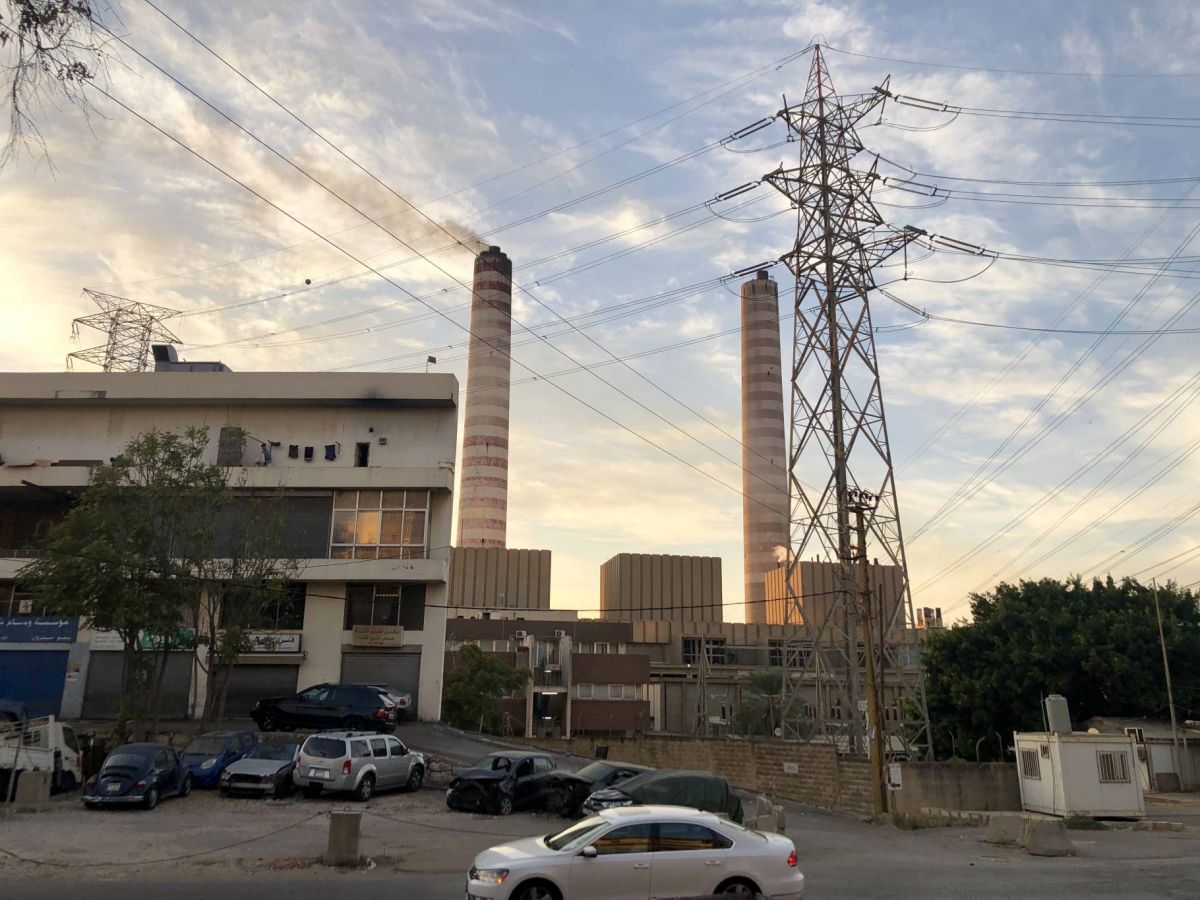
The towers of the Zouk Mosbeh power plant. Photo P.H.B.






Lebanon’s Minister of Energy and Water, Joe Saddi, who visited Zahle and its surrounding region on Saturday, affirmed that cracking down on violations of the country’s water and electricity networks is one of the ways the state must "assert its authority."
Saddi’s visit aimed to "listen to all parties regarding the challenges facing the region, particularly in the sectors of water, sanitation and electricity," according to the state-run National News Agency (NNA).
"Asserting the authority of the state is not only about monopolizing arms, but also about eliminating violations affecting public property, water, and electricity networks," he said. Many households are illegally connected to the public network or do not pay their bills. On September 29, the management of Electricité du Liban (EDL) announced the launch of a wide campaign against illegal connections and electricity theft across the country.
The minister was welcomed in the city by Lebanese Forces (LF) MPs Georges Okais and Elias Stephan, as well as by the new president of Zahle’s municipal council, Salim Ghazal.
"Even though electricity remains a major challenge, the issue of water is even more difficult, especially given the drought affecting wells and the challenges related to renewable energy and sustainable development," Joe Saddi said.
He added that he had also discussed the "problem of pollution, which is among our main concerns." On that point, the minister noted that the government has been working "for about a month on the pollution of Lake Qaraoun, in cooperation with the Council for Development and Reconstruction," explaining he had discussed the matter on Friday "with the Italian ambassador, as well as with the Banque du Liban [BDL, cetral bank] and donors." Two weeks ago, Industry Minister Joe Issa el-Khoury had toured industries located along the Litani River in the Bekaa, starting with Lake Qaraoun, to inspect the state of industrial pollution in the basin.

Four hydraulic dams
The minister also praised Zahle, "which has always been a model of success, especially in the electricity sector where Electricité de Zahle’s experience has demonstrated its ability to manage and efficiently collect bills." "Zahle can therefore serve as an example for the decentralization provided for in the Taif Agreement," added the minister, who is aligned with the Lebanese Forces.
Asked about the issue of dams in Lebanon, Saddi said that "there are four main dams — Balaa, Bekaata, Janneh, and Mseilha — for which technical solutions must be found within a maximum of three to four months." These infrastructures have either been suspended or are not functioning efficiently. "I have asked international donors to form a committee of experts charged with making technical recommendations, away from political considerations," he continued.
The minister also discussed the new role of the Electricity Regulatory Authority. "The regulatory authority has started its work with the cooperation of international experts and the World Bank to study the electricity distribution sector," he said. The goal is "to give this Authority an active role in accordance with the law, with the support of donors," he specified.
The Electricity Regulatory Authority is an independent institution responsible, among other roles, for setting tariffs and overseeing contracts with the private sector for electricity production and distribution. Although lawmakers stipulated the creation of such an Authority as early as 2002 (law 462), it was established only last month. Okais hailed this as an "important step" while expressing hope that "its positive effects would soon be seen on the ground, especially in Baalbek, far from clientelism, corruption and mismanagement."
For his part, Zahle’s municipal council president welcomed the "unique model in the electricity sector through Electricité de Zahlé’s experience, which demonstrated the importance of public-private partnership." He called on the minister to help "fund the wastewater treatment plant, which is a vital project for the region."
Stephan also called on the state to ensure the cleanliness of the Berdawni River’s waters. "We have cleaned the river twice with our limited means, but we cannot substitute ourselves for the state in carrying out its essential duties," he finally stressed.

 7 p.m. recap: Netanyahu seeks mastermind behind Flydubai incident; Washington sanctions 2 French nationals; Ben Gvir's 'I want to kill you' threat