





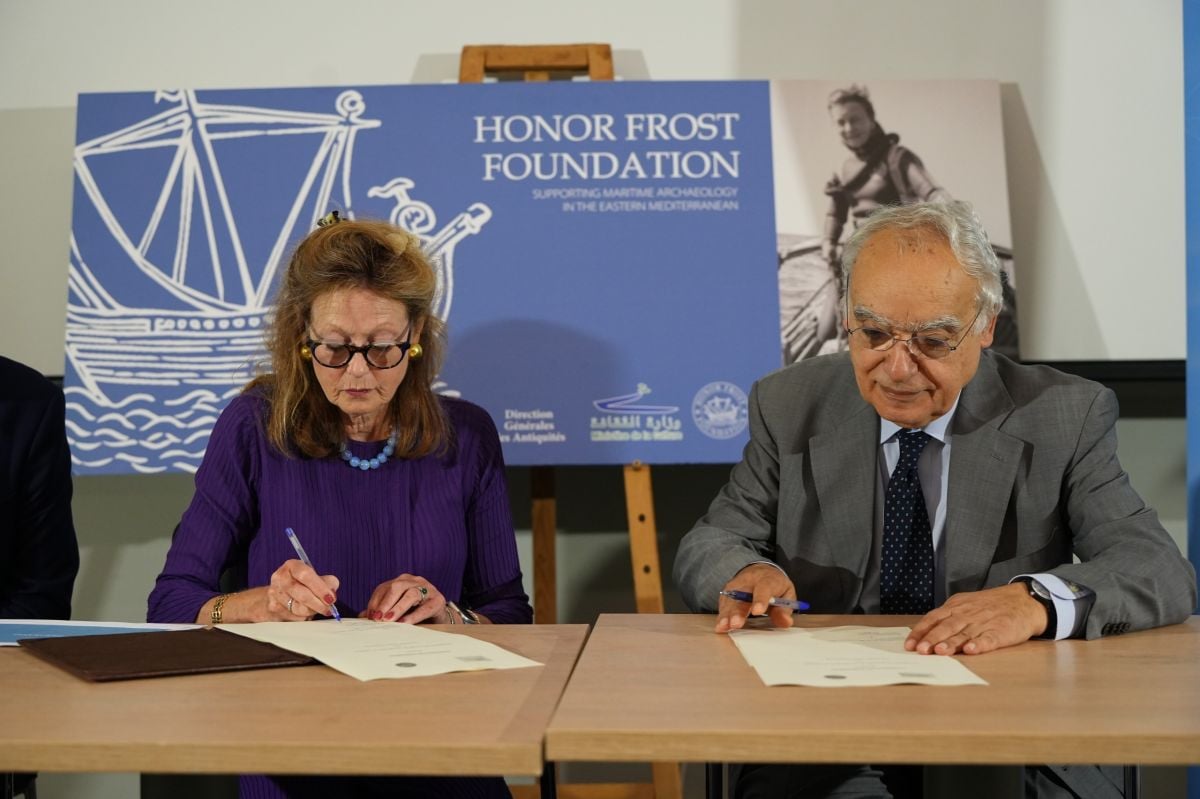
The Chair of the Board of the Honor Frost Foundation, Alison Cathie, and the Culture Minister, Ghassan Salameh, have signed a cooperation agreement for the digitization of the Bulletin d’archéologie et d’architecture libanaises (BAAL). (Credit: Mohammad Yassine/L'Orient Today)






Culture Minister Ghassan Salameh and Alison Cathie, chair of the Honor Frost Foundation board, signed a cooperation agreement at the National Library in Sanayeh to digitize the Bulletin d’archéologie et d’architecture libanaises (Bulletin of Lebanese archaeology and architecture or BAAL) — an annual or semi-annual journal published in French, English, and Arabic by the Directorate General of Antiquities (DGA).
The publication, which has not been issued in six years due to lack of financial resources, had left archaeological excavation reports unavailable to the public for that period. Now, nothing will impede their dissemination. This initiative aims to preserve written heritage, promote it, and allow broader and faster access to information.
Publish or perish
During the signing ceremony, also attended by Directorate General of Antiquities director Sarkis Khoury, archaeologist Claude Doumit Serhal (Honor Frost Foundation trustee), and David Sassine, ALIPH project manager for Lebanon and Syria, Salameh invoked the famous dictum "Publish or perish." "This applies also to archaeology, perhaps even more so than to other sciences," said the minister.
"Why? Because archaeology is a long-term job, you spend years searching for small discoveries before drawing conclusions to help historians rewrite or revisit a place's history… You are at the source of precise historical writing. That's why I have immense respect for archaeology, and maybe I'll become an archaeologist in another life…"
The minister acknowledged ALIPH’s (International Alliance for the Protection of Heritage in Conflict Areas) collaboration on this project initiated by the Honor Frost Foundation, which, he said, will foster "better scientific collaboration among archaeologists worldwide regarding our country’s rich history." He added: "I am convinced that the website will soon be visited by hundreds, even thousands, of experts in this field."

From surveys in the south to the north
Cathie expressed her delight at signing the agreement, which will allow the BAAL bulletin — once a reference for archaeology enthusiasts — to be published once again.
She noted that the foundation, which established its Beirut office in 2022 in the so-called Medawar 479 Blue House, has already invested about $5 million in educational activities and projects along the Lebanese coast.
For example, in Anfeh, researchers conducted visual recordings and created an inventory of the maritime community’s tangible and intangible heritage. In Batroun, geoarchaeological surveys were carried out. Coastal, underwater, and geomorphological studies took place in Kharayeb and Adloun. In Tabarja (Wata Slam 100), a major Neolithic site was studied, focusing on maritime exploitation and navigation.
The "Sour Maritime Cultural Landscape" project included excavations and surveys of the Phoenician port, along with efforts to reconstruct ancient sea levels along the coast. In Saida, excavations led by Claude Doumit Serhal were conducted, along with studies around Zireh Island.
Not to mention the Byblos and the Sea project, with geoarchaeological and archaeological operations led under the aegis of Collège de France by Nicolas Grimal and Martine Francis-Allouche. The foundation has also funded full documentation of archaeological discoveries in the ports of Beirut and Saida and surveys of modern shipwrecks off the Lebanese coast.
And that's not all. "The foundation started a course on maritime archaeology and geophysics (Minor in Marine Sciences and Cultures) at the American University of Beirut (AUB) in 2019. Led by Professor Nassim Raad, this program, now in its seventh year, welcomes Lebanese University students free of charge," Cathie said, noting that these students will in the future be able to identify, anticipate, and mitigate the negative impacts of coastline and natural resource exploitation projects through the use of environmental impact studies.
In short, underwater archaeology is committed to detecting and studying remains lying underwater that retain the country’s history.

Who funds the Honor Frost Foundation?
The foundation is mainly financed by private donations, legacies, and corporate sponsorships, as well as public grants. The Honor Frost Foundation’s initial capital comes from a collection of artworks inherited by Honor Frost from her guardian, lawyer Wilfred Evill: Ceramics, furniture, and a large collection of modern British art.
Notably, paintings by Sir Stanley Spencer, whose works hang in the Birmingham Museum, the Fitzwilliam Museum in Cambridge, the Tate Gallery in London, the Santa Barbara Museum on California’s coast, the National Gallery of South Australia, and the Art Gallery of Ontario in Canada.
The collection also included works by Graham Sutherland — one of the key figures of modern English painting — and Dame Barbara Hepworth, a leading figure in early-20th-century abstract sculpture, who was the subject of the "Revolution in Sculpture" exhibition at the Rodin Museum in Paris in 2020.
Other renowned painters, such as Kenneth Vaughan, Ceri Richards, and Edward Burra, were also represented. In 2011, a Sotheby’s auction — brilliantly conducted by auctioneer Henry Wyndham — set records selling the collection. The trustees have since skillfully managed the investments, dedicated to supporting maritime archaeology in the eastern Mediterranean — with particular interest in Lebanon, Cyprus, and Syria, in accordance with the will of the pioneering underwater archaeologist.
"She was a remarkable woman known for her determination and boundless energy regarding every project," Cathie recounted. "Maritime archaeology was her third career. As a young woman, she began as a ballet set designer. Later, she worked as an editor at the Tate Gallery and became a publications director. But her last and longest career spanned more than fifty years in the world of underwater archaeology. It was in Lebanon, specifically at Byblos, Saida, Sour, and Tabarja, that she undertook her first archaeological dives with scuba gear in the 1950s."

 Evening recap: Netanyahu announces West Bank offensive; 7 killed in Jordan church shooting; tents burned in south Lebanon
 US strike on Iran this weekend? ‘Absolutely,’ says Barrack; ‘I have no idea,’ says Trump