


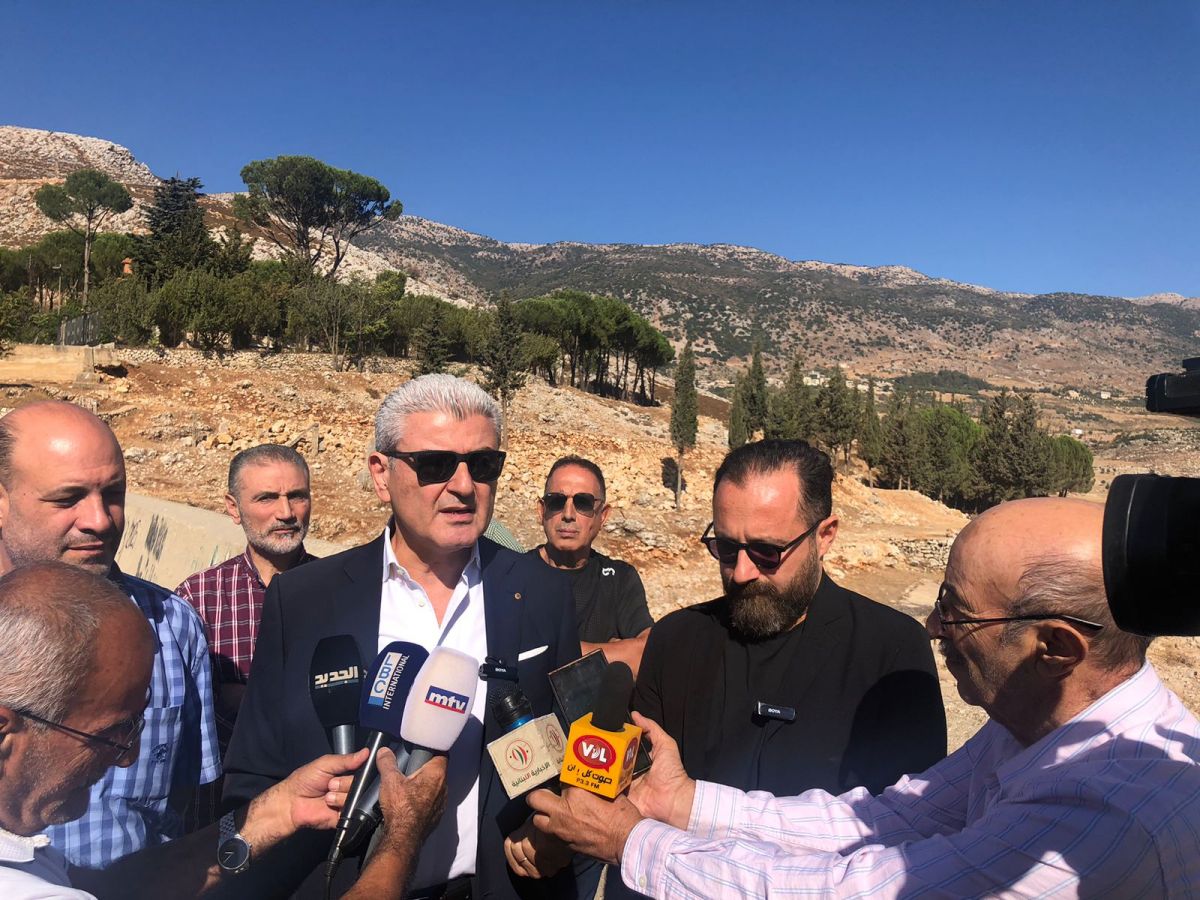
Industry Minister Joe Issa al-Khoury and Sami Alawieh, director of the Litani Office, during a tour in the Bekaa on Monday, Sept. 29, 2025. Photo sent by Sarah Abdallah.






BEIRUT — Industry Minister Joe Issa al-Khoury toured factories Monday along the Litani River in the Bekaa, beginning at Lake Qaraoun (west Bekaa), to inspect pollution in the basin, L'Orient Today's correspondent in the area reported.
He was joined by Sami Alawieh, director of the National Litani Office, who for years has been working to curb pollution in Lebanon’s largest river.
The minister reiterated his determination to bring order to the Bekaa’s industrial sector and to “strictly apply rules of compliance with environmental standards.”
The Litani stretches from Baalbeck in the north of the Bekaa to south Lebanon, passing through central Bekaa, where many factories are clustered. For decades, industries have discharged untreated wastewater into the river.
Alawieh said Monday that industrial waste is only part of the problem, noting that “more than 40 million cubic meters of municipal wastewater continue to be poured into the river every year from villages across the Bekaa.”
Identifying illegal factories
Issa al-Khoury highlighted recent progress and stressed next steps. “We are conducting this tour to ensure that industries respect their environmental commitments,” he said.
He praised the joint committee of the ministry and the Litani Office, which recently shut down an illegal factory in the Bekaa.
The minister also announced plans for “an imminent and comprehensive industrial census, with the help of the Litani Office and the army, to determine which factories are illegal and in violation.” He said noncompliant factories would be warned and closed if they fail to meet standards.
Wastewater treatment plants back online
Alawieh commended the committee’s work to protect the environment while balancing the needs of industrialists. He said the “end of electoral calculations and the advent of institutionalization” would give new weight to efforts to regulate industry in the Bekaa.
Still, he noted the Litani “remains polluted,” though some progress has been made with wastewater treatment plants, including those at Jub Jennin and Zahle (both in west Bekaa), now back in operation. Many plants had shut down during the economic crisis due to a lack of fuel and funding.
“Levels of polluted sediment and bacteria are declining, but that doesn’t mean the problem is solved — only that we are on the right track,” Alawieh said.

 7 p.m. recap: Sharaa in Riyadh; Qassem signals openness to cooperation; Ben-Gvir: ‘We demolish, again and again’