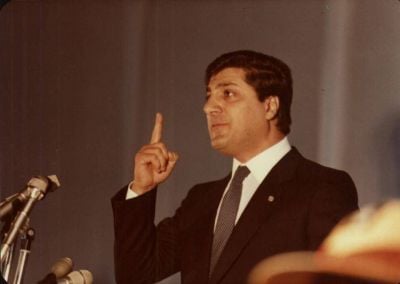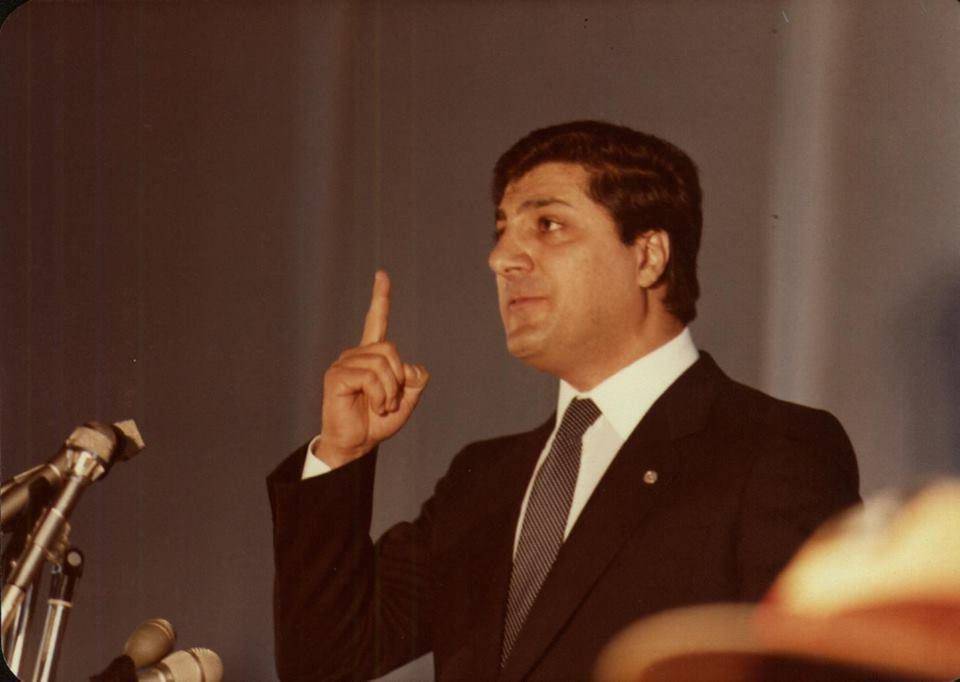
President Bachir Gemayel. (L’Orient-Le Jour archive photo)






“The symbol of determination and the will to build a strong and united Lebanon” it was with these words that Joseph Aoun chose, this week, to pay tribute to his short-lived predecessor, Bachir Gemayel, killed 43 years ago. “His assassination was not merely the elimination of a president or a political leader, but also an attempt to kill an authentic Lebanese dream. Yet dreams do not die in the hearts of those who believe in them and work to make them a reality,” continued the head of state, speaking from the very palace Bachir never had the chance to enter and govern.
Unresolved grief
But was this dream truly that of all Lebanese? For Bachir’s supporters, it has never died: they carry it with pain, unable or unwilling to turn the page. And yet, even when he was finally accorded national stature, our identity crisis still found a way to create discourses and narratives that reshaped this dream into the image of the very past it sought to escape.
The 23rd of august 2025 marked the 43rd anniversary of the election of Bachir Gemayel as president of the republic. To commemorate the anniversary of the election of their hero, an image of Bachir was hanged in Achrafieh, but one that carries a discourse far from what the head of the nation was advocating for on 43 years ago and today.
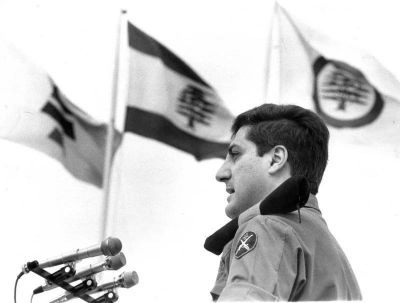
It was the Christian militia leader that was portrayed, not the national president. Wearing his famous green military suit and carrying an old machine gun, Bachir reappeared in the streets of Beirut not as a national symbol, but one of a bygone era marked by militias, civil war, and communal tensions. His image carried with it the weight of unresolved grief and the memory of a fractured republic, evoking a time when power was seized through arms rather than shared through institutions. Worse still, a quote from Bachir’s early civil war days was added to the photo: "We are the saints of this orient and its devils.’"
When a president is being remembered through the barrel of a gun, what discursive message is being sent about what constitutes the nation, who belongs, and who never will?
More than forty years after his election and assassination, Lebanon finds itself in a situation similar to that which prevailed in Bachir’s time. Armed militias still operate within the country and calls to place all weapons under the authority of the national army are stronger than they have been in decades, driven in particular by the right-wing Christian parties, foremost among them the Lebanese Forces and the Kataeb.
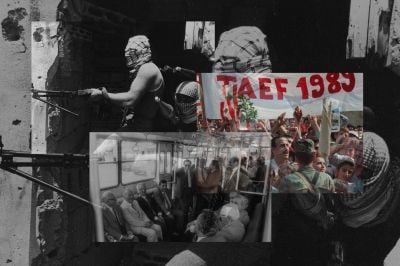
The Lebanese civil war has been over for more than 30 years, yet communities still hold different visions of the nation, each through the prism of its own sectarianism, and remain trapped between fault lines that keep them divided. Such discourse helps to preserve this divide by invoking historical grievances and fear of coexistence, drawing them ever further away from the unifying national spirit so dear to Bachir.
Resisting the trap
Politics lives as much in its hidden narratives as in its public declarations, and discursive political tools like these go beyond the Christian right. It’s a mechanism that resurfaces across Lebanon’s identity politics, most recently in Hezbollah’s rhetoric surrounding its armed role within the state.
The Shiite community, represented mostly by Hezbollah, is recently emerging from a war that has inflicted upon them heavy costs, damages, and pain. Such feelings are very easily mobilized for political purposes, invoking sectarianisation and radicalisation openly. The party has leaned towards a language of existential threat from Israel, and historical grievances invoking "harbour workers" and "Karbala griefs", framing their weapons as a necessary shield. When politicised, sectarian identity is positioned as both the grieving victim and the sole defender. The result is always the same with everyone, one that reinforces the same cycle of mistrust and division that has haunted Lebanon since the civil war.
In the face of Hezbollah’s powerful discourse, the response from the rest of the country must resist falling into the same trap. It should be anchored in an inclusive vision that goes towards the authority of a state protecting everyone, and not a reactionary posture that leads nowhere, apart from tensions, violence, and division. Commitment to the state is being advocated by some day and night politically, yet the same mechanism they condemn is replicated discursively.
Despite the history of trials and errors shared by all communities, the Lebanese Christian right still struggles to see Lebanon outside the lens of Christian primordialism. Even at a time when all Lebanese communities, apart from the Shias, are committed to the sole authority of the state when it comes to arms, they still choose to portray their hero with a weapon in his hand, let alone the choice of a quote that portrays how they still identify as a community.
Christians in Lebanon also carry their own shock, aged by time yet still heavy and profound. They are the community that Lebanon was founded around, and they lost most of the privileges of their founding fathers. They also suffer demographically, having fallen from a demographic majority to a relative minority that cannot calibrate their role in the nation. They find themselves in reactionary, identity-centric narratives, clinging to a mythologized past in which they were the nation’s natural custodians.
It is a page that still hasn’t been turned, a refusal to adapt to the present realities and a failure to accept that they lost the civil war and with it their own isolationist vision of Lebanon. These griefs of history keep them blinded to one Bachir as they cling to the other, ensuring that even remembrance can become a victim of powerful discourses that trap it along fault lines it cannot cross. The situation is no different, where a unifying national discourse is the only resort for protection and survival as ‘angels of this east’ and not green fighting suits making them ‘devils’.
Was the dream of the republic ever more than the man himself, a force that could truly bind a nation, or merely the reflection of a single man’s shadow on history that vanished the moment his voice was silenced? The answer was written in the smoke of Sept. 14 1982, when the Blast took the man and with him the vision of a unified nation to the long list of Lebanon’s broken dreams.