






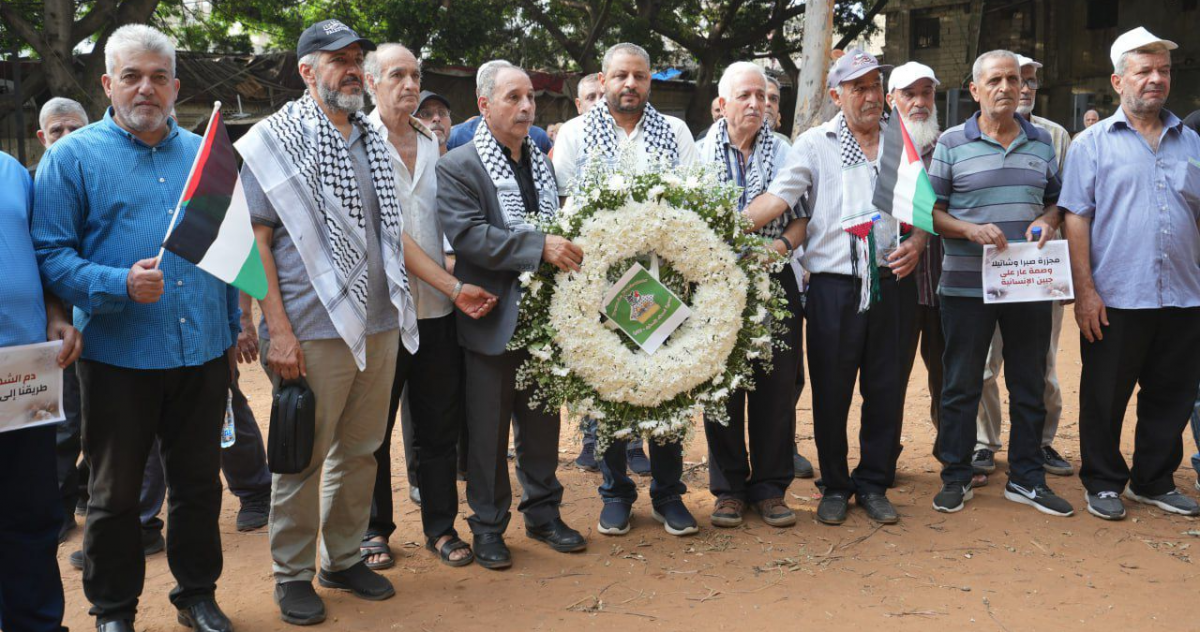
Representatives of several Palestinian organizations gathered and held a sit-in in front of the memorial erected for the victims of Sabra and Shatila, in West Beirut, on Sept. 16, 2025. (Credit: National News Agency)






On the occasion of the 43rd anniversary of the Sabra and Shatila massacres, several organizations advocating for the right of return for Palestinian refugees – Thabit, the Popular Congress of Palestinians Abroad, and the Organization for the Return of Palestinians – organized a sit-in on Tuesday in front of the memorial erected for the victims in West Beirut.
The Sabra and Shatila massacre was carried out from Sept. 16 to 18, 1982, by Christian militiamen under the eyes of the Israeli army, two days after the assassination of the elected president Bachir Gemayel in a bombing in Achrafieh.
"The Sabra and Shatila massacre, which took the lives of thousands of innocent Palestinians, Lebanese and people of other nationalities, will remain a testimony to the brutality of the Zionist occupation and its allies, and what is happening today to our compatriots in Gaza is the continuation of this cycle of blood since the Nakba," the organizers declared in their speech. They also thanked the municipality of Ghobeiri for its support.
The Aamal el-Jamahiri association, the social and civil arm of Hamas, published a statement saying it was "one of the most atrocious massacres perpetrated by the Israeli occupation against the Palestinian people, during which hundreds of Palestinians and Lebanese were killed by gunfire, axes and knives over three days."
Resistance as a response
The group affiliated with the Palestinian movement added that "the response to the crimes of the Israeli occupation at Sabra and Shatila, in Gaza, and in the West Bank must be the pursuit and support of resistance, Palestinian national unity and confronting the occupier's plans."
The Lebanese government insists on the return to a state monopoly on arms, notably those of Hezbollah and Palestinian factions, it should be recalled. The Lebanese Army has already begun dismantling Hezbollah's arsenal and military positions south of the Litani River, which marks a broad border strip with Israel, since the cease-fire agreement went into effect on Nov. 27, 2024.
Regarding the collection of weapons in the Palestinian camps, it began in Burj al-Barajneh camp, in Beirut's southern suburbs, at the beginning of August. The Lebanese Army subsequently collected Palestinian arms located in the Rashidieh, al-Bass and Burj al-Shemali camps (Sour district), south of the Litani River. The disarmament of Palestinian camps continued last Saturday in the Beddawi camp in the north and Ain al-Hilweh camp, at the entrance to the city of Saida in the south.
No agreement has yet been announced with the Hamas movement on any potential handover of its arsenal to Lebanese authorities.

