






Before we leave you, here’s tomorrow’s program — because our festival goes on!
⏰ 3 p.m. – Opening
🌳 Come enjoy the Hippodrome, discover our exhibition “L’Orient-Le Siècle, 100 Years of Front Pages,” relax at the food court, and let your children take part in activities organized in partnership with Cirquenciel.
Admission is free.
🚌 3 p.m. – Guided Tour “In the Footsteps of L’Orient-Le Jour”
This bus tour of Beirut with Caroline Hayek, senior reporter (Albert Londres Prize 2021), is reserved for our subscribers who registered in advance.
🎤 3 p.m. – “Flash Talk” with John Achkar + Debating Contest
Four groups of students from the faculties of law, political science, literature, philosophy, and technology at USJ will face off.
The topics, kept secret until the last moment, will be revealed on site. Two elimination rounds followed by a final: in the end, a team of two winners will be chosen by a jury made up of Marie-Claude Najm Kobeh, dean of the USJ Faculty of Law and Political Science, comedian John Achkar, and Élie Fayad, co-editor-in-chief of L’Orient-Le Jour.
The debates will be held in French. Admission is free.
📰 5:00 p.m. – L’Orient Today x Kim Ghattas
A conversation with journalist Kim Ghattas, weaving together writing, reporting, and regional issues. Kim Ghattas is the author of "The Secretary," an account of travels alongside former U.S. Secretary of State Hillary Clinton, and "Black Wave," which analyzes how the year 1979 — with the Iranian Revolution and Saudi Arabia’s conservative turn — reshaped the Middle East.
The conversation will be in English. Admission is free.
🤖 6 p.m. – Artificial intelligence: A new religion?
Fatima Abu Salem (professor at AUB, AI consultant), Kristen Davis (innovation expert), and Craig Forman (tech & media entrepreneur) will reflect on one question: could AI become the next religion? To explore the stakes, three distinguished voices will take the floor, each bringing a unique perspective.
The panel will be in English, with simultaneous translation into French. Admission is free.
💬 6:45 p.m. – In conversation with Nawaf Salam
A rare open conversation with a sitting prime minister!
Our festival will wrap up with our audience interviewing the former president of the International Court of Justice... and current prime minister of Lebanon.
This conversation, conducted by our editors-in-chief Élie Fayad and Anthony Samrani, will take place at the Grand Serail.
Participants will gather at the Beirut Hippodrome (children’s area) at 6:45 p.m. Registered attendees will be transported by bus to the Grand Serail and brought back to the Hippodrome after the discussion.
The event will be in French. Registration is closed.
See you tomorrow for another day full of discussion, dialogue, debate! 💫
🎺 With the “Trumpets of Michel Ange,” Ibrahim Maalouf unveils a manifesto work — a wide-ranging project where musical audacity, transmission, and innovation intersect.
“Symbolically, this album is a passing of the torch between my generation and the next, a kind of celebration of the values of transmission between parents and children, teachers and students, etc.,” Maalouf says of the project. “And it is also a wonderful opportunity for me to fulfill my father’s dream of sharing his quarter-tone trumpet with the entire world.”
Maalouf is set to take the stage at the Hippodrome at 8:30 p.m.
Today's round-table discussions are now over. Wrap up an afternoon filled with stories ranging from knee-slapping to heart-wrenching with a concert by celebrated Lebanese musician Ibrahim Maalouf.
Danielle Arbid responds to Maya's question without hesitation: beyond the absolute necessity of reforming the 1947 censorship law, artists must above all be funded.
“The dignity of artists in Lebanon is being trampled on; they are not respected,” she asserts, denouncing a deep contempt, often perpetuated by the state itself.
“This contempt for artists is also conveyed by the state. We must fight to be respected and supported.”
Maya Ghandour-Hert, head of L'Orient-Le Jour's culture desk and this round table's moderator, asks: "If you had a battle to fight, what would it be?"
“Actors and activists who speak out against the genocide in Gaza are threatened simply for talking about it," Rita Hayek responds. "I have spoken a lot about Gaza and Lebanon, and people often ask me, ‘Aren’t you afraid of losing work?’ I don’t find that question logical.
"Our region is marked by a plurality of politics and religions that must be respected. I appreciate that L'Orient-Le Jour is opening up this space for discussion. We must accept this plurality of opinions, and that is my fight, as an actress and a Lebanese citizen: to always be able to express myself openly."
Sometimes, censorship just encourages more creativity.
When Metropolis Cinema director Haniah Mroueh had a film that was slated to screen at the cinema censored, the team decided to print the line that they'd been forced to remove from the film onto a piece of paper and distributed at the entrance to the theater.
“It went viral on social media, and the phrase got more views than the film got admissions at the cinema!” she laughs.
Danielle was determined to return to Lebanon to make her latest film, even in the midst of war. When the Israelis began bombing Lebanon, “I thought to myself that Lebanon was going to disappear. They are going to destroy us.”
Faced with war, she felt the need to film in her country, to capture its places, its atmospheres, its scenery.
“The idea was to save Lebanon before it was destroyed, through my film, through these scenes.”
But Danielle has also experienced censorship that she couldn't laugh at. Her film Beirut Hotel (2011) was completely censored for political reasons. She decided to take legal action against the state, but she lost ad the film remains censored.
She admits that she was so deeply discouraged by this legal defeat that she didn't even appeal. “I told myself: I have to stop playing with censorship.”
The experience was so disheartening she didn't film in Lebanon at all until just this last year.
Though censorship is serious and has suffocating consequences for artists in Lebanon, sometimes it's just too out-there to take seriously, and one has to laugh.
Danielle shares a funny story from 2004, when the government was out to censor one of her films, which was showing at Cannes. When she heard of their intentions, she decided to call the head of the censorship department directly. "Your film is a porno," he said bluntly over the phone.
An odd exchange ensued, which Danielle recounts with irony. She says the surreal conversation illustrated to her both the arbitrariness and absurdity of the censorship system in Lebanon.
Danielle Arbid talks about a lawsuit she filed against the Lebanese state: “I was tired of being censored,” she explains. She was moved to wonder: if the documentaries she made in the 2000s were to be released today, would they also be censored by the current Lebanese government?
Despite the presence of intense state surveillance, actress Rita Hayek proudly insists that fear does not silence her. “But creativity faces social and political realities that work as a restriction to artistic freedom," she says. "Every role we play can be implicitly censored by the law, by society, by traditions, or even by fear of scandal.”
In any case, she says later, artists will not give up: “Living in Lebanon means accepting diversity of opinion, and that is my fight.”
Film director Danielle Arbid opens the discussion with a brief lesson in law, reminding us of the legislation around government control of artistic productions.
"Article 1," she reads out. “All films [in the case of cinema, but applicable to all artistic creations] are subject to control and may not be screened publicly without a license from the General Security Directorate. Control covers all types of films, including those from abroad.”
She comments on the article she has just read: “For example, when the law refers to morality, what exactly does it mean? A kiss on screen? A bare breast? Who decides what morality is?”
That concludes this round table discussion. Thanks to everyone who joined!
💬 We look forward to seeing you in a few minutes for the next discussion, "Creating under constraints: Artists under surveillance."
The panel will include film director Danielle Arbid, actress Rita Hayek, and director of Metropolis Cinema Hania Mroueh.
🎥 What do these three artists have in common? A direct connection to cinema, an art form that undoubtedly suffers the most from restrictions in Lebanon: archaic laws, recurring censorship, fragile infrastructure, and political pressure... But what does it mean to persist in creating in an environment that seems to be closing in on itself more and more every day?
Discussions will be held in French, with simultaneous translation into English available. Admission is free.
For Malek, it was a moment some years after the Tunisian "Jasmine Revolution" of 2011 that held in it the most optimism.
"The day the parliament voted the constitution in 2014 was more important than the toppling of the regime to me," he says. "We finally had a constitution which actually represented the whole of society."
That constitution introduced, for the first time in North Africa's legal history, a target parity between men and women in all elected bodies.
"Shireen wasn’t killed once, she was killed twice," Lina says. "Once when she was killed in Jenin and again during her funeral procession."
Lina describes how, when Shireen's casket left the church, amid a "river of people," Israeli police broke the windows of the Hearse that was carrying her, covering her coffin with glass.
"We didn’t just lose Shireen in a brutal way, but we also we weren’t allowed to let her rest in peace. Her dignity, even during her funeral, was denied."
“Every time I was in the street chanting ‘Free Palestine,’ I saw my father's face,” Wafa Moustafa tells the audience. "For twelve years, when Bashar was still ruling Syria, we had no news. It was still too early to mourn him. But today, ten months after the fall of the regime, now that the prisons have been emptied, it seems to me that it's too late to mourn. So I still find it a little difficult to hope. But it's my responsibility to continue the fight."
“The most I can hope for my father now is a grave, I want a headstone where it says my father ‘fought for freedom and died for freedom.’”
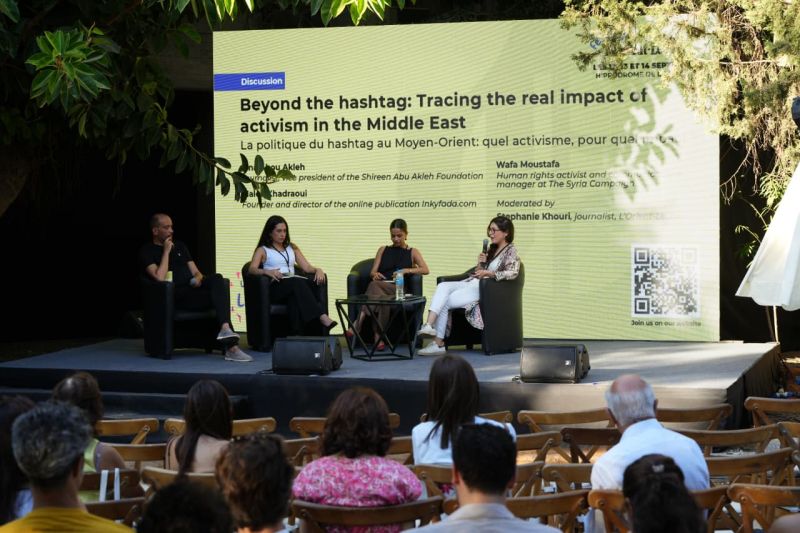
What does hope look like for this panel of speakers, after all these we are experiencing in the world?
For Lina Abou Akleh, it is “the large scale of solidarity and support on a global level." She cites the Global Sumud Flotilla, a fleet of dozens of sailboats currently en route to Gaza with humanitarian supplies and food, in a bid to break Israel's suffocating siege of the Strip.
“It’s not just about justice or accountability it’s about real change," Lina continues. "[Such as] sanctioning the army that killed [Shireen]."
"It’s discouraging some times to continue to fight and to seek justice, yet, at the same time, so many journalists are still being killed. [Shireen's death] set a precedent that you can be a journalist and still be targeted and get killed," Lina says.
According to the Committee to Protect Journalists' latest tally, Israel has killed 197 journalists in Gaza since Oct. 7, 2023, the highest number recorded by the organization since its inception in 1992.
Lina Abou Akleh's aunt, the well-known Al Jazeera journalist Shireen Abou Akleh, was killed by Israeli forces as she reported on a raid of an Palestinian refugee camp in the occupied West Bank in 2022.
"That one bullet that killed my aunt, has changed my life and my family’s life forever," Lina says at the "Hashtag politics" round table.
“Palestinians do not have time to mourn. As a journalist, my role shifted after my Aunt Shireen was killed, in the sense that I’m not only fighting for justice for my aunt, but now I want to advocate for justice."
Malek Khadraoui, founder of the Tunis-based independent non-profit media collective Inkyfada, is also speaking about the end of a regime, but from the point of view of his experience in Tunisia.
“The toppling of a dictatorship is a journey mixed with hope, depression and disappointment," he says. "We didn’t find time to celebrate the toppling the dictatorship in Tunisia because we did not have time."
"It’s not the end of a struggle, it s the beginning of a new struggle," Wafa says. "Its a moment for activists to rethink what tools they use. To rethink what it means to be in exile, what it means to fight for truth."
"For us, the families of the disappeared, it’s just the beginning."
At the "Hashtag politics in the Middle East" round table discussion currently underway, Wafa Moustafa, a Syrian activist whose father disappeared during the Syrian Civil War, tells the audience: “I spent the last 12 years in exile since my father’s disappearance in 2013.”
“My father fought for freedom even when politics was not something you were allowed to practice.”
“It was a powerful reminder for myself that these slogans I used for so long: ‘Dictatorships can not last,’ are not just slogans to me anymore”
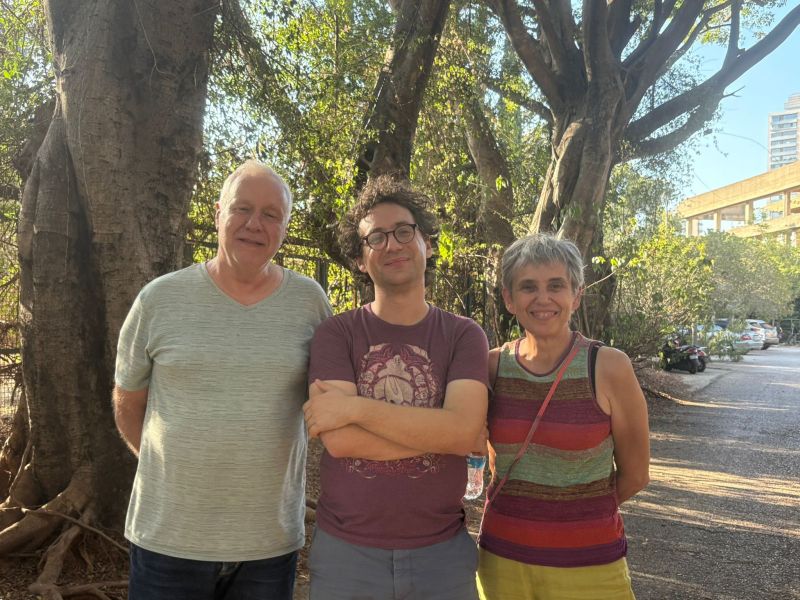
Colin Jahel and his parents just came back from Caroline Hayek's bus tour of Beirut. Colin recently moved to Lebanon, but he had been reading L'Orient-Le Jour long before he arrived. His father was born in Lebanon and left in 1978, three years into the Civil War.
“This tour was both an introduction to the city and to the newspaper,” says Colin.
It was a real homecoming for this family, who discovered a lot about the Civil War through the eyes of L'Orient-Le Jour journalists.
💬 Program highlight: We invite you to join us at the round table space at 5 p.m. for a discussion on the following theme: Hashtag politics the Middle East: What activism, what impact?
🌍 In a world saturated with images, fleeting slogans, and viral trends, what does it still mean to commit to a cause?
During this round table, Lina Abou Akleh (journalist, vice president of the Shireen Abou Akleh Foundation), Malek Khadraoui (Founder and Publishing Director of Inkyfada.com), and Wafa Moustafa (human rights activist and communications officer at The Syria Campaign) will question contemporary forms of activism in the Middle East at a time when hashtags, algorithms, and digital narratives shape political struggles as much as they weaken them.
The discussions will be held in English, with simultaneous translation into French available.
Admission is free.
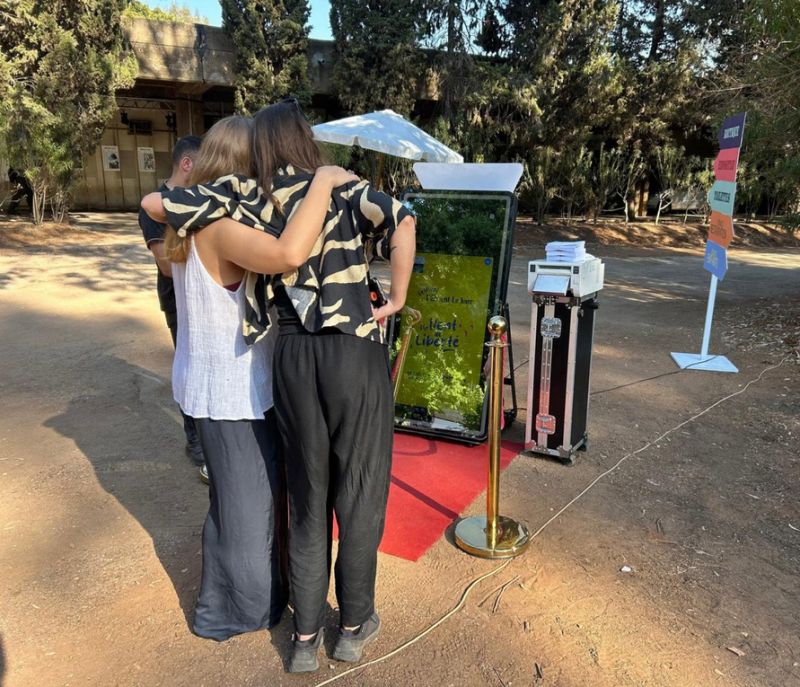
🧐 Hmmm, what are they up to?
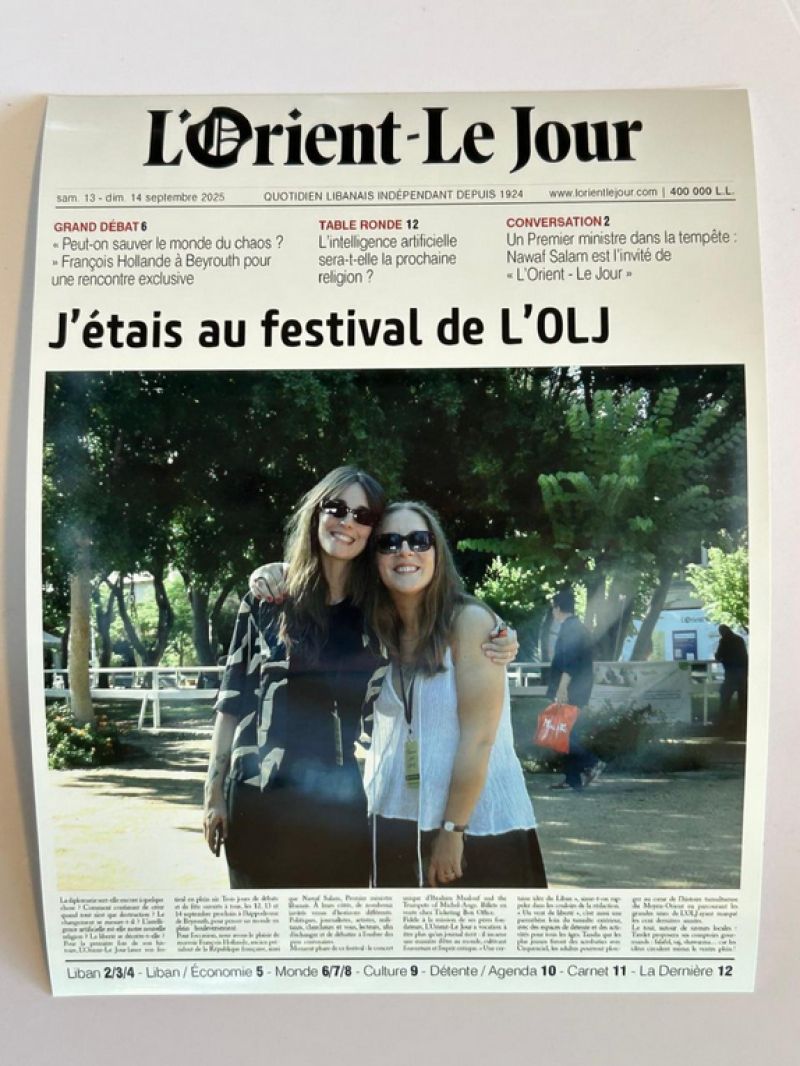
They're on the cover of L'Orient-Le Jour, thanks to our photobooth magic! 📰📸
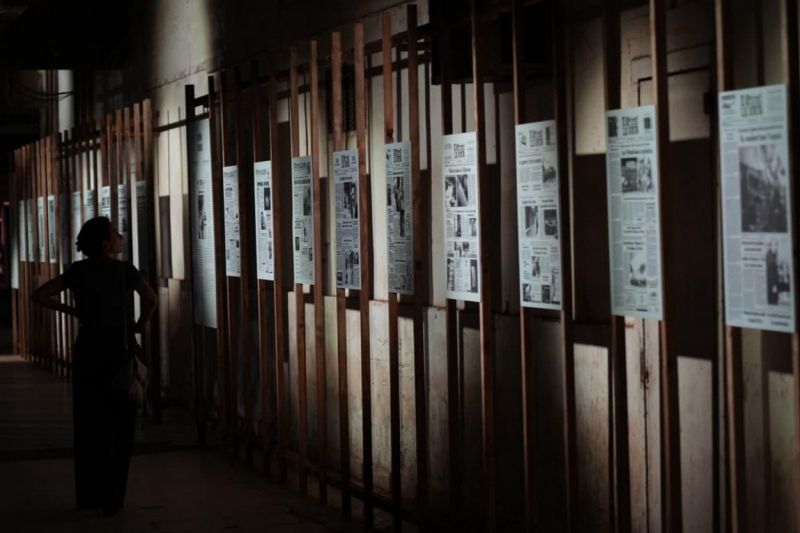
While waiting for round table discussions to begin, we invite you to take a stroll through the archives of the exhibition “L’Orient-Le Siècle, 100 ans de unes” (L’Orient-Le Siècle, 100 years of front pages).
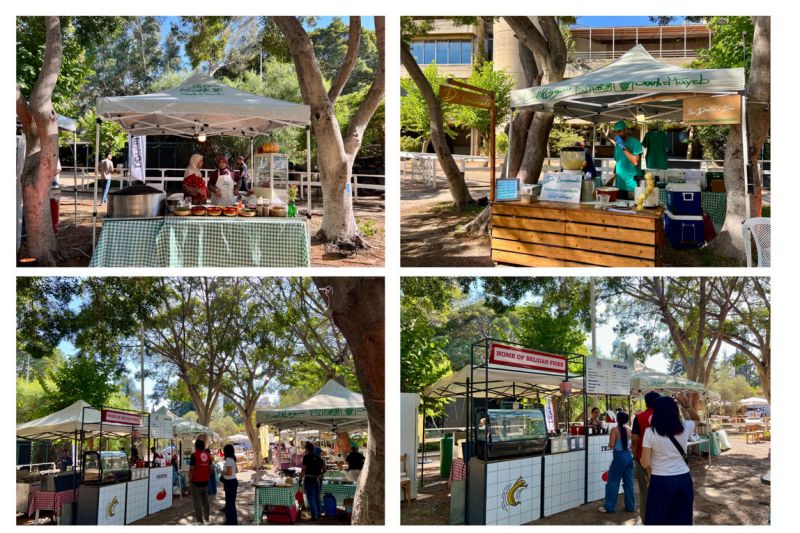
Feeling peckish? Want to cool off? Our food court is waiting for you 🌮🥤
🚌 Another highlight of the day: a bus tour retracing L’Orient-Le Jour's footsteps through Beirut. Guiding you through the newspaper's 100-year history is Caroline Hayek, senior OLJ reporter and recipient of the prestigious Albert Londres Prize.
For some behind-the-scenes insights, here's an interview Maalouf gave to L'Orient-Le Jour journalist Zena Zalzal last month. 👈
🎶 Today's run of events will be topped off with a concert by Ibrahim Maalouf and his "Trumpets of Michel Ange," a big band and initiative built around sharing the quarter-tone trumpet invented by his father to better integrate the instrument to traditional Arabic music.
Maalouf was the first Lebanese instrumentalist to be nominated for a Grammy for his album "Queen of Sheba," which he made in collaboration with the iconic Angélique Kidjo.
Saturday's program is packed:
⏰ 3 p.m. – Hippodrome gates are open
🌳 Come enjoy the hippodrome, discover our exhibition “L’Orient-Le Siècle, 100 Years of Front Pages,” relax at the food court, and let your children take part in activities organized in partnership with Cirquenciel.
Admission is free.
🚌 3 p.m. – Guided tour, “In the Footsteps of L’Orient-Le Jour”
This bus tour of Beirut with Caroline Hayek, senior reporter (Albert Londres Prize 2021). Reserved for our subscribers who registered in advance.
💬 5 p.m. – Hashtag politics in the Middle East: What activism, what impact?
This round table, moderated by our journalist Stéphanie Khouri, will bring together Lina Abou Akleh (journalist, Shireen Abou Akleh Foundation), Malek Khadraoui (founder, Inkyfada.com), and Wafa Moustafa (activist, The Syria Campaign).
It will be held in English, with simultaneous translation into French available.
Admission is free.
🎭 6:30 p.m. – Creating under constraints: Artists in restricted freedoms
This round table, moderated by Maya Ghandour Hert, head of OLJ's culture desk, will bring together Danielle Arbid (filmmaker), Rita Hayek (actress), and Hania Mroué (director, Metropolis Cinema).
It will be held in French, with simultaneous translation into English available.
Admission is free.
🎶 8:30 p.m. – Concert: Ibrahim Maalouf and the Trumpets of Michel-Ange
🕢 Doors open: 7:30 p.m.
For latecomers, a few tickets are still available at Ticketing Box Office.
And to relive the first day even better, watch our video.
In front of you, along with many guests such as Druze leader Walid Jumblatt, Justice Minister Adel Nassar and Culture Minister Ghassan Salameh, François Hollande answered numerous questions from our co-editor-in-chief Anthony Samrani — and even from the public.
Topics ranged from the state of democracies, Lebanon’s political situation, the war in Gaza, the use of force worldwide, to sanctions against Israel… the debate was intense. For those who couldn’t watch the live broadcast on our site, don’t worry — you can catch the main moments of this discussion via this link.
Let’s start with a quick recap of the festival’s first day, highlighted by an exclusive meeting with former French President François Hollande 👆
👋 Hello and welcome to our live coverage of the second day of the L'Orient-Le Jour festival, "Un vent de liberté."
Already have an account? Login here
You have reached your article limit
Stay informed about a Middle East in crisis.
Subscribe now and save 30%: just $8.9/month instead of $12.9.
This article is only available to L’Orient Today subscribers.
Already have an account? Login here
