






That’s it — you now know everything. We’re looking forward to seeing many of you tomorrow. Have a great evening!
That’s it for today. Thank you for joining us, both at the Beirut Hippodrome and here for this live coverage, for the very first event of our festival.
We’ll see you tomorrow for a rich and festive program.
Tomorrow:
⏰ 3 p.m. – Opening
🌳 Come enjoy the Hippodrome, discover our exhibition “L’Orient-Le Siècle, 100 Years of Front Pages,” relax at the food court, and let your children play with Cirquenciel.
Admission is free.
🚌 3 p.m. – Guided tour “In the Footsteps of L’Orient-Le Jour”
This bus tour of Beirut with Caroline Hayek, senior reporter (Albert Londres Prize 2021), is reserved for our subscribers who registered in advance.
💬 5 p.m. – Hashtag Politics in the Middle East: What Activism, for What Impact?
This round table, moderated by our journalist Stéphanie Khouri, will bring together Lina Abou Akleh (journalist, Shireen Abou Akleh Foundation), Malek Khadraoui (founder, Inkyfada.com), and Wafa Moustafa (activist, The Syria Campaign).
It will be held in English, with simultaneous translation into French available.
Admission is free.
🎭 6:30 p.m. – Creating Under Constraints: Artists in Restricted Freedoms
This round table, moderated by Maya Ghandour Hert, head of the culture section, will bring together Danielle Arbid (filmmaker), Rita Hayek (actress), and Hania Mroueh (director, Metropolis Cinema).
It will be held in French, with simultaneous translation into English available.
Admission is free.
🎶 8:30 p.m. – Exclusive Concert: Ibrahim Maalouf and the Trumpets of Michel Ange
🕢 Doors open: 7:30 p.m.
For latecomers, a few tickets are still available online here and at Ticketing Box Office.
“It’s good to have someone with influence in our country, and I particularly enjoyed the questions," said Stéphanie Rizk, management officer at Organisation internationale de la Francophonie (OIF) (International Organisation of La Francophonie), to our reporter on the scene after Hollande wrapped up his talk.
"They weren’t just there to please, except maybe the journalists — and I really appreciate that about L’Orient-Le Jour. I wasn’t disappointed."
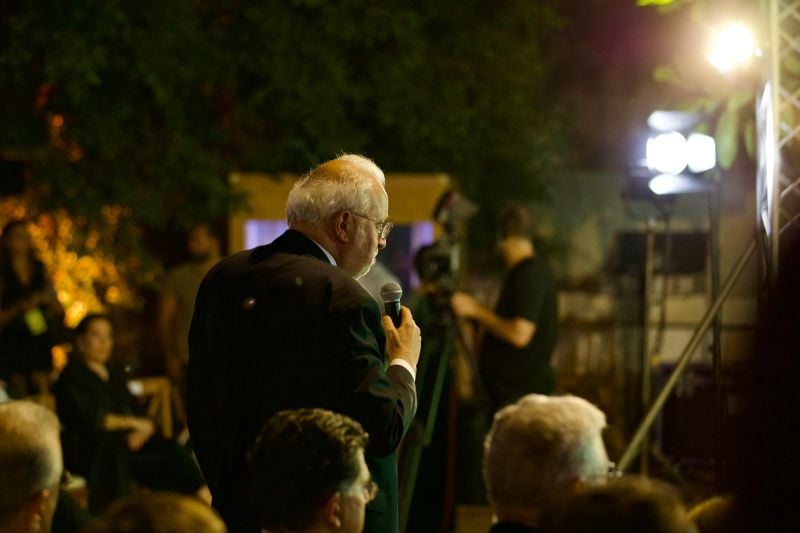
Justice Minister Adel Nassar asks Hollande a question during the Q&A portion of the debate. (Credit: Matthieu Karam/L'Orient-Le Jour)
When asked if he would consider running for the French presidency again, Hollande chose to talk about his country: “France stands for democracy, pluralism, culture, the defense of international law, and the right of peoples to self-determination.”
He then recounted an anecdote: “The Chinese president once asked me what the population of France was. He probably knew the answer. He replied that China had a population of 1.4 billion. But it's not just the number of citizens that counts, it's ideas.”
While the Lebanese are experts at compromise, “Westerners are apparently experts at exemptions,” said Hollande, pointing out that “sanctions are effective only if they are applied at the highest level.”
“It's not a pleasure you're asking me to share, but a pain!” Hollande joked after Samrani asked him to comment on the "pleasure" of the famous phone call between him and former U.S. President Barack Obama in August 2013, in which Obama said that the U.S. would not intervene in Syria, despite the use of chemical weapons by Bashar al-Assad's regime.
“Conflicts that have been going on for so long without ever really being resolved are swept under the carpet, only to resurface with tenfold violence,” explained Hollande, who points to the suppression of the Palestinian question “after the failure of Oslo” in 1993.
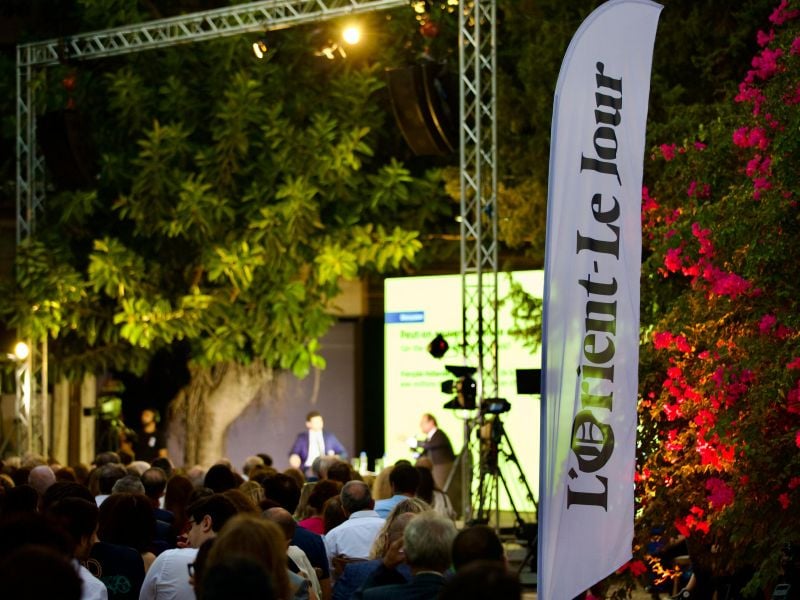
(Credit: Matthieu Karam/L'Orient-Le Jour)
“Will the West ever manage to move beyond the tragedy of the Holocaust and treat Israel like any other country in the world?” asked our co-editor-in-chief, as the audience applauded.
Hollande and Samrani are now addressing the Gaza war.
Putin, Trump, Netanyahu — what do these men have in common?
“Lies!” Hollande replied. He added that they also use “force above the law,” and that he does not advocate “force against force.”
“Between Putin and Donald Trump, between a KGB agent and a real estate developer, there are few real connections…” Hollande joked. He was less talkative when it came to Netanyahu.
A new trend has emerged: anger is no longer collective around shared demands such as changing the social order, but rather has become individualized.
“My anger is my fight, and I do not share it with others,” said Hollande, who explained that social media amplifies this phenomenon because people seek “confirmation, not contradiction.”
“Will there soon be a compromise in Lebanon?” Hollande asked. He seemed hopeful, recalling that in Lebanon, “you are specialists in compromise,” as the audience laughed.
“Democracies are much weaker today than authoritarian regimes,” Hollande said, answering a question on the future of representative democracy.
He listed the challenges: “There is a parliamentary crisis [no majorities], a political crisis [a gap between society itself and its form of representation], and above all a crisis of democracies, which were built on the principle of representation.”
François Hollande takes the floor and begins by congratulating the Lebanese people for something that has not always been a given: “You have a complete government! And a prime minister and a president,” in response to a comment from our co-editor-in-chief that France may have “become more ungovernable than Lebanon.”
De Freige takes the floor again and explains that, for her, the festival is an opportunity to celebrate “our archives, our memory, our history.”
"For this first edition, we have chosen the Beirut Hippodrome, a green setting in the heart of the capital. We're near Résidence des Pins, where Greater Lebanon was proclaimed, a few meters from the National Museum and the former demarcation line that tore Beirut apart during the war," she says. "A place of memory, culture, violence, and reconciliation."
Then, addressing former French President François Hollande, De Freige adds, “Mr. President, we're eagerly waiting for your insights on the challenges facing our region and the major issues facing the rest of the world, hoping to see a little light and hope.”
“L'Orient, founded in 1924, then Le Jour in 1934, have weathered the storms of history in a troubled region... And yet, L'Orient-Le Jour, born from the merger of these two French-language titles, is still here, more alive than ever,” says Nayla De Freige, CEO of L'Orient-Le Jour, as she inaugurates the festival.
De Freige introduces from the festival the screening of a film recounting the history of L'Orient-Le Jour.
The film, created using archive footage, mainly from the Georges Boustany collection, was brought to life by artificial intelligence developed by our technology partner, WhiteBeard.
"I’m new to Lebanon — I’ve only been here for three weeks," Agustin Bollue, a Belgian student studying at USJ in Beirut, told L'Orient Today from the festival. "There’s so much history I’m trying to understand about this country, and this festival felt like the perfect opportunity. It’s wonderful that it’s free, and the atmosphere is just great.”
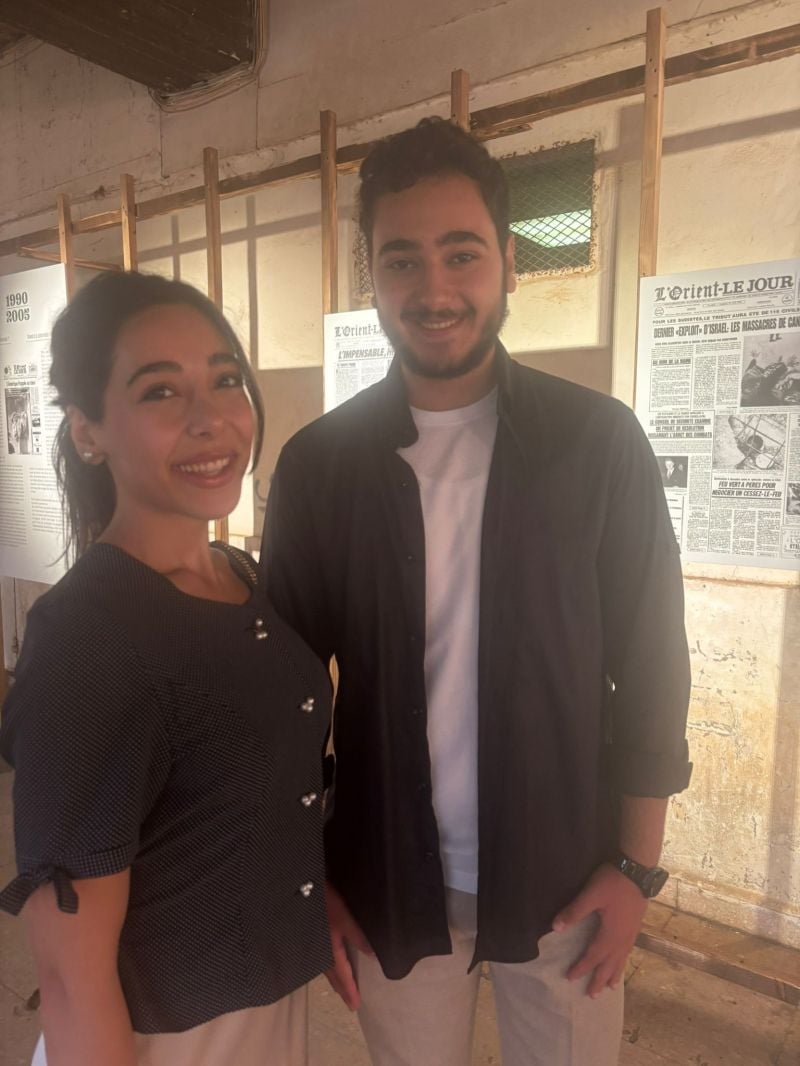
Rowan and Ali Ibrahim at the L'Orient-Le Jour festival. (Credit: Renee Davis/L'Orient Today)
"I came to the festival to see François Hollande, his point of view, how he talks, and his take on what’s happening in our region and around the world," Rowan Ibrahim, a law student, told our reporter from the festival, as guests filed in for Hollande's talk. "I'm here to connect with like-minded people."
Her brother, Ali, a high school student, echoed the same sentiment: "I'm here because I want to connect with other attendees and network for my future."
We are inaugurating the festival with an exclusive meeting with former President of France François Hollande (2012–2017), at exactly 6 p.m.
👉 Can the liberal order still be saved? What will the West look like after Gaza? What will the world of tomorrow be?
Hollande, author of Bouleversements – Pour comprendre le nouvel ordre mondial (Stock, 2022), will analyze, in conversation with our co-editor-in-chief Anthony Samrani, the dynamics of an international stage governed by the law of the strongest.
And in particular, Gaza — a tragic issue on which, in March 2024, he told L'Orient-Le Jour that Netanyahu had to “stop.”
🌍 International affairs, politics, art, censorship, artificial intelligence
👉 Join us for three days of discussion and celebration with major guests including:
- Former French President François Hollande 🇫🇷
- Lebanese Prime Minister Nawaf Salam 🇱🇧
- Artists, researchers and activists 🎨📚✊
🎶 And an exclusive concert by Ibrahim Maalouf and the Trumpets of Michel Ange, on Saturday night.
👋 Hello and welcome to our live coverage of the very first L’Orient-Le Jour festival.
Initially planned for last year, on the occasion of our centenary, the festival was postponed due to the ongoing war between Israel and Hezbollah. But giving up was never an option.
Today, we are delighted to welcome you to this historic first edition, in an iconic venue: the Beirut Hippodrome, at the heart of a capital whose history is deeply intertwined with that of our newspaper.
Already have an account? Login here
You have reached your article limit
Stay informed about a Middle East in crisis.
Subscribe now and save 30%: just $8.9/month instead of $12.9.
This article is only available to L’Orient Today subscribers.
Already have an account? Login here
