





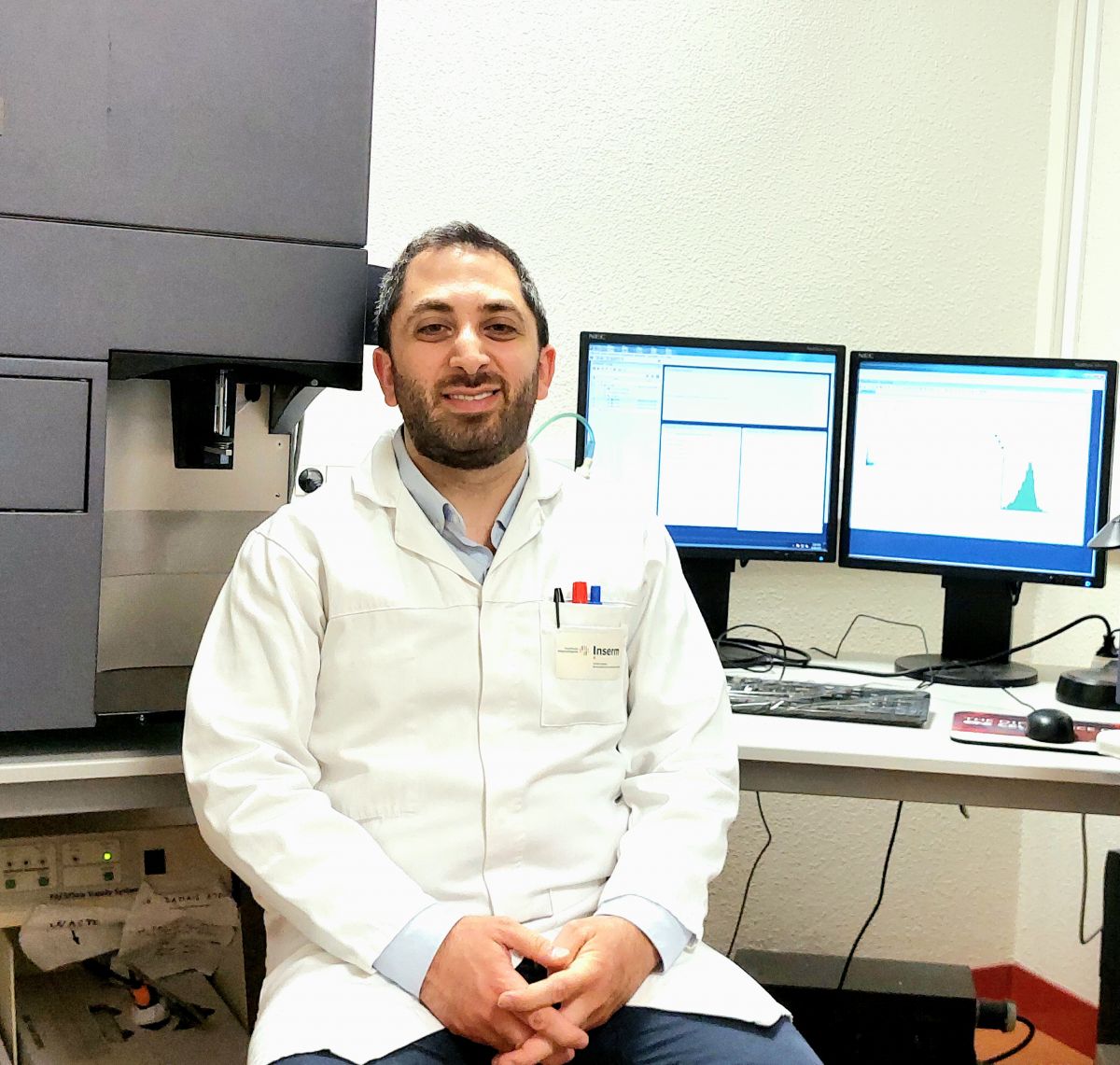
Dr. Georges Doumet Helou, at the Center for Research on Inflammation (CRI). Photo Deepak Pokhreal






Through their research, Georges Doumet Helou and his team, Immunomodulation Mechanisms in Pulmonary Fibrosis (MIFIP), at the French National Institute of Health and Medical Research (Inserm), are pursuing an innovative approach to treating idiopathic pulmonary fibrosis (IPF). The work involves using “immunotherapies that reprogram immune cells in the lung so that they adopt an anti-fibrotic response,” Dr. Helou said.
“In the long term, our translational research, which combines basic and clinical approaches, could contribute to the development of promising new therapeutic strategies against this serious disease. It will also lay the foundations for future scientific projects, sparking growing interest in the emerging field of anti-fibrotic immunotherapy,” he added.
The research is conducted in close collaboration with the Reference Center for Rare Lung Diseases (RespiRare) at Bichat Hospital, coordinated by Professor Bruno Crestani. “This is a major asset for its implementation and clinical integration,” Helou said.
The Sanofi iAwards Europe program, a call-for-projects initiative, aims to help transform ideas from academic medical and translational research into potential therapeutic targets. Award-winning projects receive a one-year collaboration with scientific support from a Sanofi expert, along with seed funding of 120,000 euros.
The Franco-Lebanese researcher called the award “a decisive financial boost” for his work, allowing faster progress. It complements funding already secured by his team, including support from the French National Research Agency (ANR), Inserm Transfert (Inserm’s biomedical research transfer and valorization arm), and the Fondation du Souffle, a French charity focused on respiratory health.
The prize could also serve as a springboard for long-term collaborations with Sanofi, broadening the project’s prospects for innovation and scientific development. “The Sanofi iAwards Europe prize helps to increase my visibility, as well as strengthen my integration within the scientific community, particularly in Europe,” Helou said. It also “rewards years of intensive study and a solid professional career, which began as an assistant research professor at the Keck School of Medicine at the University of Southern California.”
On a personal level, he called the prize “a deeply rewarding recognition” and a success he shares with his group members and collaborators. He also described it as “the culmination of unwavering determination and constant perseverance.” “It holds a special meaning for me, coinciding with the birth of my son Ryan, to whom I dedicate it,” he said.
Immune system and pulmonary fibrosis, the undeniable link
Based at the Inflammation Research Center (CRI), Helou’s group focuses on pulmonary immunity in pathological contexts. In particular, they aim to explore “the immune mechanisms that may be involved in idiopathic pulmonary fibrosis (IPF), a fatal respiratory disease characterized by excessive accumulation of scar tissue in the lungs, thus impairing gas exchange.”
Helou explained that as part of doctoral candidate Deepak Pokhreal’s thesis, the research revealed deregulation of a protective immune mechanism in IPF patients, preventing it from functioning properly. As a result, the immune system, by promoting inflammation, contributes to worsening the disease. However, by activating certain regulatory mechanisms, the immune system could also play a protective role, Helou said.
“In this latest project, we hypothesize that targeting and strengthening these protective mechanisms could not only reduce inflammation but also significantly slow the progression of fibrosis in patients with IPF,” he added.
The main goal of the project is to “develop therapeutic molecules capable of targeting these mechanisms to restore or enhance their protective activity. We have already developed two monoclonal antibodies that are currently being evaluated on biological samples from IPF patients who have agreed to participate in our study,” Helou said.
He emphasized that “idiopathic pulmonary fibrosis is a fatal disease, with an average life expectancy of three to five years after diagnosis.” For Helou and his team, the challenge is to propose new therapeutic avenues, since “the currently available treatments are very limited and only slow the progression of the disease, without curing it.”
“This lack of therapeutic options is mainly due to the insufficient understanding of the cause of the pathology, hence the term idiopathic. In particular, the role of the immune system in triggering IPF remains poorly elucidated,” he said.
Combining his two passions, teaching and research, Helou said he has made it his mission to support new talent “to innovate continually” and “to concretely contribute to improving patients’ lives.”
Declaring himself “deeply grateful” to the United States and France for the opportunities they have given him, he confided that he feels “great nostalgia” for his native Lebanon. “I hope that one day, I could also play a role in the development of medical research in this corner of the world, which is especially close to my heart,” he said.
This article was originally published in French in L'Orient-Le Jour.

 7 p.m. recap: Iran warns Egypt, Israeli soldiers vote in south Lebanon, Haret Hreik responds to Kataeb