





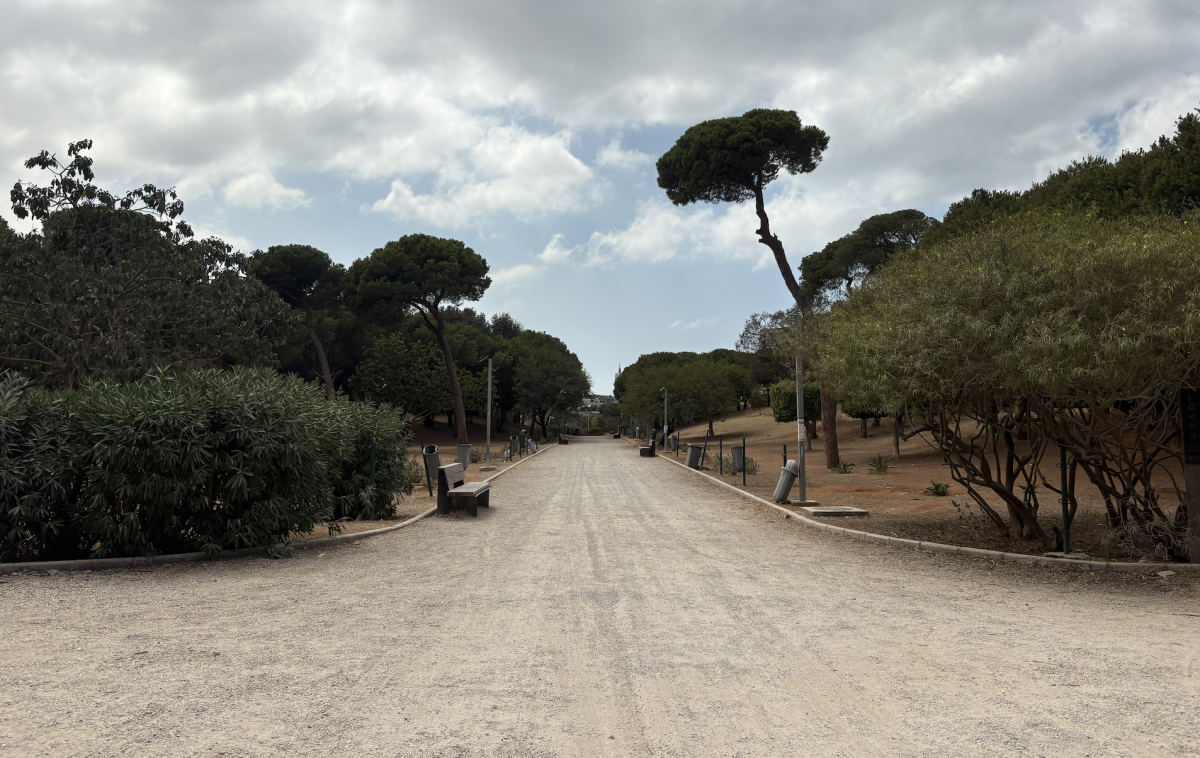
The main entrance to Horsh Beirut, the green lung of the Lebanese capital, on Sept. 10, 2025. (Credit: Yara Sarkis/L'Orient-Le Jour)






The first phase of a revitalization project in Horsh Beirut was completed on Wednesday, bringing a 1.7 km bike path, upgrades to the skatepark, and rehabilitated restrooms to Beirut's largest park, also called Horsh al-Snawbar, or "Pine Forest," a coveted patch of land in a city with little public green space.
The project was carried out by the ENABLE program, funded by the European Union, and supervised by the International Labour Organization (ILO), in partnership with the Ministry of Social Affairs and the municipality of Beirut, as well as the Lebanese NGOs Nahnoo and Arc-en-ciel. There are two remaining phases to the project, including building an amphitheater, a library, and additional green space, according to ILO regional director Rouba Jaradat, though she did not specify a timeline.
The goal, according to an ILO press release, is to cement Horsh Beirut's position as “an inclusive, vibrant, sustainable, and open public place for everyone.” The statement adds that there are also plans to launch “a series of sports and cultural activities.”
A social dimension accompanies the project: the ILO has enabled 200 individuals, previously on the margins of the labor market, to “benefit from genuine employment opportunities by directly participating in the rehabilitation work,” Jaradat pointed out.
‘Not used to coming here’
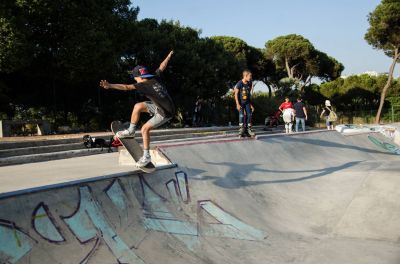
The NGO Nahnoo, which advocates for the preservation of public spaces in Lebanon, will organize bicycle riding training, group rides, as well as running and skateboarding activities starting in October, said Mohammad Ayoub, the association’s president. The Snoubar Skatepark, the country’s first public skatepark, inaugurated in 2021, covers 1,100 square meters and is located on the Tariq al-Jadideh side; however, the skatepark, in a mark of indirect spatial discrimination, is fenced off, cutting off the working-class neighborhood and nearby refugee camp from accessing the rest of the 330,000 square meter park.
Horsh Beirut has a few benches, playgrounds, and makeshift fields where children play soccer. But the area sees few visitors, except on weekends. “It gets much busier at the end of the week,” says Sara, 35, who came to the green oasis for a walk. “But it’s a shame some people still throw their trash on the ground.” Nearby, a grandmother from Tariq al-Jadideh is celebrating her birthday with her family: “It’s true we’re not really used to coming here,” she admits.
The park, once a jewel of the capital’s natural heritage, was also a symbol of Lebanon’s divisions: situated on the former demarcation line, it was largely destroyed by a fire resulting from Israseli bombardment of the city in 1982. After 1990, access remained strictly limited to foreign tourists and Lebanese with a special permit, as the municipality feared further deterioration. Beginning in 1992, a program launched by the Regional Council of Île-de-France managed to rehabilitate the forest and turn it into an urban green space.
However, it wasn't until 2015, thanks to the efforts of the Nahnoo association, that Horsh Beirut was partially opened to the public and, a year later, opened daily to the public.

 Evening recap: Netanyahu announces West Bank offensive; 7 killed in Jordan church shooting; tents burned in south Lebanon
 US strike on Iran this weekend? ‘Absolutely,’ says Barrack; ‘I have no idea,’ says Trump