






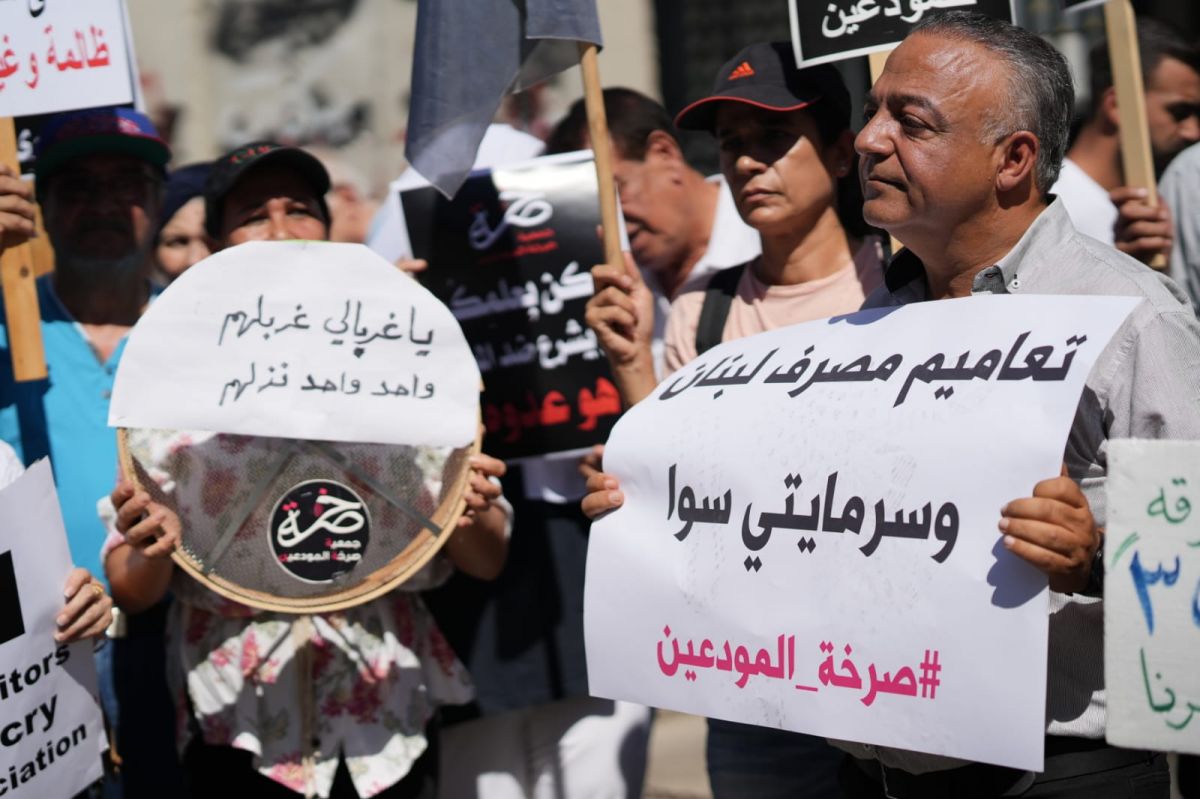
A member of the 'Le Cri des déposants' collective holds a sign against banking restrictions during a protest on Sept. 7, 2023, in front of the central bank's headquarters in Beirut. (Credit: Mohammad Yassin/L'Orient-Le Jour)






The collective Le Cri des déposants [The cry of the depositors in English] on Monday presented Lebanese Finance Minister Yassin Jaber with a series of demands, including "an immediate increase in withdrawal limits" as Lebanon continues to struggle with a severe economic and financial crisis since 2019, according to the state-run National News Agency (NNA).
In a letter delivered to the minister, the group also suggested "allowing depositors to pay all taxes with their funds frozen in banks, taxing companies that have benefited from subsidies, and requiring those who repaid their bank loans in Lebanese lira at the rate of 1,500 LL to the dollar, or by bank checks — meaning at 15 percent of the loan's value — to settle these loans at their real value."
The association further reiterated its rejection of "the hundred thousand dollar plan and the conversion of the remaining deposits into bonds," insisting that "depositors bear no responsibility for the financial crisis," and calling on "all officials not to impose any burdens on them as part of any proposed solution." According to options explored by authorities to resolve the banking crisis, priority would be given to repaying small deposits — up to $100,000 — over several years.
The collective's demands do not fall solely under the Finance Ministry, even though it is involved in drafting law proposals to resolve the banking crisis. Le Cri des déposants, according to its critics, is believed to be close to the Association of Banks in Lebanon, which holds that the central bank and the state should bear responsibility for the crisis.
Yassin Jaber, for his part, told the association's delegation that "depositors will not lose their rights, even if the recovery mechanisms are varied," noting that "no banking system in the world ... can return all deposits to every client at once and over a fixed period." The finance minister then assured that "serious work is underway between the government, the Finance Ministry, and the Banque du Liban to adopt a law that determines how financial losses are distributed between various stakeholders: the state, the central bank, banks and depositors."
After the banking secrecy law was amended in April and the bank resolution framework was adopted this summer, the draft law currently being developed on restoring financial balance and returning deposits is the key reform anticipated by the International Monetary Fund (IMF) and Lebanon's partners for the implementation of an IMF financing program.
