





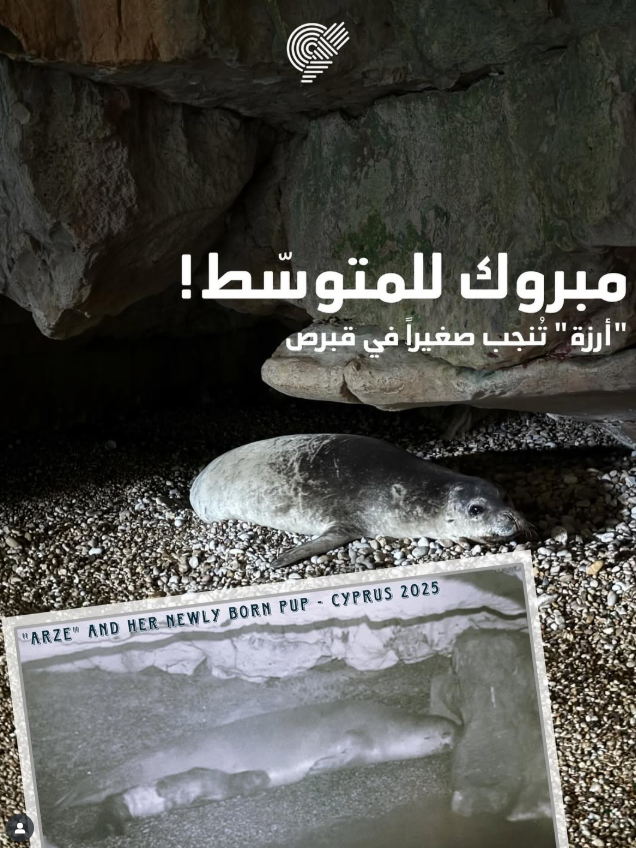
"Congratulations to the Mediterranean Sea, Arzeh had a baby in Cyprus," reads this post from Terre Liban. (Credit: TerreLiban/Facebook)






BEIRUT — "Arzeh," the female Mediterranean monk seal and a symbol of the coastal village of Amchit in Lebanon’s Jbeil district, has given birth to a pup. She had made the area her refuge despite ongoing excavation work that threatened her habitat.
The environmental protection group Terre Liban hailed the birth on Thursday as a boost for Mediterranean biodiversity, though it noted that no monk seal births have been recorded in Lebanon in recent years.
In an Instagram post, the NGO said that "Arzeh" — whose name means "Cedar" but who is also known locally as Maya or Anessa — gave birth on the Cypriot coast a few months ago.
The news is significant given that the Mediterranean monk seal (Monachus monachus), listed as endangered on the International Union for Conservation of Nature (IUCN) Red List, numbers only 350 to 450 mature individuals across the Mediterranean.
Last sighting in 2024 in Beirut
While celebrating the pup’s birth, Terre Liban also issued a warning. The organization noted that "at least three monk seals have been documented more than 30 times in Lebanon over the past four years, but no births have been recorded." The presence of "Arzeh" in Lebanon was last documented "early November 2024 in Beirut, alongside a male." The lack of reproduction is likely linked to "disruptions and pressures caused by human activities, which threaten the seals and their fragile habitats." In Lebanon, the IUCN lists the Mediterranean monk seal as “possibly extinct.”
According to the U.S. National Oceanic and Atmospheric Administration (NOAA), Mediterranean monk seals typically carry a single pup after a nine- to 11-month gestation. Births can occur year-round but are most common in autumn. The agency notes that human pressures have forced females to give birth in isolated sea caves, which are often inaccessible to humans.
The international union cites residential and commercial development as major threats to the species. In Lebanon, the monk seal made headlines in 2024 when a villa construction project threatened a cave in Amchit, occasionally used by the species. NOAA also highlights pollution, deliberate killings, bycatch, and entanglement in fishing gear as significant dangers.
"Protecting and managing the habitats of the Mediterranean monk seal isn’t optional; it’s a duty if we want to see Arzeh’s pups one day return to Lebanon," Terre Liban said. NOAA’s species factsheet, updated in April 2025, notes that while awareness campaigns, research programs, and protected areas exist, some places "still suffer from a lack of monitoring, implementation, and enforcement of protection measures."

 Evening recap: Netanyahu announces West Bank offensive; 7 killed in Jordan church shooting; tents burned in south Lebanon
 US strike on Iran this weekend? ‘Absolutely,’ says Barrack; ‘I have no idea,’ says Trump