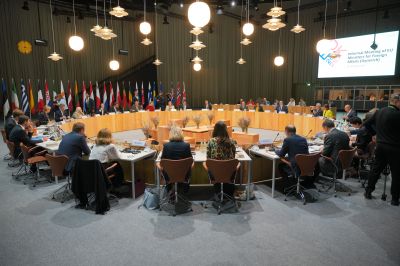
European Union foreign ministers take part in an informal meeting at the Copenhagen Forum, in Copenhagen, Aug. 30, 2025. (Credit: Emil Helms / AFP)






European Union foreign policy chief Kaja Kallas acknowledged Saturday that she was “not very optimistic” about the chances of the 27 member states sanctioning Israel, despite the catastrophic humanitarian situation in the Palestinian territory of Gaza.
“I am not very optimistic, and we are certainly not going to adopt decisions today [Saturday],” she said in Copenhagen ahead of a meeting of the E.U.’s foreign ministers. “This sends the signal that we are divided,” Kallas lamented.
The European Commission had proposed suspending E.U. funding for Israeli start-ups, but “even that measure,” described as relatively “lenient,” was not endorsed by the 27 due to their divisions, the Estonian leader underlined.
Several E.U. countries, including Germany, Hungary and Slovakia, remain reluctant to take measures against Israel, while others, such as Ireland and Spain, are much more supportive. Denmark, which currently holds the rotating presidency of the E.U. Council of Ministers, has expressed support for finding a way around the unanimity rule that governs the bloc’s foreign policy.
The E.U. must “move from words to deeds,” said Danish Foreign Minister Lars Lokke Rasmussen, suggesting, for instance, a ban on imports from Israeli settlements in the West Bank. Such a decision, he explained, could be taken by qualified majority vote as it falls under trade policy.
The unanimity rule is blocking many decisions not only on Israel but also on Ukraine, due to opposition from Hungary. “We have a constitutional problem in Europe: the slowest ship in the convoy determines the speed. We must take measures so that the majority can be expressed,” Rasmussen said.
The situation in Gaza is an “absolute tragedy,” said French Foreign Minister Jean-Noel Barrot. The Gaza Strip, where famine is spreading, has reached a “breaking point,” according to the World Food Programme (WFP).
Despite mounting pressure both internationally and within Israel to end the war, Prime Minister Benjamin Netanyahu’s government has vowed to continue its offensive in Gaza to eradicate the Islamist movement Hamas and secure the return of all hostages abducted during the Oct. 7 attack.