






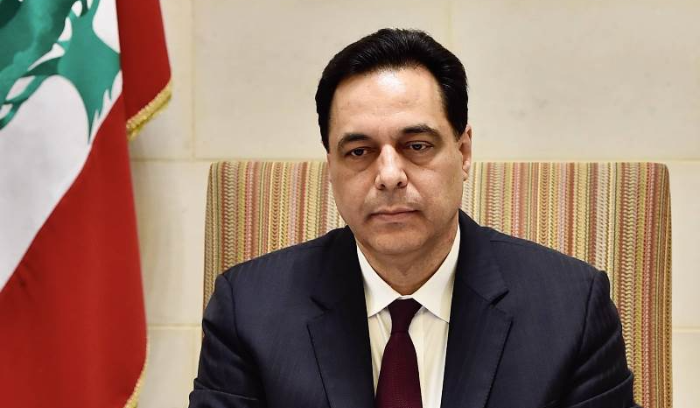
Former Prime Minister Hassan Diab. (Credit: NNA)






BEIRUT — Former Prime Minister Hassan Diab met with a Hezbollah delegation on Wednesday, as part of the group’s ongoing talks amid a government request for the army to present a disarmament plan — including for Hezbollah — by the end of the month.
The Hezbollah delegation included former Minister Mohammad Fneish, Deputy Head of Hezbollah's Political Council Mahmoud Qomati, and MP Ihab Hamadeh, member of the Loyalty to the Resistance Bloc in Parliament, al-Manar reported.
Speaking at a press conference after the meeting, Fneish said that Hezbollah is continuing a series of meetings with key figures and leaders in Lebanese society.
Fneish stated that the meeting discussed "the recent government decision that contradicts the national charter," which he said came under external — particularly American — pressure, and led to an ongoing crisis in Lebanon. He emphasized that Hezbollah, through these meetings, seeks to clarify its position and work toward reversing the decision.
Fneish dismissed any claims about a helpful American role in Lebanon, calling such claims “nonsense.” He asserted that the United States is not a neutral mediator but “more Zionist than those committing crimes in Palestine, Gaza, and southern Lebanon.”
He explained that although Washington sponsored the agreement to cease hostilities, it later reneged on its commitments, whereas the resistance, with the approval of the Lebanese government and army, adhered to the agreement.
Fneish added that “American pressure contributed to sparking internal disagreements and plunged the country into crisis, attempting to shift the blame onto Lebanese factions while absolving Israel of its responsibilities.”
He called on the Lebanese government to “correct its mistaken decision and resist external American pressure that does not serve Lebanon’s interests,” stressing the importance of a unified national stance that preserves Lebanese unity and prevents divisions fueled by foreign interference.
The Israeli army is still occupying parts of Lebanon and continues to carry out attacks in the south, and sometimes in other areas such as the Bekaa Valley and southern Beirut.
U.S. envoy Tom Barrack is traveling around the region to help enforce a truce and arrived in Beirut on Monday night.
Hezbollah backed by Iran and strongly entrenched in southern Lebanon, emerged greatly weakened from over a year of conflict with Israel, including two months of open war before a cease-fire on Nov.27.
Hezbollah, conditions any discussion of its arsenal on a halt to daily Israeli strikes and the withdrawal of Israeli troops still held in southern Lebanon despite the cease-fire.
