






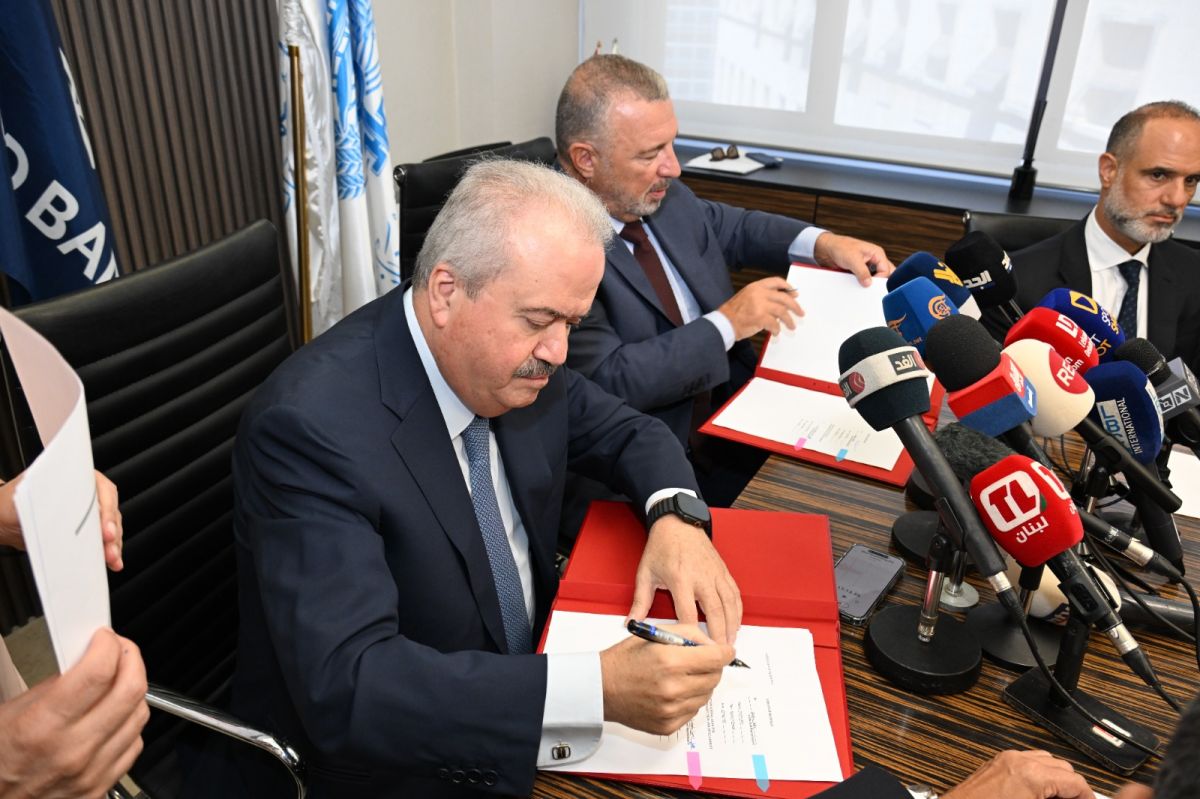
Finance Minister Yassine Jaber, and the World Bank’s Middle East Division Director, Jean-Christophe Carret, signing the loan agreement at the Finance Ministry on Aug. 26, 2025. (Credit: Ministry of Finance)






BEIRUT — Lebanon signed a $250 million loan agreement with the World Bank on Tuesday to help rebuild infrastructure destroyed in the war between Israel and Hezbollah.
Finance Minister Yassine Jaber and Jean-Christophe Carret, the World Bank’s Middle East director, signed the deal at the Finance Ministry. The loan will finance the reconstruction of roads, water networks, electricity and health facilities in war-affected regions.
Energy Minister Joe Saddi, Public Works Minister Fayez Rasamny, and Council for Development and Reconstruction head Mohammad Kabbani attended the ceremony, which capped the loan’s approval process by both the World Bank and Cabinet.
"Funds will begin to be released once Parliament approves the loan, which should happen quite quickly, at the beginning of the regular fall session," Jaber told L'Orient Today.
"This is an important moment for Lebanon, and something to be welcomed because we are signing a loan prepared several months ago. It is the first loan dedicated to reconstruction, and I hope that in the future, more funds will be granted in the form of grants and aid rather than loans. But today, we can say that we've started the first steps of reconstruction," Jaber said in remarks cited by the Finance Ministry's statement.
Carret said the loan, part of the Lebanon Emergency Assistance Project (LEAP), was designed with a specific framework to manage spending. "The LEAP project is not just another project: it is a national framework to quickly restore essential services and rebuild public infrastructure, while laying the foundation for sustainable, inclusive and climate-resilient recovery," he said.
When the World Bank internally approved the loan in June, Carret noted that the program had been structured as a $1 billion scalable framework, beginning with the $250 million loan. It is designed to absorb additional financing — whether in grants or loans — under a unified implementation system led by the government, with a focus on transparency, accountability and results.
500 buildings
The government says it will not wait for the loan to be disbursed to begin repairs. Jaber said the Cabinet’s reconstruction committee, which met Monday at the Grand Serail, had approved measures to start work immediately.
"On Monday, the government decided to release funds to intervene on 500 buildings at risk of collapse," he said.
In addition to the World Bank loan, Lebanon’s reconstruction budget includes $20 million pledged by Iraq in recent weeks, Treasury contributions, and €75 million (about $88 million) promised by France in June, according to Jaber. The country's infrastructure, already weakened by years of neglect and rapid population growth, has been further battered by Israeli airstrikes during the war in Lebanon. Despite the cease-fire reached in late November, Israel continues to launch attacks, mainly targeting the south and the Bekaa Valley.
In a report published last winter — before accounting for destruction caused after Dec. 20, 2024 — the World Bank estimated the country would need $11 billion to rebuild.
