


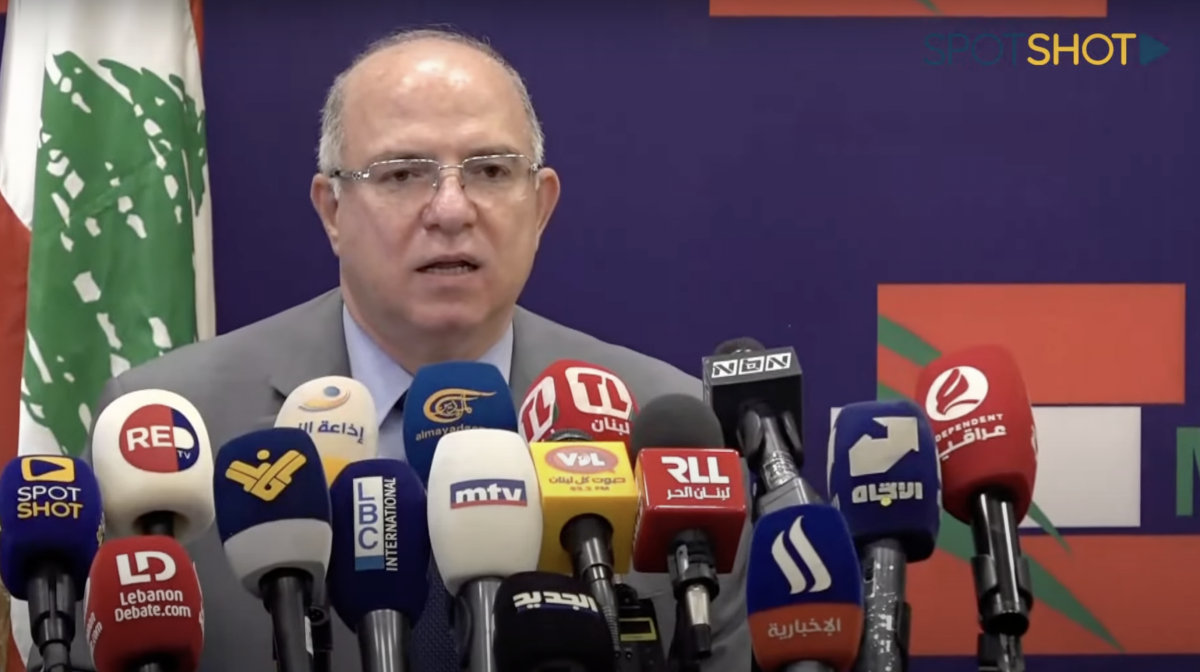
Screenshot of Labor Minister Mohammad Haidar's press conference, Friday, Aug. 22, 2025. (Credit: The Spot Shot website)






Labor Minister Mohammad Haidar announced on Friday during a press conference a series of measures designed to facilitate and regulate the labor market in Lebanon, particularly regarding foreign workers. He also discussed a number of agreements, especially with Iraq, where he met with Prime Minister Mohammad Shia al-Sudani in early August.
The minister first addressed the issue of foreign labor, confirming the presence of "foreign workers in irregular situations in essential sectors." "For about three months, we have asked several sectors to regularize their employees' status within a three-month period," he specified, before reviewing the "inspections conducted in all sectors."
"Random inspections targeted 32 establishments, 42 reports were filed, and 22 warnings were issued," he said. Starting next Sept. 1, "all inspection campaigns will be accompanied by media coverage, and violating establishments will have to assume their responsibilities," Haidar added, thanking the "security forces for assisting the inspection teams in carrying out their mission."
Agreement with Ethiopia on workers' rights
The same regularization was required for domestic workers, the minister continued. "We asked all agencies to formalize their status by a deadline that passed last month. We then extended the deadline by 15 days. It turned out that 25 percent of agencies are still not compliant," Haidar lamented.
"The Ministry is forced to suspend their activities as an initial step, beginning Sept. 1, 2025. After that, any agency that doesn't comply with these conditions will be prohibited from operating," he warned.
Moreover, the Labor Ministry has begun concluding agreements with countries whose labor force is present in Lebanon. "We are in the final stages of signing an agreement with Ethiopia regarding working conditions, workers' rights, how they should be treated, and the organization they can turn to in case of a complaint," Haidar announced, specifying that "starting from the beginning of next month, citizens will be able to hire a domestic worker ... without going through an agency."
According to recent estimates from the NGO Legal Action Worldwide (LAW), which provides legal assistance to victims of human rights violations in Africa, the Middle East and Asia, Lebanon has nearly 250,000 migrant domestic workers who are subject to the kafala system instead of the current labor code. This sponsorship system gives employers near-total control over the employment and status of foreign staff. The situation has been exacerbated by Lebanon's recent crises, from the Covid-19 pandemic to the war between Israel and Hezbollah and the financial crisis.
Haidar also explained that regarding foreign workers, it was decided to institute "a guarantee of two billion pounds deposited with the Housing Bank," which will remain blocked while the company is in operation and will be returned if it ceases to operate. "The goal is for the employer to contribute to job creation and not just to obtain a work permit," he added, specifying that "the employer must hire three Lebanese nationals to be eligible to start the legal procedures."
The minister also called on unions to regularize their status, regretting that "after three months of appeals in this direction, about 50 percent have done so." He indicated that training for Labor Ministry civil servants will be organized on Sept. 15 and 16, "on all modern work methods and on Lebanese, Arab and international laws." "The Ministry's achievements and the measures taken over the past six months will be announced on this occasion, in the presence of the prime minister and the organization's director-general," he announced.
Finally, the minister touched on the upcoming appointment of a new Social Security board of directors, the implementing decree for which was published Thursday in the Official Gazette. "After the application process is launched, we will grant a 15-day window to review applications, then an additional 15 days to appoint a new board. If we stay on schedule, we will have a new board in six or seven weeks," he stated.
Cooperation with Arab countries
Discussing bilateral relations with Iraq, Haidar said he had discussed with Sudani the issue of delivering Iraqi oil to Lebanon in order to speed up the installation of pipelines heading to the Tripoli refinery, which "will help create numerous job opportunities for Lebanese workers and facilitate the work of investors." "A Lebanese-Iraqi-Syrian commission will be set up to monitor this issue," he specified. On Aug. 12, Reuters reported that the Iraqi Oil Ministry was considering exporting crude oil via the Lebanese port of Tripoli.
The minister also mentioned " the Iraqi wheat donation to Lebanon," confirming "the agreement on sending the first shipment, totaling 50,000 tons, to the Port of Beirut." "Due to the lack of sufficient silos to store the entire donation, it has been split into several batches," he added. Haidar had previously announced in a meeting on Aug. 12 with the Parliament Speaker Nabih Berri, to whom he is close, that this delivery is part of a 300,000-ton wheat donation for Lebanon.
It was also agreed with Iraq "to improve the conditions for Lebanese workers and employers in Iraq and to facilitate their procedures, and, conversely, those of Iraqi workers and employers in Lebanon," the labor minister specified. More specifically, the Iraqi prime minister and Haidar agreed to exchange expertise, particularly in sectors needed by both Lebanon and Iraq, and to create a sort of academy for ongoing training in specific fields, especially catering, hospitality and technology. "In return, young Lebanese will be trained in management and work in the oil sector," where Iraq, a founding member of the Organization of the Petroleum Exporting Countries (OPEC), is one of the world's leading players.
Reconstruction aid was also discussed, the minister said. "The [Iraqi] prime minister expressed a desire to accelerate this process and has tasked a commission to liaise with Lebanese officials to launch the reconstruction, particularly rehabilitation work," he noted.
Haidar finally announced "cooperation with Arab countries, notably Qatar, Iraq and Kuwait, in order to exchange expertise and study the labor markets in Lebanon," praising "the cooperation with Qatar's Ministry of Labor and the Jusour ['Bridges'] organization, which is in charge of finding jobs for foreign workers in Qatar." He announced, in this context, a meeting in September with the director of this organization. "Starting next September, we will be able to announce the job opportunities available in Lebanon and abroad, as well as the procedures to facilitate applications," he promised.
 Israeli army carries out demolition at Jabal Amel School in Houla as strikes continue