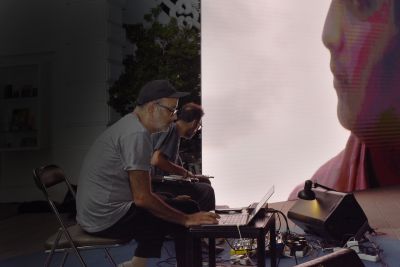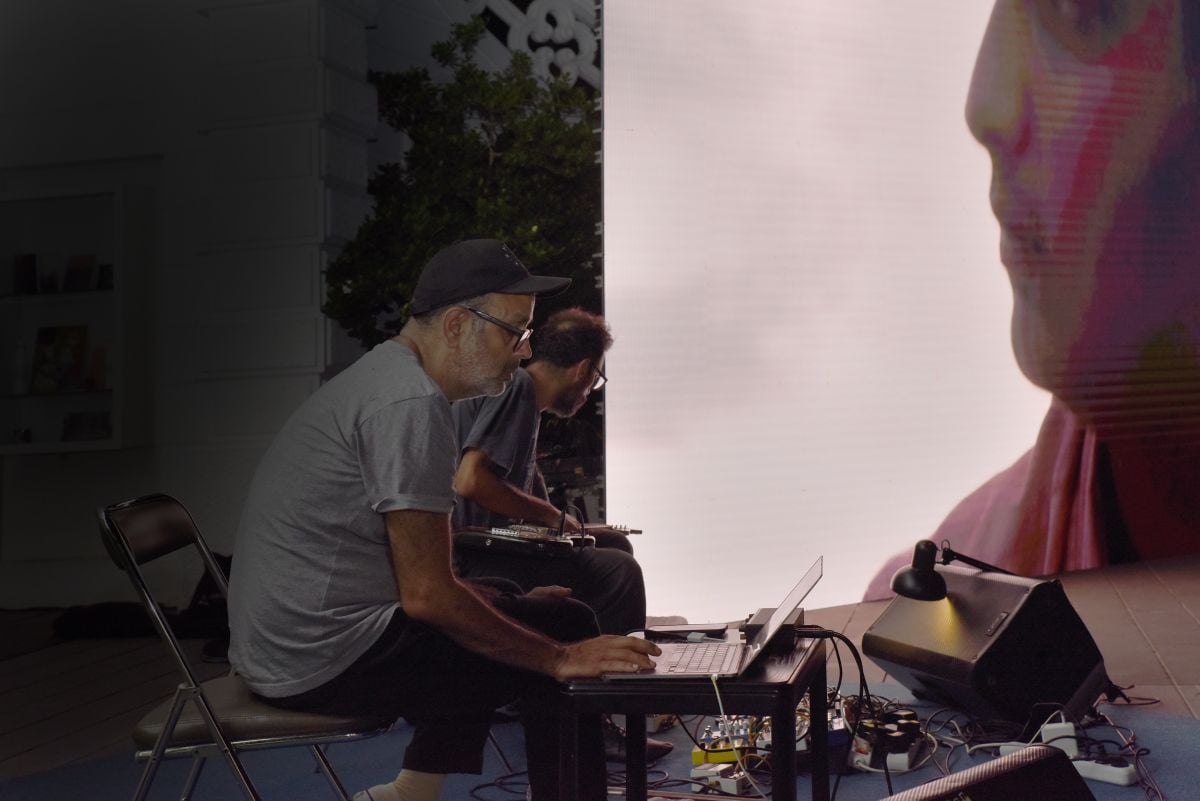
In parallel with the exhibition “Remembering the Light,” Joseph Ghosn and Charbel Habre accompanied a film made from images of the scenography presented a few floors below at Sursock Museum. (Credit: Joreige Hadjithomas)






In the plural art of Joana Hadjithomas and Khalil Joreige, poetry seeps in through every pore, carried by enchanting bards. While much of Beirut numbed itself with noise in an effort to forget, on the evening of Aug. 6 a “Concert of Sighs” was staged at the Sursock Museum — a cathartic ceremony in sound and image.
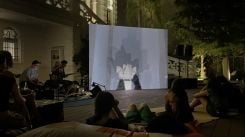
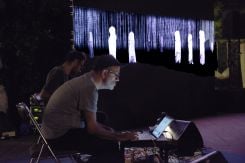
As an extension of the exhibition “Remembering the Light,” Joseph Ghosn and Charbel Habre performed a sonic dialogue alongside a film drawn from the scenography on display a few floors below the esplanade. Those who knew, knew. Through word of mouth and quiet invitations, about 100 spectators gathered in a circle under the sultry night sky.
Two days earlier, Beirut had commemorated the double explosion that devastated half the city. Aug. 6 also marks the bombing of Hiroshima in 1945. This “Concert of Sighs” arrived at just the right moment — not to conceal, but to open, to free memory rather than elude it.
Between Ghosn and Habre, dazzling sonic dialogues
“Remembering the Light” is an ongoing project, on view until Sept. 4. Through archaeological artifacts and layered revelations, the exhibition explores the persistence of the past in the present. Its final section provided the material for the concert: a long series of photographs of eyes, each accompanied by a QR code that unlocked the recorded sigh of the person photographed.
A year earlier in Paris, Joana and Khalil had entrusted this unusual collection to Joseph Ghosn, who has often collaborated with Charbel Habre on music for their short films — including the first “Remembering the Light” project and especially Je veux voir with Catherine Deneuve, set against the backdrop of the 2006 Israel-Lebanon war.
Formerly editor-in-chief of Les Inrockuptibles and Obsession, editorial director of Grazia, and now deputy director of Madame Figaro, Ghosn is a journalist, writer, essayist, collector of vintage vinyl and author of one of Instagram’s most intense music-focused accounts. He is also, at times, a musician himself. His long artistic connection with Habre is the source of what he calls “dazzling sonic dialogues.”
Habre, one of the founders of Lebanon’s underground and experimental music scene, is also founder of the post-punk group Scrambled Eggs. A composer, instrumentalist and visual artist, he plays the bow on his electric guitar as if sawing open gates between norm and fringe, reality and its underside. Habre’s presence spans Lebanon’s contemporary arts — from Joreige-Hadjithomas films to Rabih Mroueh’s theater, Maqamat’s dance, and Ali Sherri’s video at the Venice Biennale.
“We forbid him the bow,” Ghosn jokes, though Habre forbids himself nothing when it comes to music. Taciturn in speech, he says much through his instruments.
Expirations, exhumations, revelations
For a year, Ghosn has been tuning and orchestrating the sighs recorded by Hadjithomas and Joreige. A sigh is an exhalation — a release from the lungs that, in escaping, reveals the soul’s state. Their project, rooted in exhumation and revelation, fits this perfectly.
Among dozens of sighs, some express ease and well-being, others oppression, desire, pain, effort, fatigue or relief. Together, they form scales and modulations, the human substance of the minimalist music Ghosn loves.
As images of the exhibition passed on the screen — Roman mosaics and decapitated sculptures, underwater or underground visions, a darkened museum gallery where visitors lit artworks with their phones — Ghosn’s sighs blended with voices, snippets from a film about Asmahan and Farid el-Atrache seen the night before at Metropolis, and a loop from a 1970s post-punk track recounting Hiroshima and Nagasaki. These sounds conversed with Habre’s singular bow.
“For those wondering how such symbiosis works, yes, it’s improvisation with a few preliminary notes — which can be very, very elliptical: ‘What key? No idea…’ But each of us prepares material that evolves during the performance,” Ghosn says. “I revisited an old system where I play with loops — especially sighs — and other sounds I’ve collected or created. I mix and modify them live, assembling them with what I hear from Charbel. It takes constant attention, even though I know where I start and where I end.”
“Ghost sounds”
That August night on the museum esplanade, the audience sat contemplative, letting daydreams and emotions flow through the four-way dialogue between images and sounds. There was something therapeutic in the adhesion, in the appropriation of the moment.
“It was also a way to link everything that has implicitly and violently shaped our imaginations,” Ghosn says. “Only I could recognize the allusions and connections, but it was important they were there. I believe in ghost sounds that haunt us afterward for reasons we do not know.”
An event had taken place — ephemeral, discreet, but so intense it remained within. “We hope to make a complete recording of it and perform it elsewhere as well,” Ghosn promises.