






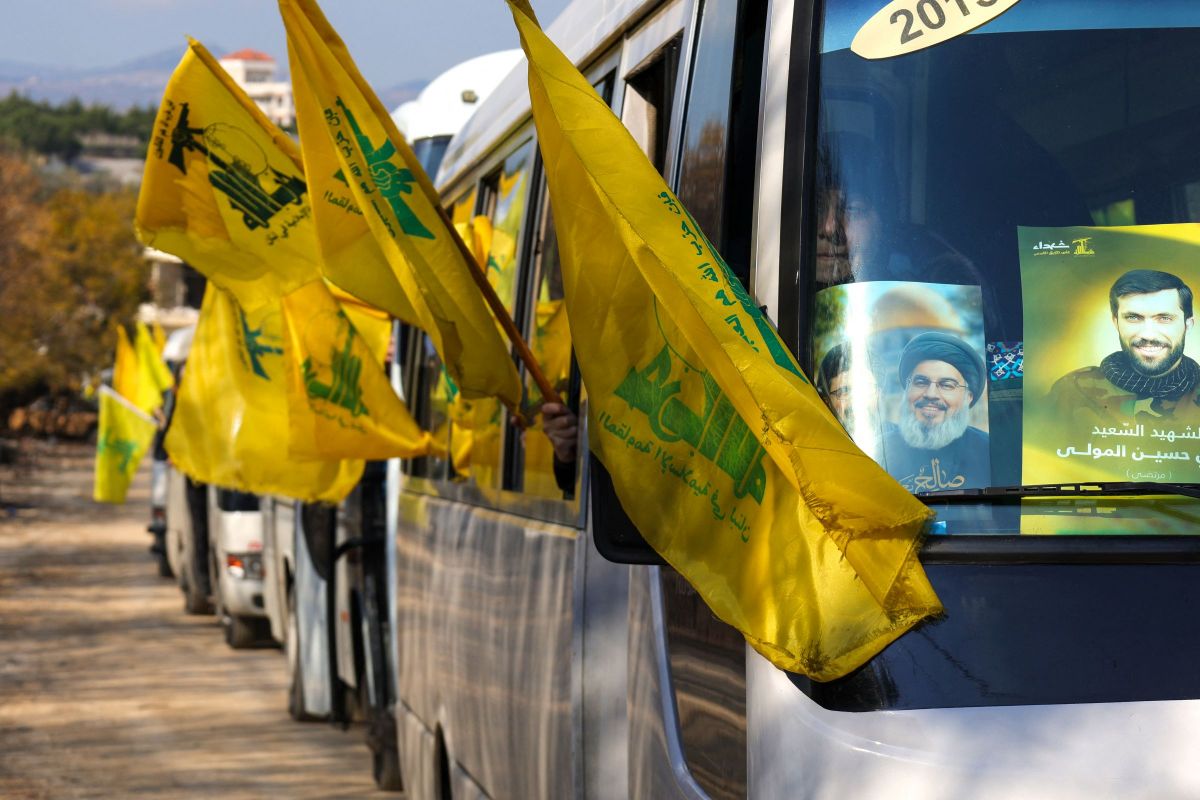
Residents of Khiam, in southern Lebanon, traveling to their village in minibuses, display Hezbollah flags, on Jan. 27, 2025. (Illustrative photo by Rabih Daher/AFP)






BEIRUT — In a meeting of Hezbollah's parliamentary bloc — the “Loyalty to the Resistance” — on Thursday, the attendees condemned, once again, the Lebanese government's decision to disarm the group, saying that this "sinful decision (...) contradicts the preamble of the constitution, the Taif agreement, the ministerial statement, and the legitimate right of the Lebanese people to defend themselves against occupation and aggression."
On Aug. 5, the Lebanese government tasked the Lebanese Army with preparing a plan to disarm Hezbollah by the end of the year. Following this decision, Hezbollah officials and leaders condemned the move and supporters staged motorcycle convoys, but the protests remained limited in scope.
Chaired by Hezbollah MP Mohammad Raad, the meeting discussed a number of political and parliamentary issues and affairs in Lebanon and the region.
"In Lebanon, [Israel] continues its daily attacks, establishing additional occupation points within Lebanese territory, amid a silence and neglect from the Lebanese authorities, who insist on depriving the Lebanese people of their right to resist occupation and manipulate the content of the Taif agreement to turn the problem with the Zionist enemy into an internal Lebanese crisis", reads the statement.
The parliamentary bloc criticized the "unpatriotic decision to disarm the resistance against the Zionist enemy instead of adopting a comprehensive national strategy for the security and defense of Lebanon and the protection of its sovereignty and people, (...) and blocking the path to improvised and dangerous positions that could cause cracks in national unity."
Furthermore, the group described the government decision as a "major downfall and a complete and unjustified submission to external dictates, especially American ones, which place the interests of the Zionist enemy above all other considerations." The bloc stressed “the necessity of retracting that decision and reversing the sin of passing it and insisting on stubbornly defending it.”
Few days before the anniversary of Moussa al-Sadr, the former leader of the Amal Movement who disappeared during a visit to Libya on Aug. 31, 1978, the bloc renewed its commitment to the resistance approach established by Sadr.
Finally, Hezbollah praised "the official fraternal visit" of Iran's Supreme National Security Council Secretary, Ali Larijani, to Lebanon around a week ago and expressed its "deep thanks and gratitude for the positive positions supporting Lebanon and its resistance", and Iran's "constant stand alongside our beloved country and its honorable people and their natural right to liberate their land and defend their homeland."
Despite a cease-fire agreement reached in November 2024 following more than 13 months of conflict between Hezbollah and Israel, the latter still carries out airstrikes on a near-daily basis, especially in the South, and still occupies five areas within Lebanese territories.
