






Families of the killed Lebanese army members arrive to Badaro on 10 August 2025. (Credit: Nabil Ismail/ Annahar






BEIRUT — The bodies of the six Lebanese soldiers killed Saturday in an explosion at an arms depot in south Lebanon were returned Sunday to their respective hometowns, where they were mourned and laid to rest, according to our Bekaa correspondent and multiple Lebanese media outlets.
The soldiers’ bodies had been transported Saturday night to the military hospital in Badaro, Beirut. On Sunday morning, the Lebanese Army held a formal ceremony to accompany their departure.
The army announced Saturday afternoon that the arms depot the soldiers were dismantling was located in the Zebqine valley, near Majdal Zoun (Sour), in south Lebanon. The deadly incident came shortly after the government approved the U.S.-backed roadmap aimed at establishing the state's monopoly on weapons — at the expense of Hezbollah’s arsenal — and enforcing an Israeli withdrawal from south Lebanon.

Justice Minister Adel Nassar visited Majdal Zoun, where he met with soldiers and expressed his “deep appreciation” for their “courage and resilience,” praising their “great sacrifices in protecting the homeland and preserving the dignity of its people.” He stated that “Lebanon will always be indebted to them for their bravery and dedication in fulfilling their duties.”
At the Biyada Army barracks, also in the same district, the minister offered his condolences to 5th Brigade Commander General Michel Bardawil over the soldiers’ deaths. He emphasized that the army, through its central national role, remains “a cornerstone in the building of the state.”

The six soldiers killed in South Lebanon are: Chief Warrant Officer Abbas Fawzi Salhab (Younine, Baalbek-Hermel), Ahmad Fadi Fadel (Ghobeiri, southern suburb of Beirut), Ibrahim Khalil Moustapha (Majdaloun, Baalbek), Hadi Nasser al-Bayy (Sour), Mohammad Ali Choucair (Laylaki, southern suburb of Beirut), and Yamen Hallak (Qarha, Akkar).
The military statement on the incident did not specify whether the depot where the explosion occurred belonged to Hezbollah, which the army is currently tasked with dismantling in areas south of the Litani River, in accordance with the cease-fire agreement that came into effect on Nov.27, 2024, after thirteen months of war between Hezbollah and Israel.
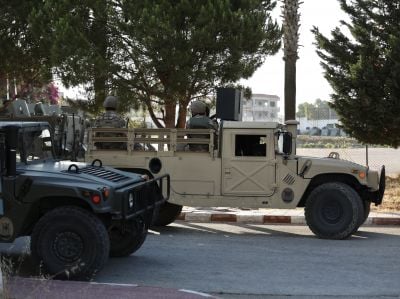
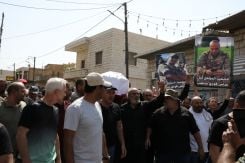
Chief Warrant Officer Salhab was taken to Riyaq, in the Baalbek district, according to our correspondent. His family resides in this locality, which is why he was not buried in Younine, his place of origin, according to our information.
The coffin of this "hero," as his mother called him, was carried by pallbearers and rested on the shoulder of his father, Fawzi. The funeral procession was led on foot by his daughter, Maram, proudly holding a photo of her father, who had once dedicated to her a video showing him detonating remnants of Israeli bombings in the South. Official honors were paid to him in front of Riyaq hospital.
The municipality of Younine nonetheless honored the soldier. “With deep sadness and great pride, the municipality of Younine extends its sincere condolences to the Lebanese army, to the family of the late hero, Chief Warrant Officer Abbas Salhab, as well as to our fellow citizens of Younine.
Abbas dedicated his life to serving and protecting his country with courage and loyalty. His loss is immense both for the army and for our town,” read a statement.
Choucair was buried in the Rawdat al-Shahidain cemetery in Ghobeiri, in the southern suburbs of Beirut.
The Lebanese Army leadership in the Bekaa also organized the funeral procession for the martyr soldier Ibrahim Khalil Moustapha. The funeral procession departed from in front of the Baalbek government hospital toward his hometown, Majdaloun, west of Baalbek. A group of fellow soldiers paid tribute to the victim to the sound of the funeral march, performed by the military band of the Retbaa school. His coffin was draped with the Lebanese flag.

A ceremony was also held in Majdaloun, attended by Brigadier General Jihad Abou Ali, representing Defense Minister Michel Menassah.
In his speech, Brigadier General Abou Ali stated that the army is the nation’s shield “against enemies and terrorism,” and that its soldiers are always ready to sacrifice their lives for Lebanon. He praised the martyr Ibrahim as a loyal and devoted soldier who considered all of Lebanon his home and all Lebanese his family.
The location of soldier Yamen Hallak’s funeral remained uncertain for some time. He was registered in Qarha, in Wadi Khaled on the Lebanon-Syria border, but his family lives in a locality called Joubbenieh, part of which lies in Syria, explained our correspondent.
A military source indicated that the body was scheduled to be transferred on Sunday at 3 p.m. from the military hospital in Badaro to Wajh al-Hajar, in the Kharbat al-Tin district of Homs province in Syria, where the funeral is planned for the same day.
In southern Lebanon, the town of Dbaal held the funeral for Ahmad Fadi Fadel, while the city of Sour was still awaiting an announcement on the date of Hadi Nasser al-Bayy’s funeral as of Sunday afternoon, according to our correspondent.

Reporting contributed by Sarah Abdallah and Miche Hallak.

 Evening recap: Netanyahu announces West Bank offensive; 7 killed in Jordan church shooting; tents burned in south Lebanon
 US strike on Iran this weekend? ‘Absolutely,’ says Barrack; ‘I have no idea,’ says Trump