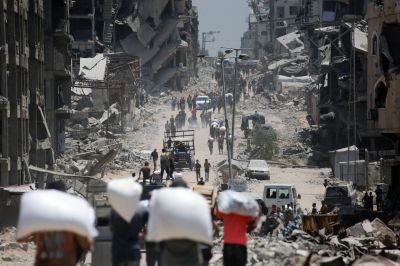
Palestinians carrying sacks of flour in a devastated street in Jabalia, in the northern Gaza Strip, August 1, 2025. (Credit: Bashar Taleb / AFP)






Under international criticism, the Israeli army prepared Saturday to take control of Gaza City, the largest in the Palestinian territory, in order to “defeat” Hamas and secure the release of hostages.
After 22 months of war, Prime Minister Benjamin Netanyahu faces intense pressure both in Israel and abroad to end his offensive in the Gaza Strip, where more than two million Palestinians are threatened with “widespread famine,” according to the U.N.
Under a plan approved by Israel’s security cabinet, the army “is preparing to take control of Gaza City,” a largely destroyed urban area in the north of the territory, “while distributing humanitarian aid to civilians outside combat zones.”
Following the announcement of this plan, the U.N. Security Council will hold an emergency meeting on Gaza at 10 a.m. Sunday, several diplomatic sources told AFP on Friday.
In addition to disarming Hamas and securing the return “of all hostages, alive and dead,” the plan aims to demilitarize the Gaza Strip and place it under Israeli control before establishing “a civilian administration” that is “neither Hamas nor the Palestinian Authority,” Netanyahu’s office said Friday. “We are not going to occupy Gaza; we are going to free Gaza from Hamas,” which has ruled the territory since 2007, Netanyahu said on X.
The army “is already preparing today for full implementation of the decisions,” Defense Minister Israel Katz said.
From Germany, one of Israel’s staunchest allies, to the E.U., France, China and many Muslim countries, the plan’s announcement has drawn international condemnation. The U.N. Security Council will meet Saturday in an emergency session. Berlin announced it would suspend exports of military equipment that could be used in the Gaza Strip. Netanyahu called Chancellor Friedrich Merz to “express his disappointment” over sanctions that “reward” Hamas.
U.N. Secretary-General Antonio Guterres warned Israel against “a dangerous escalation” that “risks worsening the already catastrophic consequences for millions of Palestinians.”
‘Protect our young men’
Hamas, which still holds 49 hostages, of which 27 presumed dead, said Israel’s decision amounted to “sacrificing” them.
Buffeted for months by Israeli army evacuation orders and daily bombardments, Gaza City residents feared the worst. The occupation of the city “will lead to many displacements. And we, as Palestinians, have been displaced dozens of times,” said Rafik Abu Jarad, a 54-year-old displaced resident.
“We will have to leave Gaza City to protect our young men, whom the occupier [Israel] will arrest,” said Jenin Rafik Abu Jarad, 23. “Children and the elderly will be forced to walk for kilometers under the sun, when there is no food.”
In Israel, hostage families are also concerned. The plan “means abandoning the hostages, while completely ignoring repeated warnings from the military leadership and the clear will of the majority of the Israeli public,” the Hostages’ Families Forum said.
Currently, the Israeli army occupies or operates on the ground in nearly 75% of the Gaza Strip, mainly from permanent positions along the border. Israel previously occupied Gaza in 1967 and established 21 settlements, dismantled during its unilateral withdrawal in 2005.
‘Risky’ airdrops
According to public broadcaster Kan, the Israeli plan calls for “conquering Gaza City, whose residents will be evacuated over the next two months” to refugee camps. “Then the troops will encircle the city and operate inside.”
The army, in cooperation with intelligence services, announced Friday it had carried out a series of “targeted eliminations” in Gaza, killing five Hamas and Islamic Jihad commanders and fighters who took part in the Oct. 7, 2023 attack on Israel.
Civil Defense spokesperson Mahmoud Bassal told AFP Friday that 18 people were killed by Israeli fire across the Gaza Strip. He also expressed concern over the “high risks” of injury and death caused by aid airdrops.
According to Amjad Al-Chawa, director of the Palestinian NGOs Network in Gaza, inspection procedures at entry points slow aid deliveries, which he said are “between 70 and 80 trucks per day,” while the U.N. estimates the need at at least 600 trucks daily.
The WHO says 99 people, including 29 children under five, have died of malnutrition since January, “figures likely underestimated.” The Gaza Health Ministry said Friday the toll was 202, including 98 children.
Israeli reprisals have already killed 61,330 people in Gaza, mostly civilians, according to figures from the Gaza Health Ministry deemed reliable by the U.N. On the Israeli side, Hamas attack killed 1,219 people, mostly civilians, according to an AFP tally based on official data.