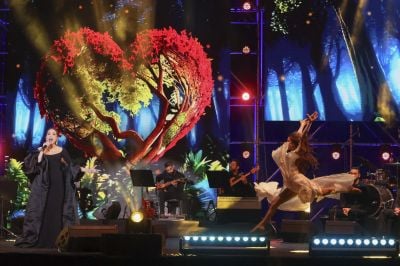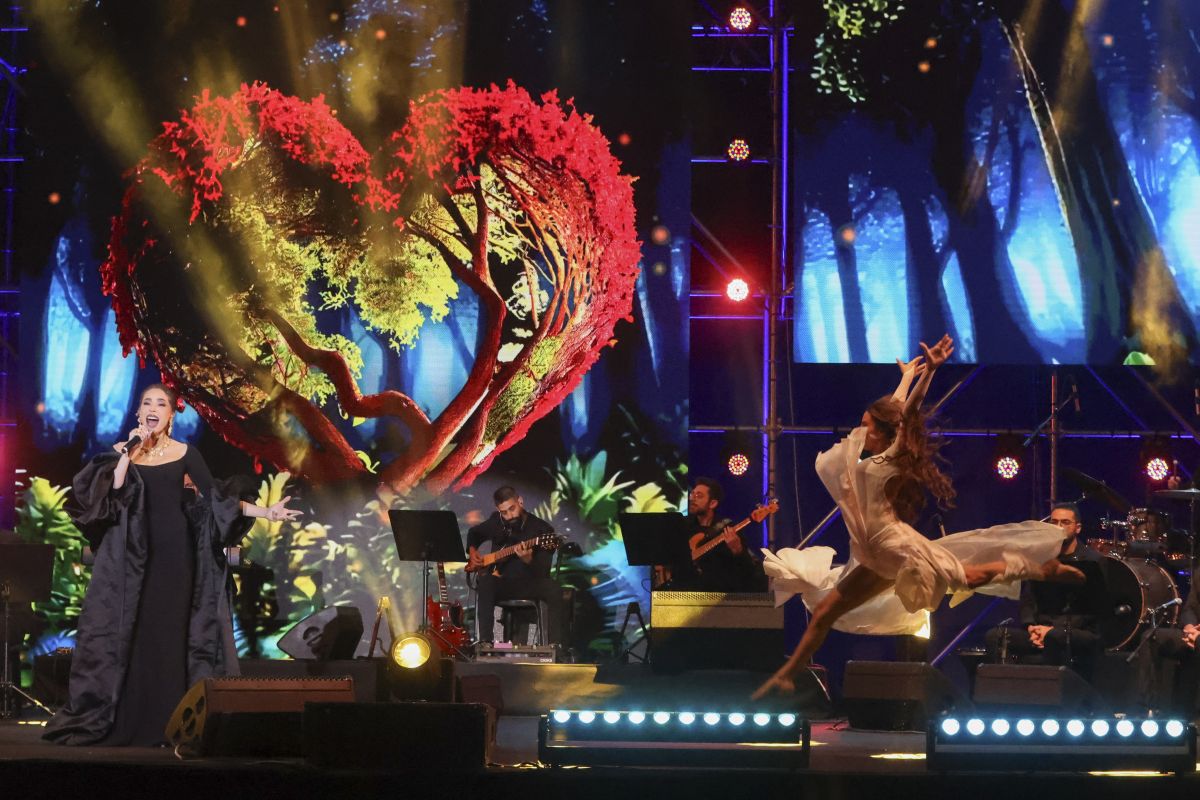
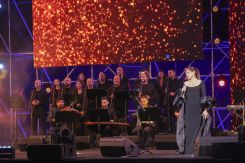
The diva Abeer Nehme on the stage of the Ehdeniyat festival. (Credit: Ehdeniyat festival)






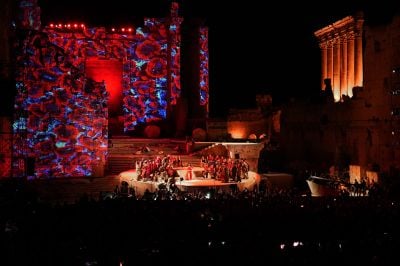
While the temples of Baalbeck drew festival-goers to the spectacular "Carmen" staged by Jorge Takla, Ehden offered its wooded cocoon to Abeer Nehme, arguably one of the most beautiful voices in the Arab world. A "specialist in all styles," the Lebanese diva once again showcased her vocal and cultural cosmopolitanism.
From Egyptian classical to tarab, through Asmahan, the Rahbanis, French songs and Anglo-Saxon pop, she integrated into her repertoire personal songs that speak of love, culminating with a song in Syriac as a tribute to Ehden, which retains a dialect accent of this extinct language, preserved only in the Maronite liturgy.

Pure joy, tenderness in song
To sing about love in front of a spirited audience at the Ehdeniyat festival, where the stage is set amidst a majestic fir forest, Nehmeh is supported by a choir and her orchestra led by Marc Abou Naoum.
In a simple black sheath that is subtly low-cut, contrasting with the deep red of her lips, her appearance is brightened by the unique smile she offers her audience — a blend of childlike joy and tenderness.
Behind her, her name shines in golden letters against a backdrop of blue lights. Throughout the show, stunning projections added to the hypnotic magic of the moment.
With the first notes of "Inta," the great classic by Mohammed Abdel Wahab, the audience is already captivated, connecting with the lyrics on a personal level. She continues with a long program that is both impressive for her audience and almost acrobatic for her voice, which spans all registers.
Her soulful notes in English on "Simple Things" evoke Stevie Nicks of Fleetwood Mac. She confidently uses her agile soprano on the tarab of "Lamma bada" and Piaf's "Hymne à l'amour," generating enthusiasm whose echo resonates in the surrounding mountains. At times, especially during a mashup, dancers from the Carel Wardini Dance Academy performed a contemporary choreography on stage.
On the giant screen that makes her tiny silhouette appear larger, one can sometimes see her reach the saltana — that nearly altered state of total mastery and fusion with the sound that also infects the audience, especially during the trance of "Chou Bhessellak."
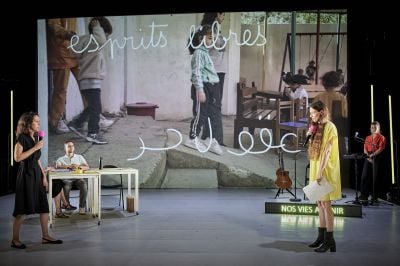
One of the highlights of the concert was a love song in Syriac, set to the popular tune of "Tallou hbabna tallou" in operatic style. It was dedicated to Ehden, the last village with the characteristic Zghorti accent of its people, whose "a" and "e" sounds are similar to the "o" sound — a reflection of the Aramaic roots of this dialect, which preceded Arabic as the region's common language.
She would have liked to add Armenian to Syriac
Backstage, she told L'Orient-Le Jour that she never rehearses her voice except on the day of a concert. "It’s the worst thing to do, but I don’t find the time. In this job, we run and travel nonstop," she says, expressing her gratitude to the large team around her, without whom nothing would have been possible.
One might expect her to be exhausted and drained after an hour and a half of nonstop singing, which is physically demanding, but she leaves as fresh and smiling as when she first stepped on stage. "It’s the audience that carries me, feeds me, gives me the energy to give again and again," she says.
Discussing her Syriac song, this musicologist — an expert in ancient ethnic music and a kanun master trained at USEK — mentioned she wanted to include an Armenian song in the program that evening. However, the director objected, citing the program's length, so it was postponed. Abeer assures it will be included later.
Krikor Jabotian's stage outfit
We were joined by designer Krikor Jabotian, who explained his stylistic choices for this particular concert. "Everything started from the necklace," the creator detailed, who is also known for his baroque jewelry. The gold necklace features pearl shapes with irregular outlines and varying sizes. Jabotian paired it with earrings, and the diva’s pearlescent nails completed the look.
"Abeer doesn’t need a dress to make her shine," the designer said. "She shines with her own light." Hence, the radical simplicity seen in the black dress is the result of long, collaborative conversations between the creator and the singer. "We then acknowledged the vastness of the stage and the large crowd that would be coming. That’s why I decided to add a black satin cape with just the right volume to accompany her movements and amplify her silhouette from a distance," he added, admitting he was inspired by something Maria Callas-like when designing the ensemble.
Since we were in Ehden, the diva gently bid farewell to her audience amidst heartfelt ululations, softly continuing to sing between goodbyes and gratitude. She turned towards the peaceful forest surrounding her and finally stepped down from the stage, almost with a hint of reluctance.
This article was translated from L'Orient-Le Jour.