






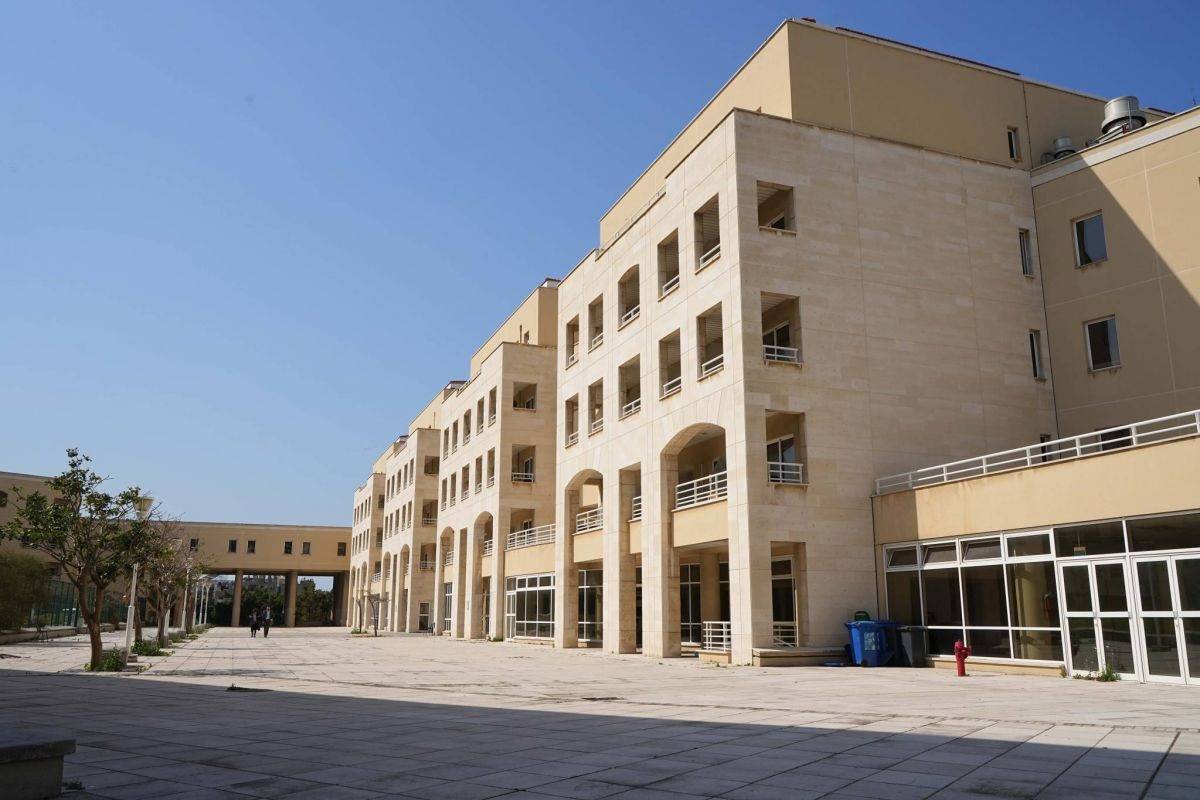
Lebanese University campus in Hadath. (Credit: Mohammad Yassin/L'Orient Today)






In a meeting at the Lebanese University’s headquarters in the Mathaf area, Beirut, President Joseph Aoun said that he wanted “the Lebanese University to be able to provide education for all the Lebanese,” the state-run National News Agency reported Friday.
LU is the only public higher education establishment in Lebanon.
Aoun was welcomed by the university’s president, Dr. Bassam Badran and Education Minister Rima Karami.

"Knowledge is Lebanon's distinctive feature," emphasizing that investing in the minds of the people is far more important than investing in natural resources. He highlighted that the LU, “with its prestigious global ranking and academic achievements, plays a crucial role in nurturing this knowledge and shaping Lebanon's future.”
During the meeting, Badran “briefed Aoun on the university's continued advancements, particularly its rising international rankings."
LU ranked between 701-750 globally in 2022, and has since steadily climbed to 515th in 2025, according to the QS International Universities ranking. "Domestically, the Lebanese University holds the second position among Lebanese institutions, with highly ranked faculties in engineering, pharmacy, medicine, and arts,” Badran said.
Badran also spoke of plans to expand the university, revealing that LU “is preparing to launch tenders for seven new buildings across Lebanon, including in Tripoli, Zahleh and Nabatieh, funded through the university’s budget and income generated from COVID-19 PCR testing.”
During the pandemic, an agreement was made to transfer all the benefits from the paying PCR testing at Beirut airport to the Lebanese University.
Badran also called for “further support to strengthen the institution’s independence and ensure the appointment of qualified deans and professors based on transparency and academic needs.”
In his address, Aoun praised the "university’s resilience and academic success, particularly in light of the challenging circumstances Lebanon has faced over the past few years — spanning economic crises, the COVID-19 pandemic and the Beirut Port explosion."
Despite these challenges, LU has maintained a "high academic standard," which Aoun credited to "effective management."
'The university of all Lebanese'
"The Lebanese University is the university of all Lebanese. We rely on you to preserve and develop this institution, which offers accessible education to many students who cannot afford the costs of private universities," Aoun said, stressing that "Lebanon’s strength lies not in its natural resources, but in the minds of its people."
Karami also welcomed Aoun’s visit, reinforcing the "university’s crucial role in the nation’s educational landscape." She expressed "confidence in the university's efforts to further improve the academic environment for students and faculty, particularly regarding faculty appointments and national quality standards."
Aoun concluded his remarks by reaffirming his support for the Lebanese University, urging continued collaboration with the government to ensure its growth and success. He called on everyone to keep the university's legacy alive, assuring that "efforts would continue to provide quality education for all Lebanese students."
University instructors at the LU regularly go on strike.
In late March, the League of Professors of the Lebanese University announced that they would observe a three-day strike demanding "the payment of the allowance for this month be made within the allotted time."
"This action is a first warning," added the League. "It results from ongoing attempts to meet with the Education Minister via her office and advisers, who had promised to contact us, then disappeared and do not answer our calls."
The Lebanese educational system, both public and private, has been in crisis since the Lebanese Lira began to depreciate in 2019 at the onset of the economic and financial crisis. The situation worsened with the COVID-19 pandemic, the explosion at the Beirut Port in August 2020 and a wave of teacher resignations and strikes as salaries lost their value. The war between Israel and Hezbollah, which began on Oct. 8, 2023, further paralyzed the sector, destroying many schools in southern Lebanon, the southern suburbs of Beirut and the Bekaa.
