






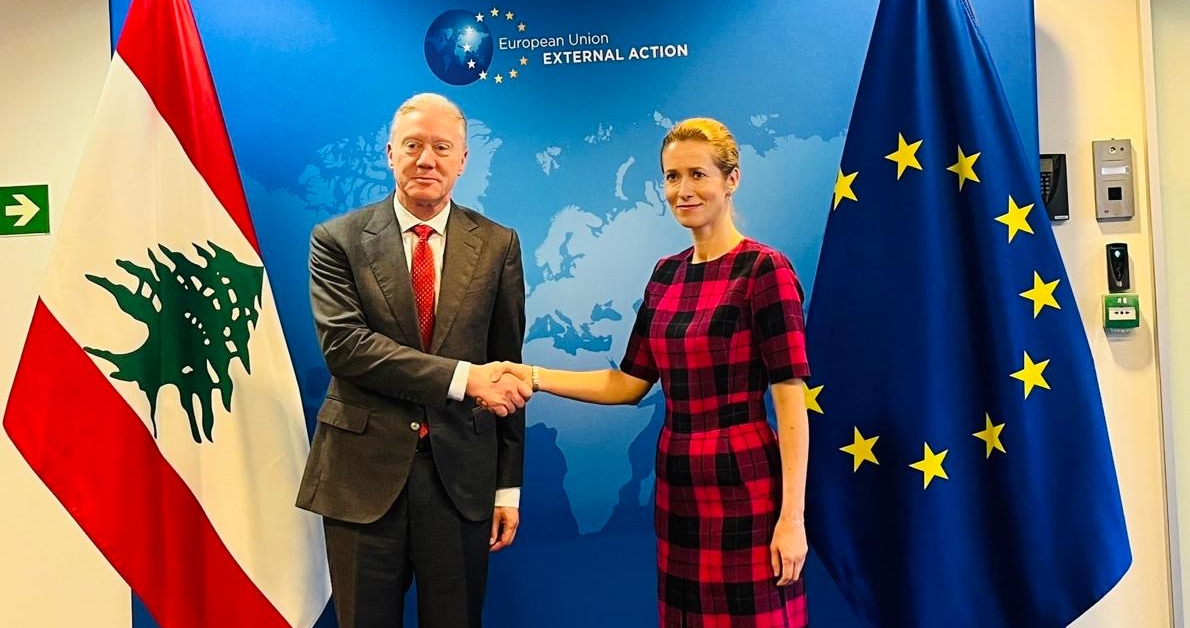
The Lebanese Minister of Foreign Affairs, Joe Raggi, with the Vice-President of the European Commission, Kaja Kallas, on July 14, 2025. (Credit: NNA).






BEIRUT — During a visit to Brussels, Lebanese Foreign Minister Joe Rajji met Monday with European Commission Vice President Kaja Kallas, to whom he requested "the European Union's help to pressure for Israel's withdrawal from the five points as well as other occupied territories in southern Lebanon."
The cease-fire, which took effect on Nov. 27, 2024, to end the war between Israel and Hezbollah that had lasted since Oct. 8, 2023, notably calls for the progressive Israeli withdrawal from villages occupied in southern Lebanon. This disengagement is intended to allow the Lebanese Army to deploy in areas formerly under Hezbollah's influence.
However, the Israeli army still maintains five positions it considers strategic: Labbouneh/Alma al-Shaab, in the Sour district, Jabal Blat, near Ramieh in the Bint Jbeil district, Jal al-Deir, south of Aitaroun (Bint Jbeil), a position along the Markaba-Houla road in the Marjayoun district, as well as the Hamames hill, near Khiam, also in Marjayoun.
Last March, Israeli Prime Minister Benjamin Netanyahu asserted that the Israeli state "will not relinquish" these positions.
Rajji also stressed the importance of European support for renewing the mandate of the United Nations Interim Force in Lebanon (UNIFIL). Lebanon has officially sent a letter to the United Nations in this regard, requesting the extension of this mandate until Aug. 31, 2026.
The Lebanese minister also affirmed that Beirut "is continuing on the path of economic, financial, judicial and administrative reforms." He called for increased support from the European Union in this process and presented the main points of the government's plan for managing the issue of Syrian refugees, emphasizing "the importance of their return to their country."
Thousands of Syrian refugees are thus to return to Syria as part of the first U.N.-supported program offering financial incentives for their return. Nearly 11,000 people have already registered to return in recent days, as the Lebanese government is estimating "200,000 to 400,000 returns" by the end of the year.
The new Syrian authorities, in power since the fall of Bashar al-Assad's regime last December, state that "all [Syrian] citizens are welcome," despite the scale of destruction in many areas and persistent concerns about the security situation.
Kallas reiterated "the importance of bilateral relations between Lebanon and the European Union," calling for "the implementation of reforms and the conclusion of an agreement with the International Monetary Fund [IMF] before the planned meeting, by the end of the year, of the Lebanese-European Association Council."
The reforms demanded by the IMF, with which Lebanon is negotiating for financial aid, notably aim to restructure tens of billions of dollars of debt and to clean up a banking sector that has been in technical bankruptcy since late 2019. These reforms, which have long been blocked – well before the formation of the current government – saw initial progress last April under pressure from the IMF and international partners, when deputies passed a law partially lifting banking secrecy after attempting to introduce amendments that would have limited its effectiveness.
