






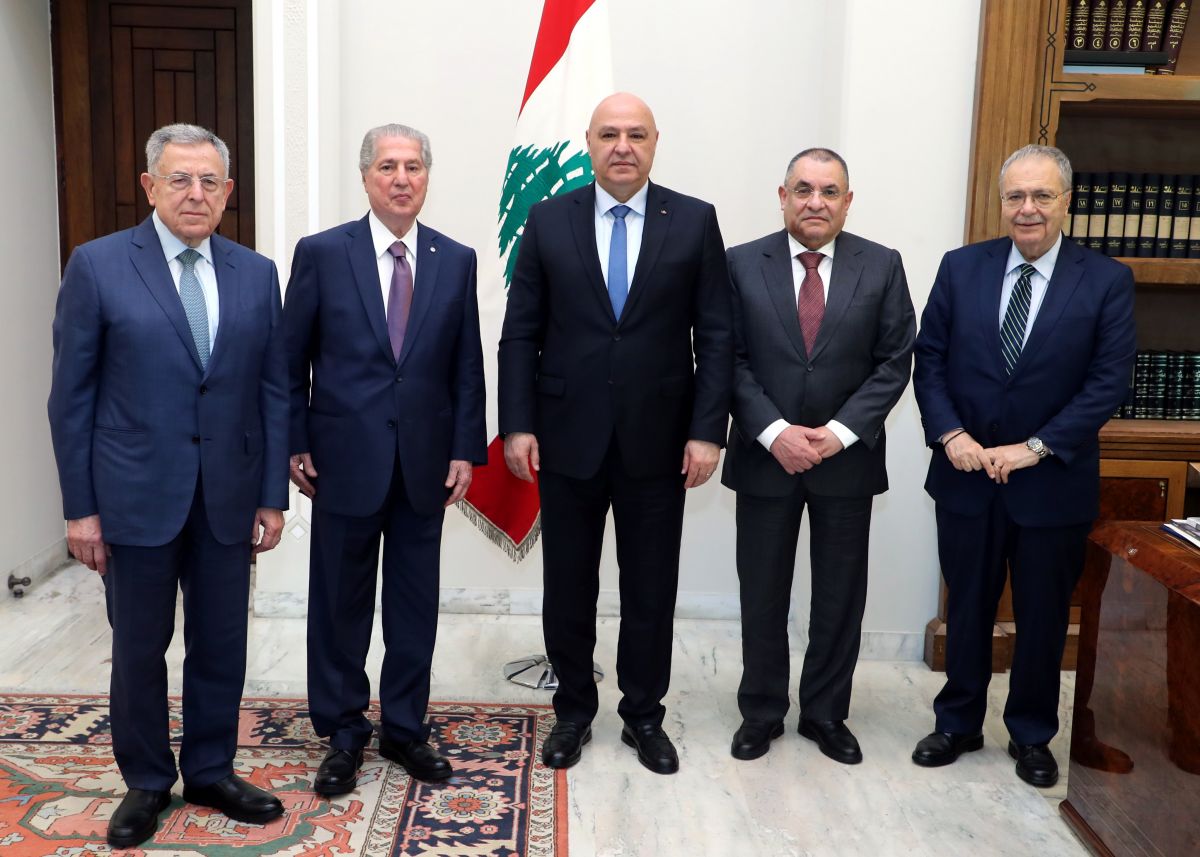
President Joseph Aoun (center) is pictured alongside Kuwaiti politician Mohammad Jassem al-Saqr (to the president's left), Deputy Prime Minister Tarek Mitri (far right), former president Amine Gemayel (to the president's right), and former prime minister Fouad Siniora (far left). (Credit: @LBpresidency/X)






President Joseph Aoun received on Friday at Baabda a delegation from the Arab and International Relations Council, a think tank based in Kuwait and chaired by Kuwaiti politician and businessman Mohammad Jassem Al-Saqr. He told the delegation that while living in "peace" is currently a priority in Lebanon, whose south is hit almost daily by the Israeli army, normalization with Israel "is not being considered in Lebanon’s current foreign policy."
During the meeting, attended by former President Amine Gemayel and former Prime Minister Fouad Siniora, President Aoun emphasized the importance of "the unity of the Lebanese people and the cooperation of various parties with the state in order to protect the country, strengthen it and face conspiracies that may be plotted against it." "The decision on the monopoly of arms has been taken and is irreversible, and the decision of war and peace is the prerogative of the Parliament, which acts according to what it considers to be in Lebanon’s interest," he added.
The president’s approach to the disarmament of Hezbollah is the source of divisions, with some parties such as the Lebanese Forces (LF) reproaching him for not imposing his decision and for favoring dialogue. The LF and other groups have also criticized the government's failure to respond to the roadmap proposed by the U.S. administration for Lebanon, which notably includes the issue of disarming all remaining armed militias.
Israeli occupation in the South, 'without military usefulness'
On this subject, Aoun stated that the implementation of the decision on the monopoly of arms "will take into account the interest of the state and security stability, in order to preserve both civil peace and national unity." On Thursday evening, LF leader Samir Geagea considered the president’s fear of divisions in the event of an abrupt decision on Hezbollah’s arms "excessive."
Aoun also asserted that "peace, that is, the absence of war, is what concerns us at present in Lebanon. Normalization, on the other hand, is not included in current Lebanese foreign policy," referring to a potential normalization of relations with Israel. Israel bombs southern Lebanon and at times other regions almost daily, despite the truce in effect since Nov. 27, 2024, after 13 months of war between Hezbollah and Israel. The Israeli army also continues to occupy five positions on Lebanese hills along the border. An occupation "without military usefulness and on false pretenses," which "hinders the full deployment" of the army in southern Lebanon as stipulated explicitly in U.N. Security Council Resolution 1701, which forms the framework for the truce agreement.
Nabih Berri's efforts
"We wish to establish good relations with Syria, while insisting on non-interference in the internal affairs of both countries," Aoun added, saluting "the role played by Parliament Speaker Nabih Berri in helping to stabilize, supporting state reconstruction efforts and achieving the monopoly on arms." The speaker is a mediator in discussions on disarmament.
For his part, Mr. Al-Saqr expressed after the meeting his "hope" that Lebanon will achieve "comprehensive solutions that will end the current crises and restore stability." The delegation of the Arab and International Relations Council "listened to a detailed presentation on the current situation in Lebanon," "expressed its point of view, and discussed concrete contributions it could make to support Lebanon at this time," the message on X said. "We are aware that Lebanon faces significant challenges, but we believe that solutions exist and are clear," said Al-Saqr, who believes that the "inauguration speech [by President Aoun on Jan. 9] constitutes a clear roadmap for building the state, but its implementation is not easy due to certain obstacles, including the arms issue."
According to information on its website, the Arab and International Relations Council is an independent, non-governmental and non-profit Arab organization based in Kuwait. Its main goal is to "consolidate and strengthen inter-Arab relations."
Aoun wants to bring Lebanon back into the Arab fold after years of estrangement caused by the growing influence of the pro-Iranian Hezbollah in Lebanon, against a backdrop of regional tensions between Iran and the Gulf monarchies. The election of Michel Aoun in 2016, then an ally of Hezbollah, over Sleiman Frangieh marked, for the first time, a rift between Lebanon and the Arab countries, as well as a rapprochement between Beirut and Tehran. The significant weakening of Hezbollah, at least militarily, following the recent war with Israel, has shifted the balance.
