






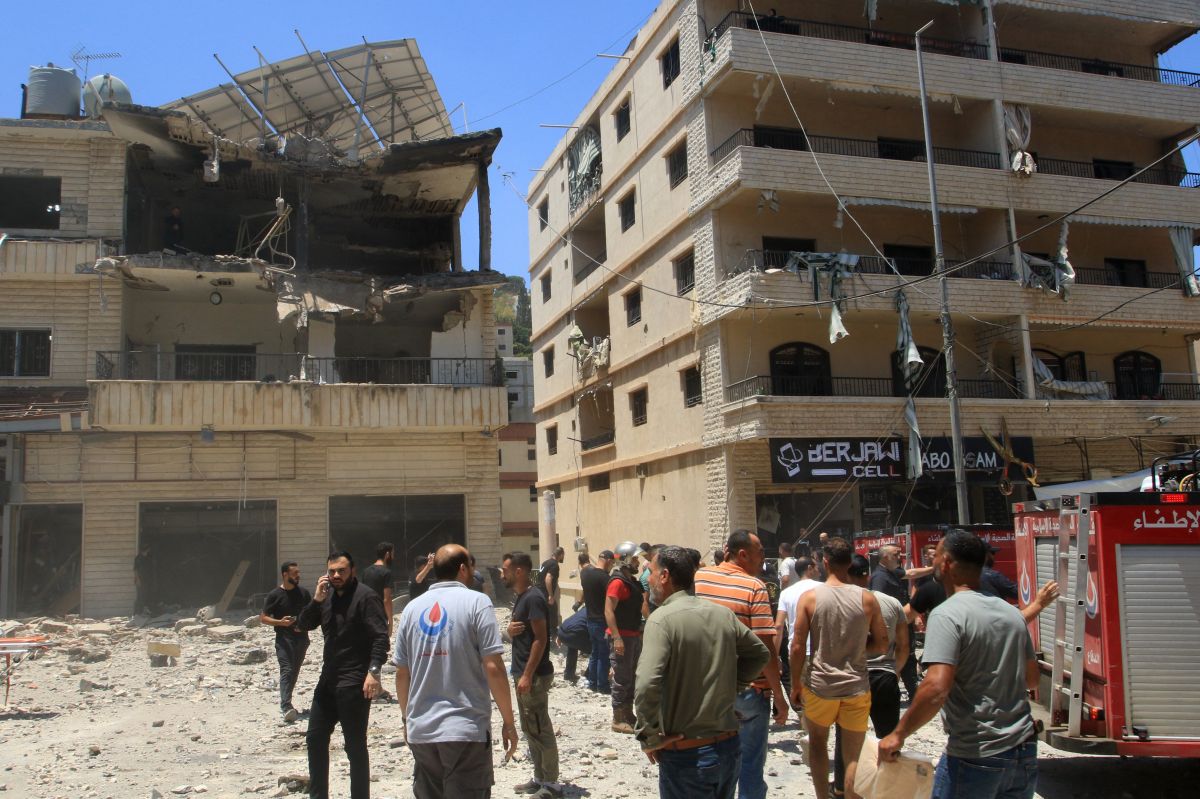
People inspect the damage after an Israeli strike on Nabatieh in southern Lebanon on June 27, 2025. (Credit: Mahmoud Zayat/AFP)






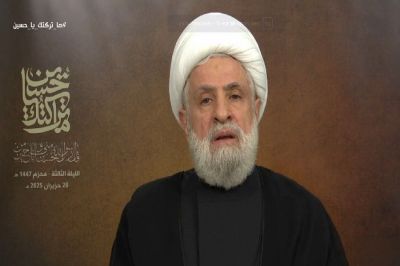
Jaafarite Mufti Ahmad Qabalan, close to the Amal-Hezbollah alliance, harshly criticized the Lebanese state in a statement relayed Sunday by the state-run National News Agency (NNA), calling it a "failing," "guilty," "nonexistent" state. The dignitary was reacting to recent Israeli violations in southern Lebanon that continue almost daily despite the cease-fire that came into effect on Nov. 27, 2024, following 13 months of war between Hezbollah and the Israeli army.
"In this field, the state is guilty, very failing, it deliberately punishes its own people with premeditated intent, and it is even mired in suspicions related to its positions ... Everyone was surprised to see Israel act at will without the slightest response from a nonexistent state," he stated.
The mufti insisted on the need to "prove the state's ability to protect its population and sovereignty, especially south of the [Litani] river," referring to the cease-fire agreement with Israel, which calls for the deployment of the Lebanese Army and the United Nations Interim Force in Lebanon (UNIFIL) south of the Litani, as well as the implementation of U.N. Resolution 1701, which notably includes the disarmament of Hezbollah.
In the statement for the start of the month of Muharram in the Islamic calendar, Sheikh Qabalan also praised the "resistance that will not accept to sell Lebanon."
'Media Game'
The sheikh also likened "the media game in the country" to a maneuver by the "Mossad ... targeting the head of the resistance and its people."
"Making war on an entire community is condemning Lebanon to ruin. And to those concerned, I say: we will not hand over the head of Lebanon to anyone, and those who care about security and sovereignty do not put their necks in the hands of Washington and, behind it, Israel," he added
These remarks come as Prime Minister Nawaf Salam said Saturday, in an interview with the Saudi daily al-Sharq al-Awsat, that "the state's monopoly on arms is a need for Lebanon before being an international requirement."
The leader of the Lebanese Forces (LF) and Hezbollah adversary, Samir Geagea, stated that the soft approach adopted by President Joseph Aoun on disarmament "has reached its limits over time."
Three people were killed and two others injured Saturday in Israeli strikes in Kounin and Mahrouna. The Arabic-language spokesperson for the Israeli army, Avichay Adraee, said that "the person responsible for anti-tank missiles in the Bint Jbeil region" of Hezbollah had been "eliminated" in Kounin. On Friday, in the Nabatieh region, as part of an Israeli military escalation, a deadly strike killed a woman and injured 21 people. Shortly before, Israeli forces conducted about 20 bombings on wooded areas of the Nabatieh mountains, causing seven minor injuries.
The mufti's position is aligned with that of the Hezbollah secretary-general. In a speech on Saturday, Naim Qassem said that these "violations are the responsibility of the state," which he challenged, calling it unacceptable to consider handing over Hezbollah's arsenal to the Lebanese Army without a prior stop to Israeli violations.
The issue of Hezbollah's disarmament was brought back to the table by the American envoy Tom Barrack, who called for an end to the state of war with Israel and demanded new commitments from Lebanon regarding the monopoly of arms and the restoration of the state's sovereignty over its entire territory. This dossier has made no progress despite various consultations between the president and Hezbollah MPs.
On May 13, UNIFIL announced that it had discovered more than 225 weapons caches in the south since the cease-fire. The Israeli army still occupies five points along the border and continues to bomb the country almost daily.
