






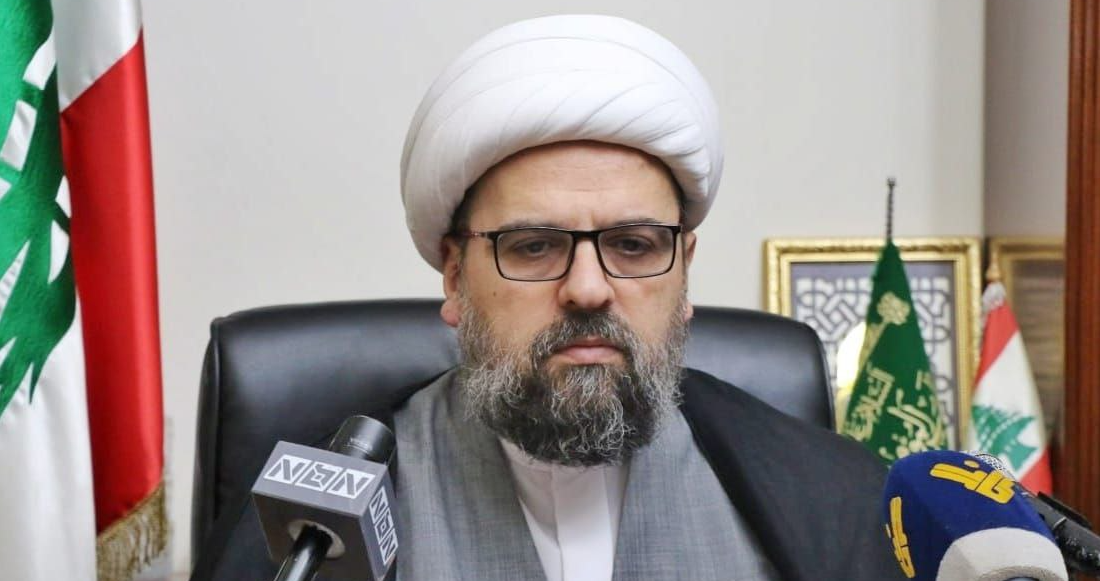
Jaafarite Mufti Ahmad Kabalan. (Credit: National News Agency)






Grand Jaafarite Mufti Sheikh Ahmad Kabalan said that "what is needed is an exceptionally effective national initiative to save Lebanon from sectarian savagery and the state of political enclaves," in a statement relayed by the state-run National News Agency Sunday.
He continued, “There can be no national project without an electoral law that abolishes sectarian tendencies and the entrenched political zones that continue to drag Lebanon down the path of a failed state. The only solution is a cross-sectarian electoral law backed by a non-sectarian national public. Promoting a culture of citizenship requires a national media that does not resemble the current one, which is awash in illicit regional and international funding.”
The country has been grappling with a severe financial crisis since 2019, which has led to the devaluation of its currency, widespread poverty and the collapse of basic public services. Efforts to form stable governments and implement reforms have repeatedly stalled, largely due to entrenched sectarian power-sharing structures and political infighting.
Kabalan concluded that “laws must be reinforced to present the state as a national power in the face of sectarian and personal tendencies. This requires a non-sectarian electoral system, highly neutral government policies, an independent judiciary and public services that cover healthcare, education, retirement and unemployment, all in a context of involving citizens in making local decisions."
The existing political framework divides power among religious sects, often resulting in patronage networks, institutional paralysis and a lack of accountability.
Iranian Foreign Minister Abbas Araghchi had recently visited Lebanon and expressed Iran’s willingness to finance reconstruction efforts in the country, alongside a delegation from the International Monetary Fund (IMF) that was also in Lebanon.
Shortly after the Iranian delegation left, on June 5, Israeli airstrikes targeted Hezbollah positions in the southern suburbs of Beirut, marking one of the most significant escalations since the November 2024 cease-fire. The Israeli military claimed to have struck underground drone production facilities allegedly operated by Hezbollah with Iranian support.
Before the attacks, Israel issued evacuation warnings to residents in neighborhoods such as Hadath, Haret Hreik and Burj al-Barajneh, leading to widespread panic and mass evacuations. Despite these warnings, Lebanese authorities reported that no military equipment was found at the targeted sites, and the Lebanese Army attempted to prevent the strikes but was obstructed by Israeli warning strikes. The airstrikes caused thick smoke and forced thousands to flee, resulting in traffic chaos. Lebanese President Joseph Aoun condemned the strikes as violations of the U.S.-brokered cease-fire from November 2024.

