






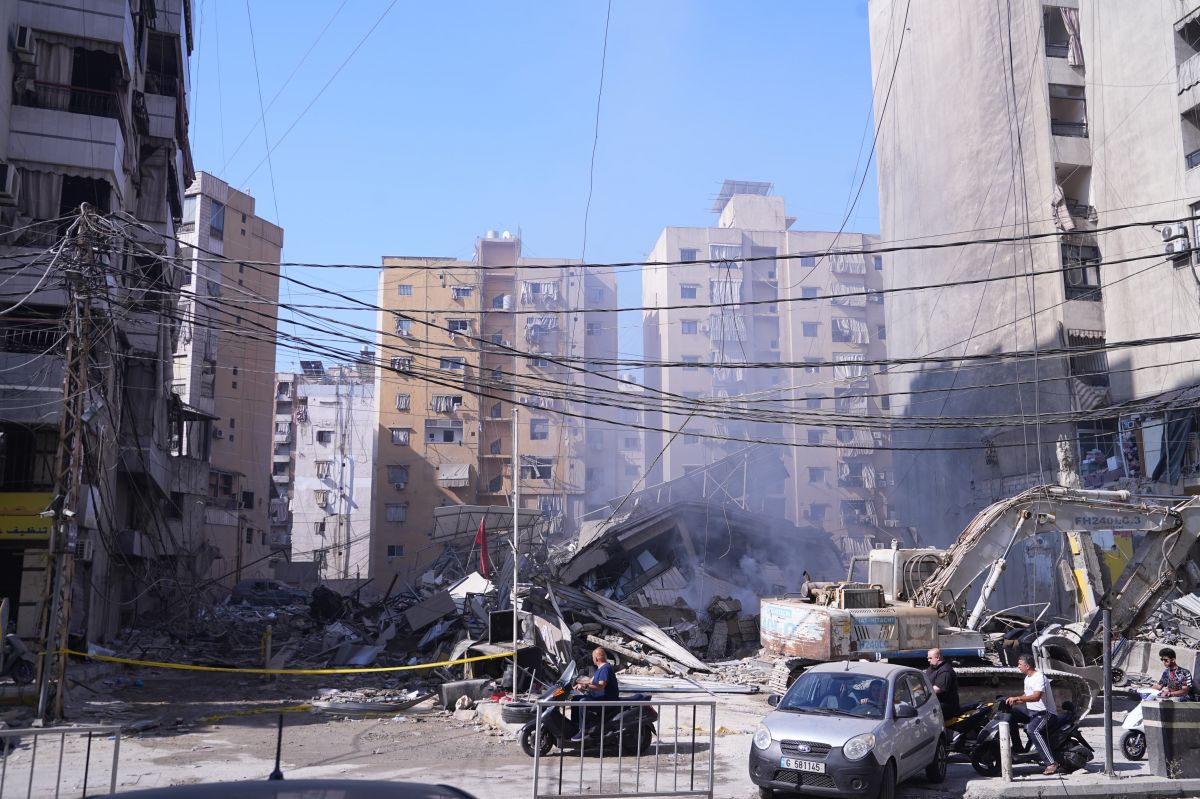
Scene of destruction at the site of the Israeli strike on Beirut’s southern suburb, June 6, 2025. (Credit: Mohammad Yassine/L’Orient-Le Jour)






The spokesperson for the United Nations Interim Force in Lebanon (UNIFIL), Andrea Tenenti, described Thursday night’s Israeli airstrikes on Beirut’s southern suburb as a “dangerous development,” coming more than six months after the cease-fire agreement of Nov. 27, 2024.
After issuing evacuation orders, the Israeli army carried out eight strikes on the suburb, claiming it had “targeted terrorist objectives belonging to Hezbollah’s Air Unit 127.”
In an interview with the daily Asharq al-Awsat, Tenenti stressed that the attacks “not only constitute a violation of Lebanese sovereignty and Resolution 1701, but also pose a serious threat to the fragile stability in this contested area following the cessation of hostilities.” He added, “This not only heightens tensions, but could also create a very dangerous situation in a region already suffering from 15 months of conflict.”
Tenenti said the international force is “not aware of any contact between Lebanese authorities and the cease-fire monitoring committee,” noting that such communication is beyond its mandate. “We continue to carry out our assigned duties under Resolution 1701, supporting the full deployment of the Lebanese Army within Lebanon, demanding the Israeli army withdraw from all positions in southern Lebanon, and calling for a cessation of hostilities — not only into Lebanon, but also from within its territory — because this could endanger the truce,” he said.
The Israeli strikes caused the complete destruction of nine buildings, while 71 others, along with 50 vehicles and 177 institutions, were damaged, according to a preliminary damage assessment by the Reconstruction Commission for the Beirut region, which is affiliated with Hezbollah.
As for casualties, Lebanon’s Health Ministry has not released official figures, but Minister Rakan Nassereddine reported that a number of people were hospitalized, without providing further details.
The strikes, which destroyed apartment blocks in Hezbollah’s densely populated stronghold, mark the fourth attack on the capital’s outskirts since the cease-fire took effect.
Shortly afterward, the Israeli army also ordered residents of a building in Ain Qana (Nabatieh district) to evacuate, citing its “proximity to Hezbollah facilities.” A strike was launched just over an hour after the warning.

 1 p.m. recap: Qatari PM expected in Beirut; missile intercepted in Medina; Hezbollah seeks to recover its explosives seized in Dahr al-Baidar