





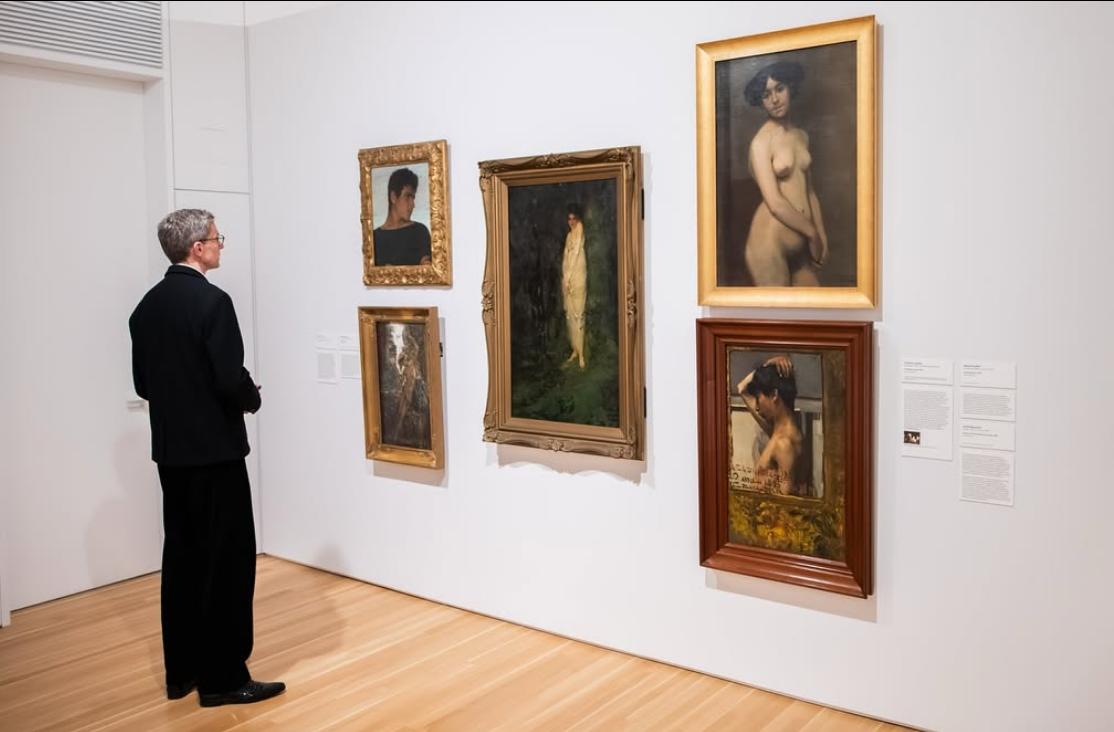
An artistic exhibition but also with a political reach. (Credit: @thefirsthomosexuals.)






In Chicago, there is a unique space known for its striking design by renowned Japanese architect Tadao Ando, who masterfully uses natural light. The space is also notable for its focus on engaging, thought-provoking art.
Staying true to its mission, Wrightwood 659 has opened its doors today (through July 26) to an exhibition that struggled to find a venue. Titled "The First Homosexuals: The Birth of a New Identity, 1869–1939," it explores the early stages of a still-controversial topic through over 300 works — paintings, drawings, sculptures, prints, photographs, and films — many being shown for the first time.
The exhibition features both well-known masterpieces and unexpected works by unknown or anonymous artists, drawn from over 100 museums and private collections worldwide. More than just an art display, the event is set "within the framework of a global reflection on ‘queer’ and colonial issues," says curator Jonathan Katz. A leading specialist in the field, Katz holds a chair in the history of art, sexuality, gender, and feminism at the University of Pennsylvania. He explains that he worked with a team of eleven experts from various countries over six years to create this installation.

The term "homosexual" created in 1869
Katz also emphasizes the date chosen as the starting point of this history, the year 1869, which is when the term "homosexual" was created by the Austro-Hungarian physician and sexologist K.M. Benkert (1824-1882). "Before the invention of the word homosexual," he explains, "this orientation was mentioned as such without relating to its personification.
Today, in the exhibition "The First Homosexuals, we recount how, after this turning point, members of this community were endowed with an identity specifying their sexuality. Which marginalized them."
A social differentiation that has been easier to convey through images rather than narration, as evidenced by the various themed sections of the exhibition that unfold a great evocative richness of artistic creativity. From the outset, the visitor goes back to the era known as "Before the binary," notably represented by Japanese erotic engravings illustrating how homosexual and heterosexual desires were not always perceived as opposed before the late 19th century.
The second important section, "Portraits," dedicated to the first "coming out," is devoted to artists and writers who openly displayed their homosexual identity. Among these works is the iconic portrait of Gertrude Stein by Félix Vallotton (1907), the only full-length portrait of Oscar Wilde painted during his lifetime, and a seldom-shown pastel sketch of the great French artist Rosa Bonheur by her companion Anna Klumpke. At the beginning of the 20th century, the "Public Affirmation" begins with young women dancing together by French painter Marie Laurencin and a canvas by the American-Norwegian painter Andreas Andersen, capturing an intimate moment between his brother and another man.
From the representation of ambiguous gender to defined bodies
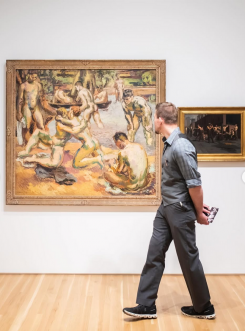
While 19th-century artists often represented adolescents with ambiguous gender, the 20th century saw the rise of well-defined bodies with a multitude of nudes of adult men and women.
With the advent of colonialism, European artists became curious about sexuality under other skies. Thus, it is learned that some had perceived homosexual desire as inherent to territories unknown to them. For their part, the artists, who had developed the Orientalist style, imagined especially the East as a place overflowing with forms of sexuality excluded in the West.
Finally, one discovers "Beyond the binary," one of the most in-depth explorations of homosexual and transgender identity, with a focus on eight paintings by the Baltic-German artist of the 40s, Elisàr von Kupffer, which have never been exhibited in the United States. In this group is a scene of a homosexual wedding, a first in art history. This artist, also a poet and playwright, was a pioneer of tolerance towards people of different orientations.
No discrimination
This exhibition suits this venue called Wrightwood 659, which defines itself as the result of a private and non-commercial initiative designed as an integral part of the cultural and civic fabric of Chicago. Its director, Lisa Cavanaugh, clarifies its path: "We are delighted to open a new space dedicated to art in Chicago, conducive to serene reflection and thoughtful engagement, while promoting activism for a more just society. We aim to host exhibitions generally alternating engaged art and exploration of the world of architecture and design."
To always remain available for any creativity, Wrightwood 659 does not possess collections, nor does it aim to become a museum, but a cultural opening without any discrimination.
This article was orginally published in French by L'Orient-le Jour.

 Evening recap: Netanyahu announces West Bank offensive; 7 killed in Jordan church shooting; tents burned in south Lebanon
 US strike on Iran this weekend? ‘Absolutely,’ says Barrack; ‘I have no idea,’ says Trump