


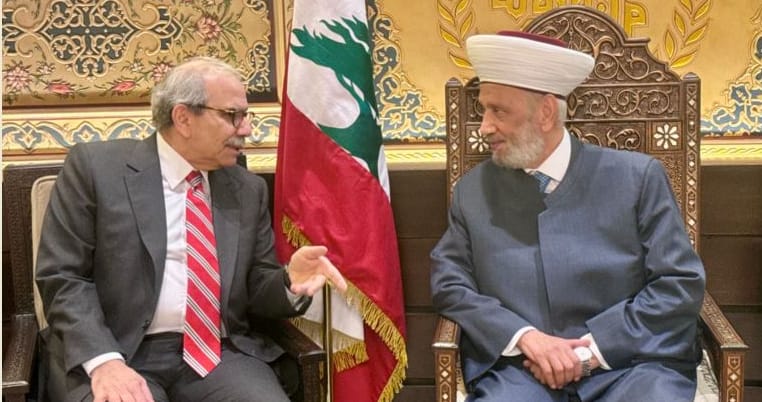
Prime Minister Nawaf Salam (L) meets with the Mufti of the Republic, Abdel Latif Derian, in Dar al-Fatwa on May 22, 2025. (Credit: National News Agency)






BEIRUT — In a meeting with the Mufti of the Republic Abdel Latif Derian in Dar al-Fatwa on Thursday, Prime Minister Nawaf Salam emphasized that “the government is making contacts, endeavors and diplomatic and political initiatives, both Arab and international, to stop the continued Israeli aggression against Lebanon," according to Dar al-Fatwa's media office.
"[Lebanon] will overcome the crisis it is going through with the solidarity of all its people," Salam added.
Despite a cease-fire agreement reached in late November 2024 that ended more than 13 months of war between Hezbollah and Israel, the Israeli army has been carrying out airstrikes on southern Lebanon on a near-daily basis and continues to occupy five areas inside Lebanese territory.
Last night, an Israeli drone targeted several prefab houses in Mhaibib, a village that had been partially razed by the Israeli army, which had detonated explosives to blow up the houses and streets, when it was still occupying parts of southern Lebanon.
Yesterday, drone strikes killed three in southern Lebanon, in Ain Baal, Yater and Aitaroun. The Israeli army said it had targeted an "engineer and expert in arms" for Hezbollah and a commander of its elite al-Radwan unit.
During his meeting with Derian, Salam also stressed during the meeting that “the government has made significant progress in tangible reforms that directly affect citizens in various fields, and it continues its reform efforts in the economic, living, social and developmental levels, especially by activating the state institutions that embrace everyone, based on the Taif Agreement and the constitution."
He explained that “Lebanon's relationship with its Arab brothers has begun to return to normal and is now at an advanced stage of cooperation and support for the good of the country.”
President Aoun and Salam’s government have been working to mend ties with the Gulf states after years of diplomatic strain, mainly linked to Hezbollah’s influence in Lebanon.
For his part, Derian expressed his keenness to “support the government and its president in its inclusive national work and the reforms it is carrying out,” calling for “more achievements that the Lebanese are waiting for, especially the speedy resolution of the issue of Lebanese and foreign detainees, especially Islamists, who have been held for a long time without fair trials.”
Prisons in Lebanon suffer from chronic overcrowding and often deplorable detention conditions. Many detainees languish in their cells for years awaiting trial. The protests for the release of the Islamist-affiliated detainees and general amnesty have intensified following the fall of the Assad regime in Syria and the rise to power in Damascus of a regime led by the former head of the rebel group Hayʼat Tahrir al-Sham (HTS).
Finally, Derian expressed his satisfaction with “the atmosphere that prevailed in the municipal elections in Lebanon, especially in Beirut, in terms of calm and democratic competition, through which all Lebanese expressed their will." He congratulated Salam on “his achievement and follow-up of this national entitlement and for his good management of the electoral process.”
The municipal elections, which are finally happening after three years of repeated postponement due to various circumstances, have already taken place in Mount Lebanon, northern Lebanon, Beirut and the Bekaa, with only southern Lebanon remaining.

 7 p.m. recap: Netanyahu seeks mastermind behind Flydubai incident; Washington sanctions 2 French nationals; Ben Gvir's 'I want to kill you' threat