






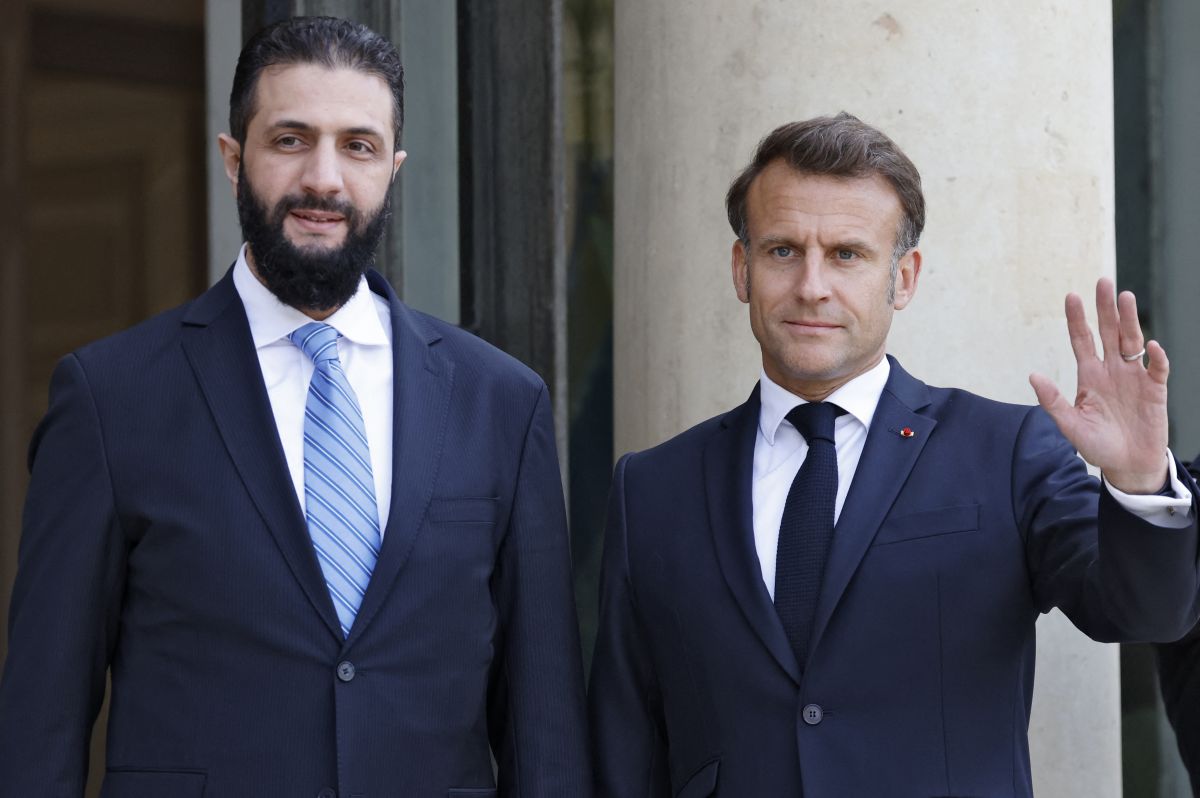
French President Emmanuel Macron (R) welcomes interim Syrian President Ahmed al-Sharaa upon his arrival for their meeting at the presidential palace of the Elysee in Paris, on May 7, 2025. (Credit: Ludovic Marin/AFP)






Emmanuel Macron on Wednesday welcomed Syrian President Ahmad al-Sharaa for his first visit to the West since he came to power at the head of an Islamist coalition following the fall of Bashar al-Assad in December. The French head of state greeted the Syrian transitional leader with a handshake in the courtyard of the presidential palace, AFP journalists reported. The two men are expected to hold a press conference following a meeting.
The French president is sharply criticized by the French right and far-right for inviting this man with a jihadist past. "Stupor and dismay" over this visit, reacted French far-right leader Marine Le Pen, describing the Syrian president as "a jihadist who went through Daesh and al-Qaida." "The red carpet of the Élysée will be stained with the blood of the victims of Islamic terrorism," added her ally, the very conservative deputy Eric Ciotti.
The head of the right-wing party Les Républicains, Laurent Wauquiez, denounced "a serious error," arguing that "you don't welcome leaders who are former terrorists, members of organizations that want to attack France." However, Xavier Bertrand, a former minister and member of the same party, said that "those who criticize Emmanuel Macron have not understood the role of the head of state."
'No complacency'
Massacres that claimed 1,700 lives, mostly Alawites, in March, recent fighting with Druze, and abuses documented by NGOs have raised doubts about the new authorities' ability, in power since the fall of Bashar al-Assad in December, to control some extremist fighters affiliated with them.
Several dozen members of Syrian religious minorities demonstrated in Paris on Wednesday, shouting "Jolani [Sharaa's former war name] get out! Get out of France, get out of Syria!" The protesters, from Alawite, Druze, Christian and Sunni communities, gathered at Place de la République under the Syrian flag. "Just because you changed your outfit doesn't mean you're someone respectable," said Issa Ali, president of the Franco-Alawite Collective organizing the demonstration.
But in receiving the Syrian leader, Macron hopes to help guide the transition towards "a free, stable, sovereign Syria respectful of all components of Syrian society," the French presidency told AFP on Tuesday.
The French presidency dismissed any "naivety," insisting on being aware of "the past" of some Syrian leaders and demanding that there be "no complacency" with "terrorist movements." The head of state will therefore ask his guest to "ensure that the fight against impunity becomes a reality" and that "those responsible for atrocities against civilians" are "brought to justice," added his entourage during a press exchange.
"Our request is for the protection of all civilians, regardless of their origin and religion," the same source insisted.
Lifting sanctions
"Not engaging in dialogue with these transitional authorities," would be irresponsible towards the French and, above all, it would pave the way for Daesh," said French Foreign Minister Jean-Noël Barrot. According to him, "the fight against terrorism, the control of migration flows, the control of drug trafficking," as well as "the future of neighboring Lebanon ... all this is at stake in Syria."
Since taking power, the Islamist coalition has tried to present a reassuring image to the international community, which urges it to respect freedoms and protect minorities.
At stake is the lifting of sanctions imposed on Bashar al-Assad's regime, which heavily weighs on the country's economy, weakened after 14 years of civil war. According to the U.N., 90 percent of Syrians live below the poverty line.
President al-Sharaa, formerly a rebel leader of the group Hay'at Tahrir al-Sham, derived from al-Qaida's former branch in Syria, is still targeted by a U.N. travel ban. Paris had to request an exemption from the United Nations to allow his visit.
However, while it supported the lifting of some EU sectoral sanctions and believes that punitive American measures "weigh on the transitional authorities' ability to embark on reconstruction and attract foreign investment," France believes the time is not yet right to remove the Syrian leader from the U.N. Security Council sanctions list.
