






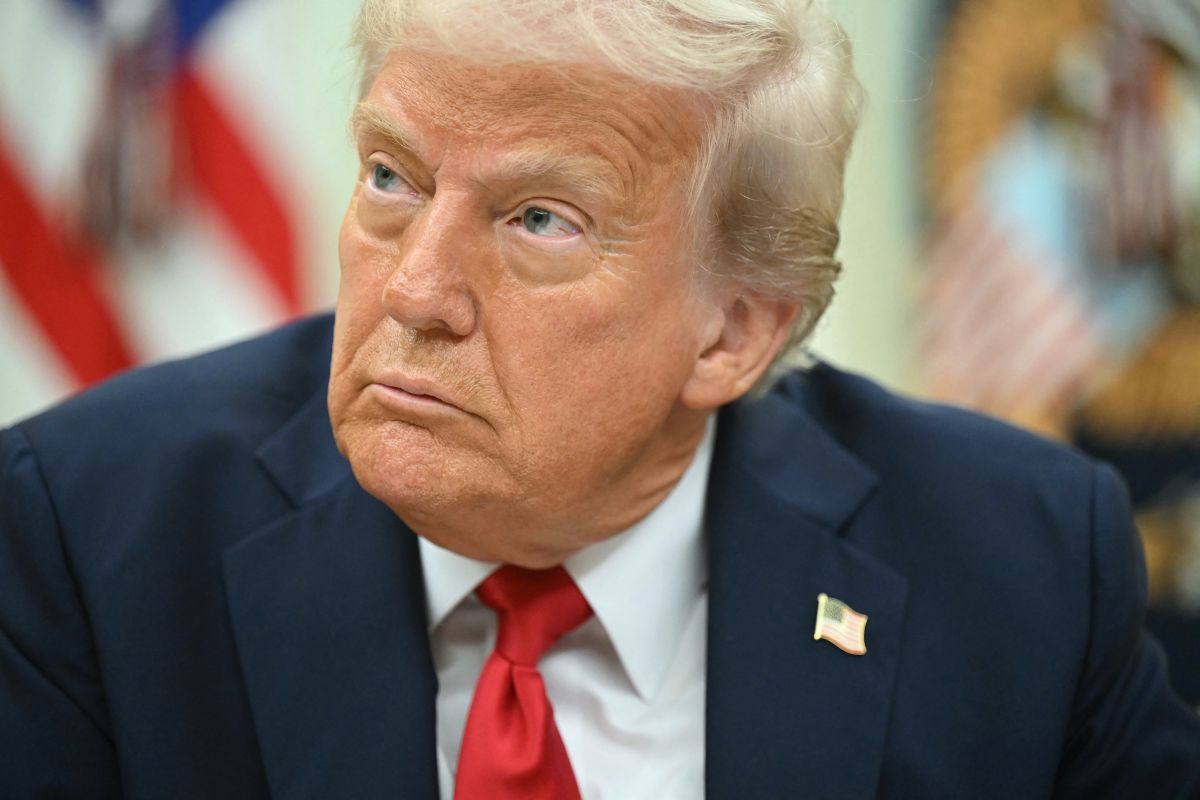
U.S. President Donald Trump speaks as he signs an executive order targeting the scalping of tickets in the Oval Office of the White House in Washington, DC, on March 31, 2025. (Credit: SAUL LOEB/AFP)






The United States' economic partners are preparing for the shock expected on Wednesday with Donald Trump's announcement of new tariffs, as he promised to be 'kind,' leaving uncertainty about the extent of this new phase in his trade war. Everyone is reviewing their options and waiting to know precisely what Trump will decide, who, true to his transactional and destabilizing approach, has sent mixed signals.
'Our countermeasures have been evaluated and analyzed, for example, how we would react to a 10% tariff or how we would react to a 25% rate,' summarized Taiwan's Minister of Economic Affairs Kuo Jyh-huei. 'All scenarios have been analyzed and evaluated to identify appropriate responses and determine the best way to help domestic industries.'
European Commission President Ursula Von der Leyen warned: 'We don't necessarily want to take retaliatory measures,' she said, 'but we have a solid plan to do so if necessary.' 'Europe will have to respond to be in a position of strength, synonymous with the power it can and must be,' said France's Foreign Trade Minister Laurent Saint-Martin.
Others have been more reassuring. Vietnam has reduced its tariffs on a range of goods to try to appease Washington. Japan announced the creation of a thousand 'consultation desks' to help businesses, while continuing its efforts to obtain an exemption for its country from Washington.
Mexican Minister Juan Ramón de la Fuente spoke by phone with U.S. Secretary of State Marco Rubio to request the maintenance of the North American Free Trade Agreement (NAFTA), binding the two countries and Canada, USMCA/ It frames one of the largest free-trade zones in the world, while Mexico and Ottawa are in Washington's crosshairs.
These stances attempt to respond to the ambiguity maintained by Donald Trump, including the timing of the announcement, which could come as early as Tuesday evening. 'We are going to be very nice,' assured the U.S. president on Monday, while promising that his initiative would allow a 'renaissance' of America.
Lower rates
Other countries 'have taken advantage of us, and we are going to be very nice, compared to what they have done to us,' Donald Trump added, assuring that U.S. tariffs would be 'lower,' and in some cases 'significantly lower' than those imposed by other states. He thus seems to downplay his threat of strictly 'reciprocal' tariffs, which would see the United States tax any imported merchandise in the same way that the country from which it originates taxes American products.
Asian and European stock markets, which fell sharply on Monday due to uncertainty, rebounded slightly on Tuesday, but investors remain on edge.
They 'prioritize risk management and will continue to adjust their exposure, waiting to have enough information about the tariffs,' says Chris Weston of the brokerage Pepperstone. 'You could call this the calm before what could be the sledgehammer blow of tariffs,' comments Stephen Innes, an analyst at SPI AM.
While awaiting the exact responses from different countries, Washington's assaults on the foundations of free trade are also pushing states to make strategic alignments to weigh against the world's leading power. Over the weekend, Beijing, Tokyo, and Seoul thus announced their intention to 'accelerate' their negotiations for a free trade agreement.
Automotive
Since returning to the White House in January, Donald Trump has already increased tariffs on some products entering the United States. He targeted those coming from China, some of those from neighboring Mexico and Canada, as well as steel and aluminum, regardless of their origin.
And reciprocal tariffs are not the last assault expected this week: as early as Thursday, at 04:01 GMT, Washington also plans to impose an additional 25% tax on cars manufactured abroad, as well as parts entering the vehicles assembled in the United States.
The fact that the United States imports more than it exports is an obsession for Donald Trump. It is the demonstration, according to him, that other countries abuse access to the American market without showing the same openness in their own. He also counts on the income from tariffs to reduce the budget deficit.

 8 p.m. recap: Israel again threatens Beirut’s south suburbs; 2 ships hit near Hormuz; Riyadh football matches canceled