





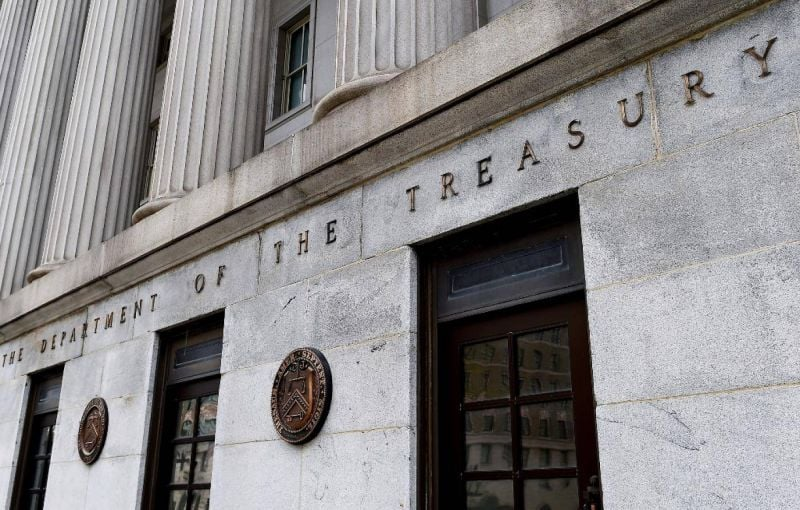
The facade of the U.S. Department of the Treasury in Washington. Illustration photo/AFP






BEIRUT — The U.S. government imposed new sanctions on Hezbollah on Friday, targeting five individuals and three entities linked to a Lebanese network accused of helping the group evade international sanctions. According to the U.S. Treasury, the sanctions aim to disrupt Hezbollah's financial operations, which include lucrative commercial projects and oil smuggling activities, often carried out in collaboration with Iran's Islamic Revolutionary Guard Corps (IRGC-QF).
In a statement, the Treasury detailed how Hezbollah's financial team uses front companies to generate millions of dollars in revenue, funneling funds to the group's operations. "The Hezbollah finance team manages a variety of lucrative commercial projects and oil smuggling networks, often in conjunction with Iran’s IRGC-QF, to generate and transfer revenue for Hezbollah," the Treasury explained.
Bradley T. Smith, Deputy Assistant Secretary of the Treasury for Terrorism, emphasized the U.S. government's resolve to expose and dismantle these funding networks. "Today’s action underscores Treasury’s determination to expose and disrupt the schemes that fund Hezbollah’s terrorist violence against the Lebanese people and their neighbors," Smith said. "These evasion networks strengthen Iran and its proxy Hezbollah and undermine the courageous efforts of the Lebanese people to build a Lebanon for all its citizens."
The individuals and companies designated today are part of a business network generating revenues and owned or controlled by Hezbollah. This network was overseen by senior financial officials of the party, including Mohammad Kassir, until his death in late 2024, as well as his son-in-law, Mohammad al-Bazzal, explained the Treasury.
The first person sanctioned is Rachid Kassem al-Bazzal, who "at the request of his brother, Rashid assumed leadership of Talaqi Group, Tawafuk, and Nagham al Hayat and took over the day-to-day operations of these companies, while Muhammad Qasim al-Bazzal remained in charge of the communications with Hezbollah," the Treasury's statement read.
The second person is Mahasin Mahmoud Murtada, widow of Qassir. "Prior to Qasir’s death, Murtada wielded influence over her husband on issues pertaining to Hezbollah operations including finances and weapons smuggling. She is also the registered owner of several companies associated with Hezbollah’s commercial investments," the U.S. Treasury accused.
The last person is Fatima Abdallah Ayoun, wife of Mohammad al-Bazzal, " with whom she works closely on various Hezbollah commercial projects, including the OFAC-designated Talaqi Group," the Treasury statement continued.
These individuals, along with Hawraa Abdallah Ayoub and Jamil Mohammad Khafaja, are accused of providing financial, material or technological support to Hezbollah. The sanctioned companies, some of which are linked to these individuals, include Ravee SARL, Lebanese United Group, Securol Glass Curtains and Ravee SARL.

 Midday recap: Hebron attack sparks Israeli crackdown, international meeting in Istanbul for regional 'de-escalation'