






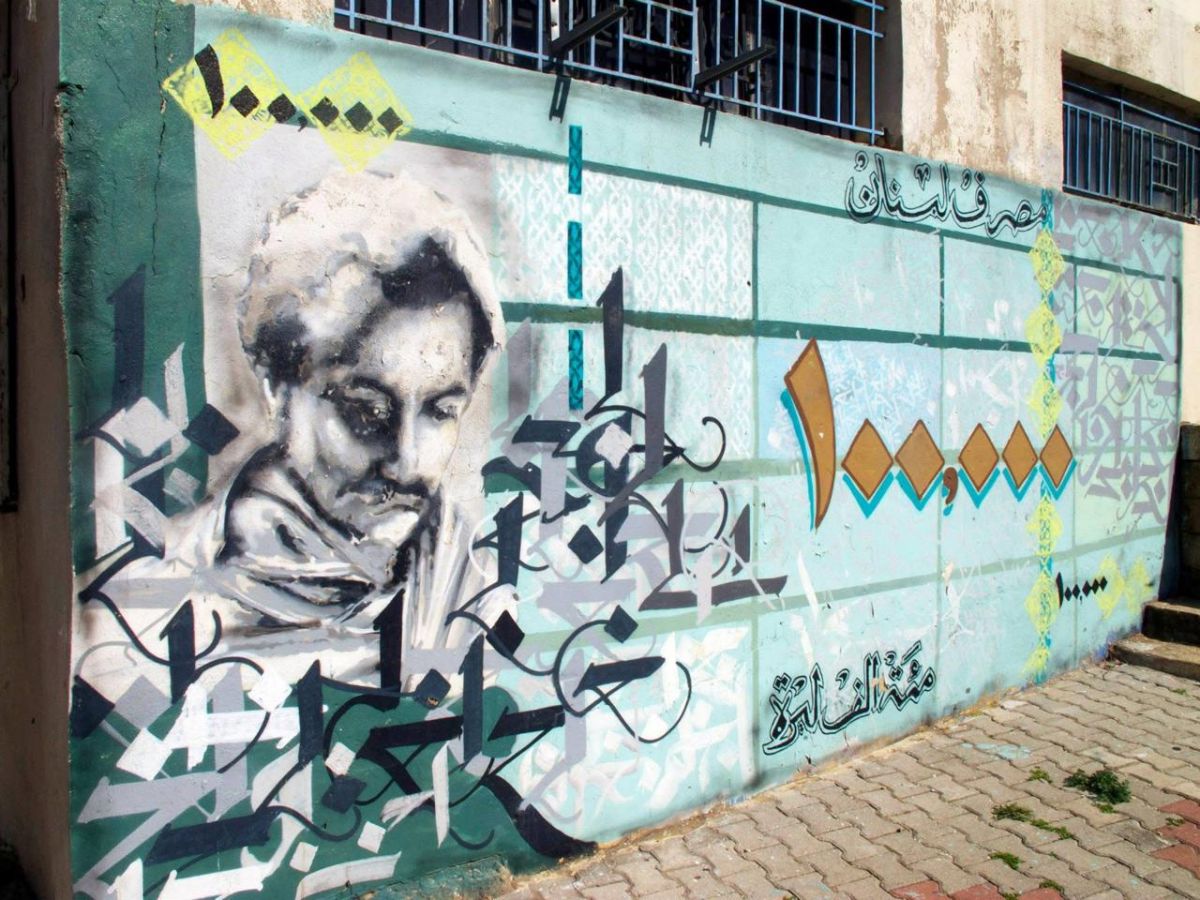
A mural depicting a stylized 100,000 Lebanese pound banknote in Achrafieh on Feb. 22, 2015. (Credit: Philippe Hage Boutros/L'Orient-Le Jour)






On the sidelines of the Cabinet meeting on Thursday, mainly focused on the appointment of a governor of the Central Bank (BDL), the Finance Ministry released a statement announcing two new features regarding the payment of income tax. The first relates to the digitization of the declaration and payment process and the second concerns the applicable tax brackets and family deductions.
Based on figures provided by the Institut des Finances Basil Fuleihan, this tax is expected to generate 9.7 percent of the total revenue expected by the state in 2025, according to forecasts in the finance law enacted by decree by the government of Nawaf Salam in early March. This proportion is up from 6.9 percent in 2024 but remains well below the revenue brought in by the VAT, which is around 30 percent.
Online forms
Regarding digitization, the ministry specified that three income declaration forms can now be completed online at the platform eservices.finances.gov.lb.
These are forms F1 (Personal Income Tax Declaration), F3 (for the statement of income and expenses of a business subject to flat rate income tax) and A49 (Declaration of the partner's share of profits and losses). Taxpayers who depend on these forms can also pay their taxes online on the same platform.
However, form F2 (Income Tax Declaration for individual businesses taxed on real income) is not yet accessible, although it is expected to be soon, along with the dedicated payment interface.
According to a ministry source not authorized to speak to the press, it is still possible to complete any of the forms mentioned on paper or pay this tax by visiting the ministry.
"Paper forms are relegated to the rank of major exceptions. Finance Minister Yassine Jaber in the government of Nawaf Salam has prioritized the digitization of tax administration services," accountant Nadim Daher, a member of the Lebanese Association for the Rights and Interests of Taxpayers (ALDIC), told L'Orient-LE Jour. "Entering the declarations takes too much time, and the ministry, which has lost a lot of human resources since the beginning of the crisis, must quickly update its figures in preparation for the 2026 budget and Lebanon's discussions with the International Monetary Fund."

Brackets and deductions
The ministry also published the applicable brackets for determining taxes on Industrial and Commercial Profits (BIC) and flat rate or real income from professionals for the year 2024, as well as family deductions. The amounts are slightly different from those in the 2024 budget.
"The ministry adjusted the amounts to account for the fact that the 2024 budget did not take effect until mid-February the following year. The first month and a half is therefore based on the deductions and brackets in force since the adoption of the 2022 budget (Lebanon did not vote on a budget in 2023). The planned deductions are thus a little less substantial." The 2025 budget did not modify the applicable brackets.
Regarding family deductions:
Individuals without children can now deduct LL 398,437,500 (a little over $4,450 converted at the rate of 89,500 LL per dollar) instead of LL 450 million on their taxable income ($5,027).
For married couples, this deduction is now LL 198,437,500 ($2,217) instead of LL 225 million ($2,514).
The deduction per child is LL 39,687,500 ($443) instead of LL 45 million ($502).
Regarding the brackets
Annual incomes below LL 475,875,000 (a little over $5,300) are taxable at 4 percent.
The bracket from LL 475,875,000 to LL 1,375,875,000 (nearly $15,400) is taxed at 7 percent.
The bracket from LL 1,375,875,000 to LL 3,175,875,000 (nearly $35,500) is taxed at 12 percent.
The bracket from LL 3,175,875,000 to LL 6,175,875,000 ($69,000 and fractions) is taxed at 16 percnt.
The bracket from LL 6,175,875,000 to LL 13,435,875,000 (a little over $150,100) is taxed at 20 percent.
Finally, all annual incomes above LL 13,435,875,000 are taxed at 25 percent.
This article was originally published in French in L'Orient-Le Jour.