






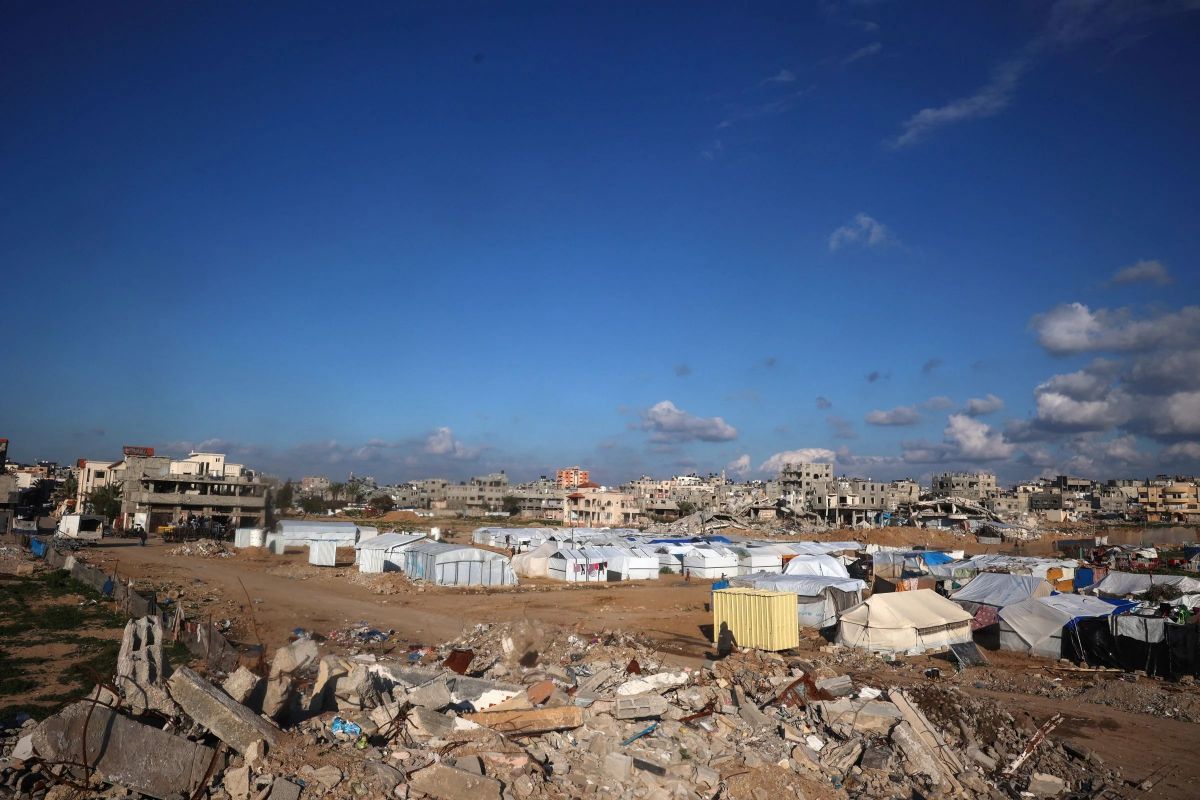
A photo shows a view of makeshift tent camps in the Bureij refugee camp in central Gaza Strip on the first day of the Muslim holy month of Ramadan, March 1, 2025. (Credit: Eyad Baba / AFP)






Israel on Sunday approved a U.S. proposal to extend the Gaza truce until mid-April, citing the lack of an agreement with Hamas to begin the second phase of the cease-fire as originally scheduled. That phase is meant to lead to an end to the war.
"Israel is adopting the plan proposed by President Joe Biden’s envoy, Steve Witkoff, for a temporary cease-fire covering Ramadan," which ends in late March, "and Passover," the Jewish holiday celebrated in mid-April, Prime Minister Benjamin Netanyahu’s office said in a statement published just after midnight (10:00 p.m. GMT Saturday).
Hamas, which has insisted that the second phase of the cease-fire must begin Sunday as scheduled, has yet to respond. Before the U.S. proposal was put forward, the Palestinian militant group reaffirmed its "commitment to implementing all remaining steps of the agreement" leading to a "comprehensive and permanent cease-fire, the full withdrawal of occupying forces from Gaza, reconstruction, and the lifting of the blockade."
Under Witkoff’s plan, "half of the hostages, both living and dead," would be released to Israel on the first day of implementation. The remaining hostages — alive or dead — would be released "at the end, if an agreement is reached on a permanent cease-fire," the statement from Netanyahu’s office added.
According to Netanyahu’s office, Witkoff formulated the proposal after determining that Israel and Hamas remained too far apart for an immediate breakthrough, and that additional time was needed for negotiations on a permanent cease-fire.
Israel, the statement said, is ready to begin "immediate negotiations on all details of the Witkoff plan" if Hamas changes its position and agrees to the framework.
The cease-fire agreement — brokered by the United States, Qatar and Egypt after months of negotiations — took effect on Jan. 19, halting the fighting after 15 months of war sparked by Hamas’ attack on Israel on Oct. 7, 2023. The agreement outlines three phases, each lasting 42 days.
Stalemate in negotiations
During the first phase, which saw multiple near-breakdowns, Hamas released 25 hostages and returned the bodies of eight others, while Israel freed approximately 1,800 Palestinian detainees. The second phase, originally set to begin Sunday, was supposed to secure the release of the remaining hostages and hundreds more Palestinian prisoners. The third and final phase is expected to focus on the reconstruction of Gaza.
Hamas has so far refused to negotiate anything other than the full implementation of the second phase, which it says must ensure a definitive end to the war and a withdrawal of Israeli troops from Gaza. Israel, however, has refused to commit to the second phase, preferring to extend the current phase with weekly hostage releases in exchange for Palestinian prisoners.
Israel demands the complete demilitarization of Gaza and the elimination of Hamas. The militant group, which has ruled the territory since 2007, insists on retaining power. The deadlock has raised fears of renewed fighting.
"It is imperative that all efforts are made to prevent a return to hostilities, which would be catastrophic," said Stephane Dujarric, spokesperson for U.N. Secretary-General António Guterres, on Saturday. "A permanent cease-fire and the release of all hostages are essential to prevent an escalation and further devastating consequences for civilians."
Hamas releases new video
Amid the ongoing impasse, Hamas’ armed wing on Saturday published a new video appearing to show a group of Israeli hostages in Gaza. AFP could not immediately verify the video’s authenticity. The footage shows three individuals with uncovered faces, two of whom appear to have been freed in February. A third hostage calls on the Israeli government in Hebrew to secure his release.
At the end of the video, a message warns that "only a cease-fire agreement will bring them back alive."
"Israel will not be intimidated by Hamas propaganda," Netanyahu’s office responded, calling it a "video in which our hostages are forced to recite a psychological warfare script."
The Oct. 7 attack killed 1,218 people in Israel, mostly civilians, according to an AFP tally based on official data. Israel’s retaliatory military campaign in Gaza has killed at least 48,388 people — most of them civilians — according to the Gaza Health Ministry, figures deemed reliable by the U.N. The war has also destroyed or damaged most buildings in the enclave, where the 2.4 million residents — nearly all displaced — live in dire conditions.
As Ramadan began Saturday, many in Gaza did not know what the next day would bring.
In Jabalia, one of the areas hardest hit by the war, volunteers hung strings of lights between bombed-out buildings as hundreds of people shared a meal prepared by aid workers.
"We will not leave this land. That is our message to the world," said 30-year-old Yasser Albas. "We will stay, even in the middle of the ruins, without water, without anything."
