


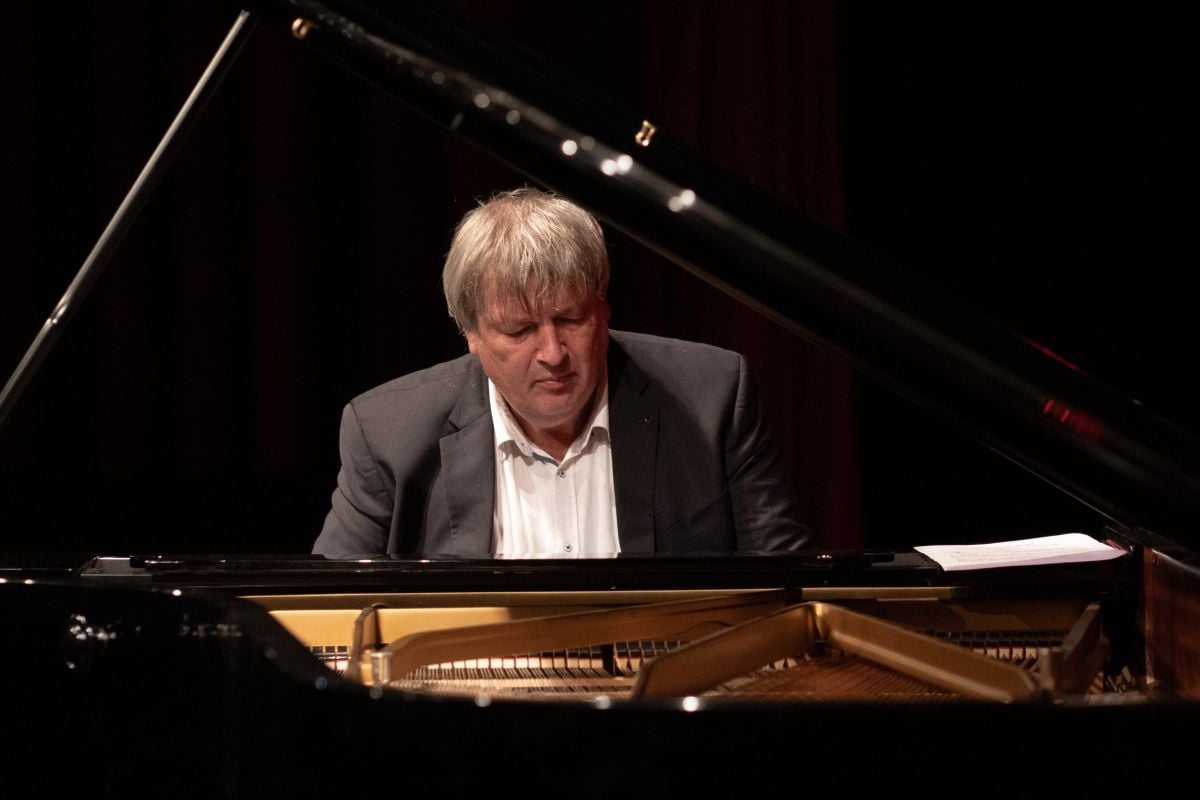
The Russian pianist Boris Berezovski at the al-Bustan Festival 2025. Photo courtesy of al-Bustan Festival.






Boris Berezovsky’s recital on Wednesday, Feb. 26, left a somewhat disappointing impression, largely due to an unexpected program change. Liszt’s Hungarian Rhapsody No. 2 was replaced by Chopin’s Scherzo No. 2, and Hungarian Rhapsody No. 12 was swapped for two Chopin études. Another anticipated piece, Mazepa, from Liszt’s Transcendental Études, was also omitted.
Beyond the altered program, Berezovsky’s interpretations of Beethoven’s Waldstein Sonata and Chopin’s Scherzo No. 2 fell short of expectations. When audiences attend a recital, it’s usually for the pianist, the program, or both — and in Berezovsky’s case, it was definitely both. The Waldstein felt rushed, while Chopin’s Scherzo was drowned in excessive pedal, leading to a muddled sound. The highest "F" notes were nearly imperceptible, especially in contrast with Canadian pianist Tony Yike Yang’s recent performance at Antonine University.
Yet, Berezovsky redeemed himself with a stunning performance of Liszt’s Mephisto Waltz, Ballade No. 2, and Hungarian Rhapsody No. 12. As a long-standing guest of the Bustan Festival, he once again displayed his love of playing — allowing his virtuosity to shine without losing the refinement and restraint that defines his artistry. If there is any critique to be made, it would be a wish for more of the “kitsch” that Liszt occasionally indulges in, which adds a certain spice to his Rhapsodies.
The pianist’s nobility and command returned in Chopin’s two études. His playing was generous, his phrasing robust, and his tone particularly rich in Ballade No. 2. Berezovsky is undoubtedly made for Liszt, and his interpretation of the Mephisto Waltz — though at times propelled more by nervous energy than internal tension — delivered beautifully nuanced middle sections that avoided any heavy-handed dramatization.
A second night with Debussy and jazz
Berezovsky returned to the stage last night with a different program, blending Debussy’s most classical pieces with jazz standards. He was accompanied by Vlad Botvinovskiy (accordion), Nidal Abou Samra (saxophone), Khachatur Savzyan (double bass), and Fouad Afra (drums).
The 31st edition of the al-Bustan Festival themed A New Dawn, runs until March 23, featuring twelve concerts. The next major event, Lebanon In a Song, takes place on March 2 and 3. This exclusive festival creation, in collaboration with Georges Khabbaz, will bring together oriental musicians under the direction of Lubnan Baalbaki for a deeply immersive musical journey into Lebanon’s rhythms and sounds.

 7 p.m. recap: 1 person killed near border with Lebanon; 200 kilos of explosives carried by mules; Riyadh shuts its airspace