


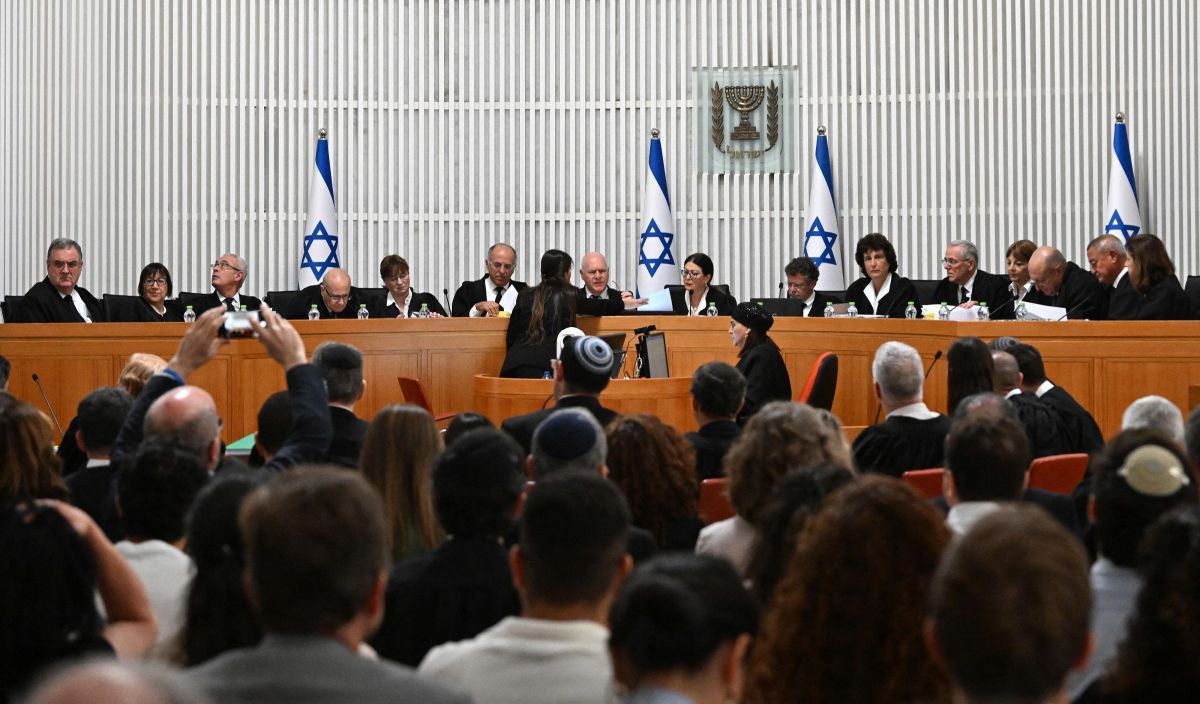
President of the Israeli Supreme Court Esther Hayut and all fifteen judges assemble to hear petitions against the 'reasonableness clause' at the court premises in Jerusalem, on Sept. 12, 2023. (Credit: AFP)






An Israeli judicial commission named a new Supreme Court president on Sunday, a decision swiftly rejected by the justice minister who has backed moves to limit the court's power.
"The committee decided to elect the Vice President of the Supreme Court, Judge Yitzhak Amit, to the position of president," the court said in a statement.
Justice Minister Yariv Levin challenged the appointment, labeling the election of Amit "illegal."
Although Levin chairs Israel's Judicial Appointments Committee, which selected Amit, he was absent during the vote.
Tensions between Levin and the Supreme Court date to early 2023, when he introduced a judicial reform plan that triggered massive street protests across Israel.
Opposition leader Yair Lapid called Amit's selection a "victory for democracy and proper governance" in a post on X.
In Israel, which has no formal constitution, the Supreme Court has the authority to nullify parliamentary laws it deems to be in violation of the country's Basic Laws.
However, Levin's proposals would have allowed parliament to reinstate laws struck down by the top court.
A key component of the controversial reform proposals included curbing the powers of what is known as the "reasonableness" clause, which would have allowed the parliament to overturn Supreme Court decisions by a simple majority vote.
The proposed reform seeks to curtail the Supreme Court's influence over Israeli politics, with the power of its judges at the center of the debate.
Another key element of the reform involved the judicial appointment process.
Currently, judges are appointed by a panel comprising judges, legislators and lawyers, under the supervision of the justice minister.
Levin, however, has said he aims to "end the election of judges by their peers" and proposes granting elected officials greater authority in these decisions.
The legislative process for the reform package was paused during the Gaza war since October 2023.
Levin has refused to confirm Amit, the most senior judge on the 15-member court, as president, citing his opposition to the reform plan.
 7 p.m. recap: Flames, smoke reported near Aramco site near Riyadh; Houthis accuse Saudi Arabia of 56 strikes on Sanaa