






The Israeli Broadcasting Corporation has reported that the Israeli army is preparing to prolong its occupation in southern Lebanon, with both UNIFIL and the United States having been notified of the plans, the U.K. based Middle East Eye reports.
According to the report, Israel has requested Washington’s approval to extend the military occupation in order to “destroy Hezbollah’s infrastructure.” The move is likely to escalate tensions, with critics warning it violates Lebanese sovereignty and risks further destabilizing the area.
Earlier today, Hezbollah warned against any attempt by Israel to extend the deadline of its withdrawal from Lebanese territory as outlined in the truce agreement. Israeli troops continue to occupy parts of the eastern and central sectors along the border, advancing into new areas, detonating buildings and laying waste to agricultural and residential areas.
Egyptian sources told Qatari channel al-Araby al-Jadeed that Steve Witkoff, President Trump's Middle East envoy, will head the international situation room in Cairo next Saturday to follow the implementation of the cease-fire agreement in Gaza, Haaretz reports.
The sources also said Witkoff would oversee the reopening of the Rafah border crossing next Sunday, and the beginning of the EU delegation's work there. The sources added that Egypt, Qatar and the U.S. will participate in administrative committees that will oversee the return of Palestinians northward through the Netzarim corridor.
Civil Defense search and rescue teams recovered two more bodies from under the rubble in Khiam, in Marjayoun district, where they have been working for more than a month to find dozens of missing residents killed in Israeli bombardment.
Since moving into areas where the Israeli army has withdrawn, and accompanied by the Lebanese Army, rescue teams have already found dozens of bodies — around 50 in Khiam alone — which were sent to local hospitals for DNA testing.
Read a full wrap up of today's events in southern Lebanon here. 👈
The Israeli government said the cease-fire deal with Hezbollah was not being implemented fast enough, three days before the deadline of the Israeli army's withdrawal and the completion of the cease-fire's terms.
"There have been positive movements where the Lebanese Army and UNIFIL have taken the place of Hezbollah forces, as stipulated in the agreement," Israeli government spokesmen David Mencer told reporters, cited by Reuters.
"We've also made clear that these movements have not been fast enough, and there is much more work to do," he said, affirming that Israel wanted the agreement to continue. Mencer did not directly respond to questions about whether Israel had requested an extension of the deal or say whether Israeli forces would remain in Lebanon after the 60-day deadline. Three diplomats said it looked like Israeli forces would still be in some parts of southern Lebanon after the 60-day mark.
Jordan could not afford another war in the neighboring Israeli-occupied Palestinian West Bank, the country's foreign minister, Ayman Safadi, told the World Economic Forum in Davos earlier this evening.
The Israeli army launched a large-scale military operation against the city of Jenin in the West Bank on Tuesday, displacing more than 2,000 families, bulldozing roads and besieging two hospitals. At least 12 people have been killed and dozens injured. On Thursday, hundreds more were reported fleeing their homes, which the Israeli army had begun to set fire to.
Hezbollah "will not accept any violation" of the cease-fire agreement with Israel, the party said in a statement released this evening.
There is much uncertainty among diplomatic circles regarding Israel's ability and willingness to adhere to the terms outlined in the agreement, which dictates that its army must be completely withdrawn over the Blue Line that demarcates Lebanese territory by Jan. 26. Israeli troops, however, continue to occupy and advance into eastern and central sectors along the border.
In early January, the Israeli army radio reported that Israel was expected to inform the U.S. it would remain on Lebanese territory after the 60-day period, and in late-December, sources in the Israeli army told Haaretz the same thing — that its troops would stay in southern Lebanon, hinging on whether the Lebanese Army "meets its obligations" of replacing Hezbollah there.
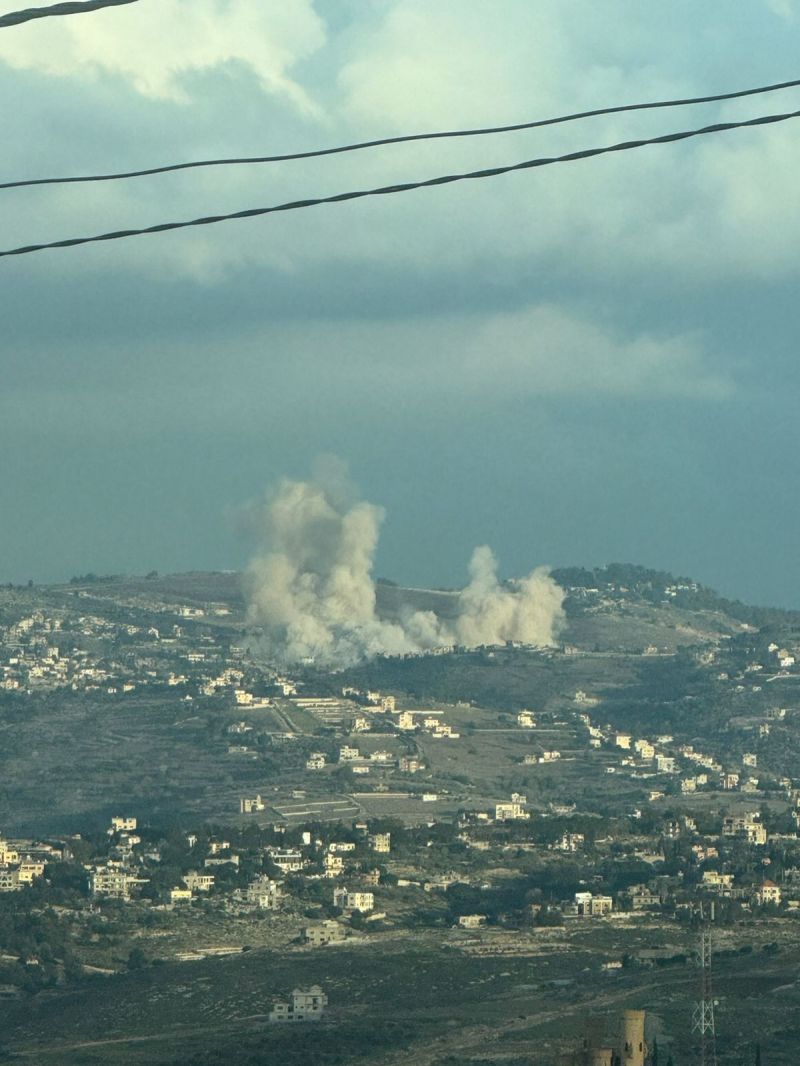
(Courtesy of Muntasser Abdallah/L'Orient Today)
A large explosion was carried out by the Israeli army in the town of Houla (Marjayoun), destroying facilities related to the 800 Water Line project near the main road, local residents reported.
The Israeli army's Arabic spokesperson, Avichay Adraee, said that Israeli forces confiscated and destroyed weapons belonging to Hezbollah in southern Lebanon.
Adraee said that forces of Brigade 7, commanded by the Galilee Division (91), "found large quantities of weapons, including Kornet rockets, bombs and Kalashnikov rifles," all of which were confiscated or destroyed.
"Troops also found several underground tunnel routes that were used as shelters and weapons storage sites for Hezbollah," he added in a statement published on X.
At least two people have been killed and 120 bodies recovered from previous attacks in Gaza in the past 24 hours, according to the enclave’s Health Ministry.
It also said Gaza’s hospitals received 306 injured people in that period.
The announcement raised Gaza’s total death toll to 47,283. Israel’s war on Gaza injured a total of 111,472 Palestinians, the ministry added.
The Norwegian Refugee Council (NRC) has expressed “alarm” at the escalating violence in the occupied West Bank, since the cease-fire in Gaza came into effect last week.
“We are seeing disturbing patterns of unlawful use of force in the West Bank that is unnecessary, indiscriminate and disproportionate. This echoes the tactics Israeli forces have employed in Gaza,” said Angelita Caredda, NRC’s Middle East and North Africa regional director, in a statement.
“Under international law, Israel must bring its occupation of Palestinian territory to an end as rapidly as possible. Until then, it must fully comply with its obligations as an occupying power, including the protection of civilians.”
Israeli forces have shut off electricity in West Bank’s Jenin refugee camp and some surrounding areas, according to Jenin Governor Kamal Abu al-Rub.
Speaking to the Wafa news agency, al-Rub said the outage extends to Jenin Hospital and the Ibn Sina Specialized Hospital, jeopardising their emergency operations.
Currently, the hospitals are trying to use fuel reserves and bring in more fuel to keep power on in their emergency, dialysis, and nursery departments, said al-Rub.
A first Turkish Airlines plane landed at Damascus international airport on Thursday, after 13 years of interruption, an AFP correspondent reported.
The plane arrived from Istanbul with 345 passengers and humanitarian aid on board, including Turkish Airlines CEO Bilal Eksi and Turkish officials.
“The first Turkish Airlines passenger plane landed at Damascus International Airport after a hiatus of about 13 years, with Syrian passengers on board,” reported the official Syrian news agency Sana.
Parliament Speaker Nabih Berri is currently meeting with the head of the cease-fire monitoring committee, U.S. General Jasper Jeffers, in the presence of U.S. Ambassador to Lebanon Lisa Johnson.
The Israeli army blew up all the tourist parks built on the banks of the Wazzani River today before noon, residents and witnesses in the area told our correspondent.
They said that explosions were heard and columns of smoke rose from the area where the parks are located.
They added that the detonation process lasted for more than an hour.
More than 11 parks are built on the banks of the Wazzani River adjacent to the Lebanese-Israeli border.
A big explosion, carried out by the Israeli army, has been heard in Mais al-Jabal (Marjayoun district), according to our correspondent in the South.
Several Lebanse Army vehicles have been stationed at the entrance of Aita al-Shaab (Bint Jbeil district) from the direction of the village of Rmeish, according to our correspondent in the South.
The mayor of Naqoura, Abbas Awada, told our correspondent in the South that the Lebanese Army allowed residents of Naqoura to enter the town for only four hours today just to inspect their properties.
Awada explained that the decision to enter for only four hours is to prepare the conditions and atmosphere for a proper return, which have not yet been met.
The municipality, with the support of the Lebanese Army, is now opening the roads inside the town.
He finally said the residents are awaiting a final decision from the Lebanese state regarding their return.
Hundreds of people visited the site where Hamas leader Yahya Sinwar was killed by the Israeli military since the Gaza cease-fire began on Sunday, according to Emirati newspaper The National News.
Sinwar was killed by the Israeli army on Oct. 16 last year in the Tel Al Sultan neighborhood in Rafah.
According to The National News, the "house where Sinwar spent his final moments, now a pile of rubble, is being seen as a symbol of honor and defiance, with some residents already starting to call the area Tel al-Sinwar as a tribute to his legacy."
"I am so proud that Sinwar was martyred in my house,” said Ashraf Abu Taha, a 52-year-old who fled his home when Israeli troops invaded the city in May.
“I plan to turn the house into a shrine to honor his memory. I’m thinking of rebuilding it and dedicating a special room as a museum, showcasing the items Sinwar used during his last moments," Abu Taha said.
Khiam residents are arriving at the Lebanese Army checkpoint at the northern entrance to their town to return after the Israeli army's withdrawal, our correspondent reported.
A similar scene is taking place on the road to Naqoura (Sour district).
According to our correspondent, four Israeli tanks, a bulldozer and personnel carriers are advancing into the Ras al-Dahr district, west of Mais al-Jabal (Marjayoun district).
A senior Israeli army officer, quoted by Haaretz and The Times of Israel, claimed that 13 "militants" were killed during the Israeli operation in Jenin, in the occupied West Bank.
Hundreds of people fled the Jenin refugee camp in the occupied West Bank after evacuation orders by the Israeli army were broadcasted on Thursday, the city's governor told AFP, on the third day of a military operation.
“Hundreds of camp residents began to leave after the Israeli army, via bullhorns attached to drones and military vehicles, ordered them to evacuate it,” said Governor Kamal Abou al-Roub.
According to our correspondent in the South, the Israeli army is demolishing buildings in agricultural areas in the Maysset sector in Wazzani (Marjayoun district).
- Wednesday evening, around 9 p.m., the Israeli army detonated two powerful explosions on the western outskirts of the village of Mais al-Jabal in the district of Marjayoun, according to our correspondent in southern Lebanon.
- Also in the district of Marjayoun, Israeli forces demolished more than three houses in the Deir Mimas area, near the locality of al-Khalla, just a few kilometers from the Lebanese-Israeli border.
- This morning, the Israeli army set fire to a house in the eastern neighborhood of the locality of Kantara, about nine kilometers west of the Blue Line, near Taybeh (both in the district of Marjayoun).
- Meanwhile, residents of Naqoura (in the district of Sour) are expected to return to their village early in the day.
Outgoing Israeli Ambassador to the United States Michael Herzog said Israel is in talks with the Trump administration to extend the Israeli army's presence in southern Lebanon beyond the Sunday deadline set by the cease-fire agreement, Haaretz reported.
"The agreement included a 60-day timeline for the withdrawal [of the Israeli army] from southern Lebanon and for the Lebanese Army to take its place, but this timeline is not set in stone and was formulated with some flexibility," Herzog told Israel Army Radio.
"We are in discussions with the Trump administration to extend the time necessary to allow the Lebanese Army to truly deploy and fulfill its role under the agreement. These talks are ongoing. The incoming administration understands our security needs and position, and I believe we will reach an agreement on this matter," he said.
Swiss prosecutors said on Wednesday they were investigating several complaints against the country's visiting Israeli president, Isaac Herzog, accused by NGOs of “incitement to genocide” in connection with the war in Gaza.
The Swiss Federal Prosecutor's Office (MPC) confirmed in an e-mail to AFP that it had received “several criminal complaints” against Herzog, who this week took part in the annual meeting of the World Economic Forum in the luxury Swiss ski resort of Davos.
“The criminal complaints are being examined in accordance with the usual procedure,” said the Public Prosecutor's Office, without divulging the details of the complaints, specifying that it was in contact with the Swiss Ministry of Foreign Affairs to "examine the question of the immunity of the person concerned."
Palestinian media have reported that Hussein Fayad, commander of Hamas's Beit Hanoun battalion whom the Israeli army claimed to have killed in May 2024, appears to be alive and well, speaking at a funeral in the northern Gaza Strip, as shown in a video posted online.
U.S. President Donald Trump signed an executive order to reclassify Yemen's Houthi rebels as a "foreign terrorist organization," the White House announced Wednesday.
The designation had been removed by Democratic President Joe Biden shortly after his election in 2020. A year later, Biden reclassified the Houthis under a less severe category as a "specially designated global terrorist" entity, citing the need to maintain the flow of humanitarian aid to the war-torn country.
Israeli Defense Minister Israel Katz justified the operation in the Jenin refugee camp as part of a "shift in the security approach" of the army in the West Bank: "We will decisively strike the tentacles of the octopus until they are severed."
Prime Minister Benjamin Netanyahu framed the operation within a broader strategy targeting Iran, "wherever it sends its weapons — Gaza, Lebanon, Syria, Yemen, and the West Bank."
France expressed "deep concern over escalating security tensions" in the West Bank and urged "Israeli authorities to exercise restraint," according to a statement from its Foreign Ministry.
Gaza's Health Ministry reported yesterday that 59 bodies and 273 injured individuals were brought to hospitals over the past 24 hours. This brings the total death toll in Gaza to 47,161 killed, and 111,166 injured, since the start of the war. Thousands remain missing.
As the Gaza cease-fire entered its fifth day, U.S. Secretary of State Marco Rubio pledged "unwavering support" for Israel amid the fragile truce and the ongoing Israeli military operation in Jenin.
During heavy gunfire in Jenin, Rubio spoke with Israeli Prime Minister Benjamin Netanyahu to "underscore that maintaining unwavering U.S. support for Israel is a top priority for President Donald Trump," said State Department spokesperson Tammy Bruce.
Rubio also "congratulated the Prime Minister on Israel's successes against Hamas and Hezbollah and vowed to work tirelessly to help secure the release of all hostages still held in Gaza," she added.
Israel and Hamas began implementing a cease-fire in Gaza on Sunday after 15 months of conflict. The agreement includes a prisoner and hostage exchange.
Initially outlined in May by Joe Biden and finalized through joint efforts with Trump’s diplomatic teams, the agreement marks a fragile step toward de-escalation.
The newly inaugurated President Trump expressed skepticism on Monday, saying he was "not sure" the Gaza cease-fire would hold.
One of President Trump’s first decisions was to lift sanctions imposed by Joe Biden on extremist Israeli settlers in the West Bank. These settlers had faced sanctions due to attacks against Palestinians.
In 2020, during his first term, Trump proposed the "deal of the century" for the Israeli-Palestinian conflict, which included Israel annexing parts of the West Bank. The plan never materialized, but Trump's return has reignited the debate on this sensitive issue in Israel.
Following Trump’s inauguration and two days after a Gaza cease-fire took effect, the Israeli army launched an "anti-terrorist operation" in Jenin, northern West Bank.
"The situation is very difficult. The occupation army has bulldozed all roads leading to Jenin camp and the hospital," said Jenin’s governor, Kamal Abu Rub, to AFP. "There are gunfire and explosions. A plane is flying overhead," he added, mentioning numerous arrests.
The Israeli army reported that it had "struck over 10 terrorists" during the operation.
The latest casualty figures from Israel's "Iron Wall" operation as of Tuesday night reported 10 killed and 35 injured, according to the Palestinian Health Ministry.
In recent months, operations have disrupted neighborhoods, with some roads destroyed by Israeli bulldozers to neutralize explosives. An AFP journalist observed a video surveillance system installed on a Jenin street, with dozens of residents passing by and some detained by Israeli forces.
Qatari channel Al Jazeera reported that its journalist Mohammed Al-Atrash was arrested at his home by Palestinian authorities "to prevent him from covering the Israeli operation."
Good morning. Thank you for joining us for our live coverage of the cease-fires in Gaza and Lebanon and the events in the region.
Make sure to read today's Morning Brief to get caught up.
Contacted by L’Orient Today, the United Nations Interim Force in Lebanon (UNIFIL) confirmed that two soldiers from the Finnish contingent were "slightly injured" on Wednesday afternoon at 1:50 p.m. by an "explosion most likely related to a controlled demolition near Markaba," in the district of Marjayoun. "In addition to these injuries, a U.N. vehicle was significantly damaged. We reiterate the importance of the parties ensuring the safety and security of U.N. personnel and premises," read a statement from UNIFIL spokesperson Andrea Tenenti.
Already have an account? Login here
You have reached your article limit
Stay informed about a Middle East in crisis.
Subscribe now and save 30%: just $8.9/month instead of $12.9.
This article is only available to L’Orient Today subscribers.
Already have an account? Login here
