






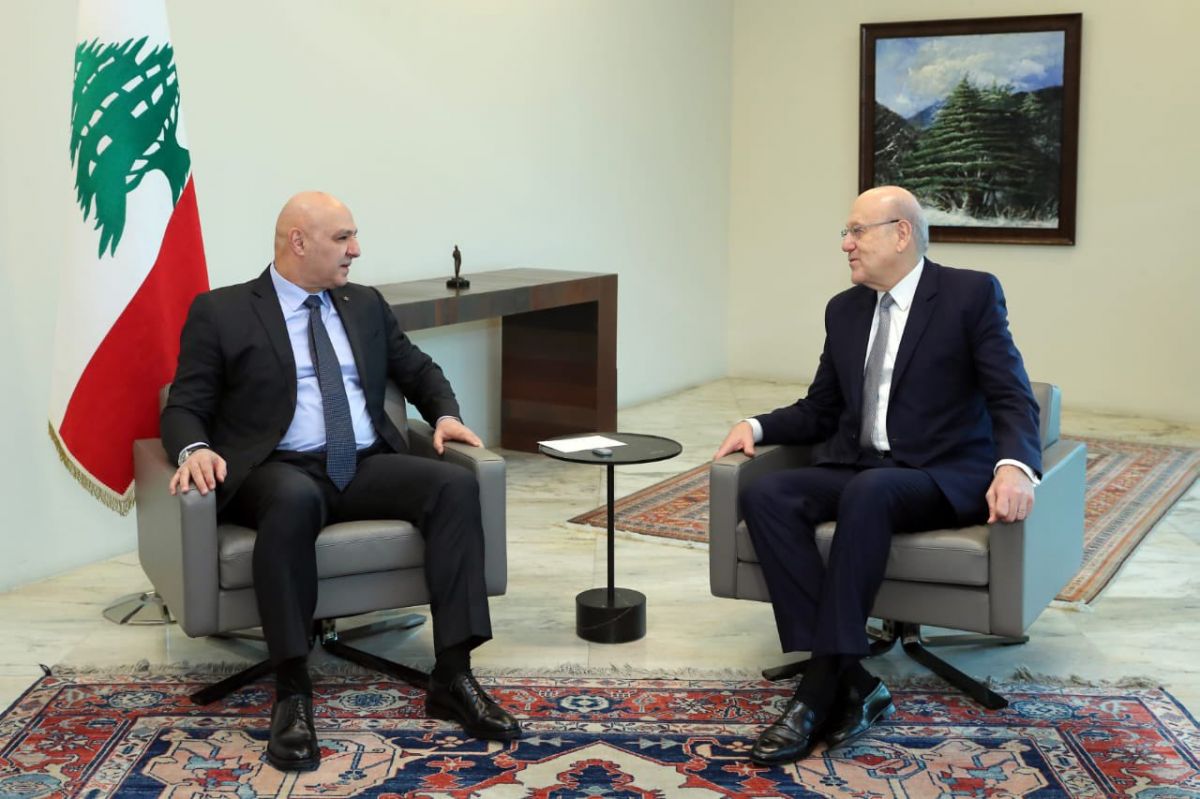
The Lebanese President Joseph Aoun (left) receiving the outgoing Lebanese Prime Minister, Nagib Mikati, in Baabda, on Jan. 10, 2025. (Credit: X/LebanesePresidency)






BEIRUT — Newly elected President Joseph Aoun started his time in office with a packed schedule: a meeting with the head of the resigned government, Najib Mikati, at the to start the day off, and another with the Maronite patriarch, Bechara Rai, late afternoon, and in between, meetings with the first two representatives of foreign countries, Cypriot President Nikos Christodoulidès and Italian Foreign Minister Antonio Tajani.
By the end of the day, Baabda Palace released a statement detailing Aoun's first decision as head of state, when he announced setting Monday as the date for binding parliamentary consultations, with the aim of appointing a new prime minister.
These consultations will take place with various parliamentary groups and deputies, who will share their positions regarding who they would like to see preside over the future government. The discussions are meant to end with the designation of a new prime minister. Aoun's first meeting on Monday will be with Speaker of Parliament Nabih Berri.
As for Friday, Aoun's first full day as president, and his initial meeting with Mikati included discussions about “the situation in the South and the need for the Israeli enemy to withdraw” from Lebanese territory and “cease its violations” of the cease-fire, Mikati later told the press. “We are facing a new challenge to save Lebanon,” the caretaker prime minister said.
New phase, particularly in southern Lebanon
Referring to the president's declaration concerning the state's monopoly on arms and the full implementation of U.N. Security Council Resolution 1701, Mikati stated: "Do we expect the president to say that weapons should be available to everyone?"
"We are today on the verge of a new phase, which is especially beginning in southern Lebanon, particularly south of the Litani, where all weapons will be withdrawn," he asserted. "It is necessary to remove the weapons and ensure the presence of the state throughout the Lebanese territory, restoring stability, starting with the South."
"President Aoun has requested the government to continue managing current affairs until a new Cabinet is formed," he added. He clarified that since Michel Aoun's term ended on Oct. 31, 2022, "the Cabinet has met 60 times, adopted more than 1,211 decisions, and issued over 3,700 decrees."
"All the measures we took aimed to maintain the functioning of the state and manage its affairs," he said, while some political factions, notably the Free Patriotic Movement, accused Mikati of overstepping his prerogatives by making decisions that would have required a sitting president.
The 'efforts' of the Mikati government
Mikati's government has been considered 'caretaker' since the legislative elections of May 2022. After the elections, Mikati was once again appointed Prime Minister by the then head of state, Michel Aoun, but both failed to agree on the formation of a new ministerial team. At the end of his presidential term, the Cabinet remained in charge of current affairs, awaiting a new head of state and the initiation of a new procedure for appointing a Prime Minister.
For his part, President Aoun thanked Mikati for his efforts and those of his government during the presidential vacancy, asking him, as mentioned by Mikati, to continue managing current affairs until the establishment of a new ministerial team.
Prior to the consultations, initially non-binding, then binding, that the new president will lead parliamentary groups to designate the future president of the Cabinet, Aoun must meet with the mufti of the Republic, the spiritual leader of the Sunni community in Lebanon, Abdellatif Deriane, and the Saudi ambassador to Beirut, Walid Boukhari.
EU support
Joseph Aoun also received his predecessor, Michel Aoun, and his Cypriot counterpart, Nikos Christodoulidès, the first head of state to visit him. According to a statement issued by Baabda, the Cypriot president assured Joseph Aoun of his country's support for Lebanon “in all fields,” and expressed his willingness to strengthen bilateral cooperation. He also invited the Lebanese president to visit Cyprus “when he deems it possible,” and announced his intention to invite him to the Council of Europe meeting next March.
The speakers of parliament of the 46 member states of the Council of Europe, as well as those of several partner and observer countries, are due to meet in Strasbourg on March 20 and 21, 2025, for a major European parliamentary summit. Aoun expressed his gratitude for “the Cypriot President's visit on the second day of his presidency,” which he described as a message of hope for all Lebanese. He also addressed Lebanon's needs in various areas, including economic support and assistance for the Lebanese armed forces.
The situation in South Lebanon was at the heart of the discussions, as was the importance of increased European support, “once the government is formed and has started work.”
The head of Italian diplomacy
The Italian foreign minister met with Aoun on Friday along with his Lebanese counterpart. "This election is a fundamental and very important step, not only for Lebanon but also for the Middle East region,” Antonio Tajani said during the meeting, according to a Baabda Palace statement.
“It is crucial to have a Lebanese president with wisdom and credibility for the security of the region," he added. "The cease-fire, after the war that caused so much damage in Lebanon, must be strengthened, and Italy will play a key role, not least through UNIFIL.” Tajani also stressed that this election represents a “guarantee for the stability of Lebanon, which is essential for Italy,” and that it could serve as a basis for strengthening bilateral cooperation. “Lebanon will now be able to play the role it deserves in this Mediterranean region, and Italy will continue its mission to support the Lebanese Army.”
On the sidelines of the visit, Italy's prime minister, Giorgia Meloni, also expressed her support for Aoun: “I am convinced that President Aoun will be a trustworthy and authoritative leader for Lebanon, a nation that is a friend of Italy and to which we are linked by deep historical ties,” she is cited as saying in a statement.
Visit to Bkerkeh
At the end of the day, Aoun went to Bkerkeh for talks with the Maronite Patriarch Bechara Rai. According to a Bkerkeh press release, the patriarch congratulated the new president on his election and called on him to achieve the objectives he listed in his speech on Thursday, in which he announced a “new era for the country.”
“The Lebanese people's joy at your election reflects their confidence in your personality on the one hand and your national positions which they have experienced in the various tasks you have been given, particularly during your command of the army,” Raid said.
The new president also received numerous messages of congratulations. From Lebanon, he was congratulated by former Head of State Michel Sleiman, Marada leader and former presidential candidate Sleiman Frangieh, and the Mufti of the Republic Abdellatif Deriane. On the international scene, Jordanian King Abdullah II and Palestinian President Mahmoud Abbas have also contacted him to congratulate him, and he has received messages from King Salmane of Saudi Arabia, his son Crown Prince Mohammad ben Salmane, and Algerian President Abdelmadjid Tebboune.
Finally, Kataeb party leader Sami Gemayel hailed Joseph Aoun's election as “a new page in Lebanon's history,” describing his inaugural speech as “unprecedented,” in which he spoke out strongly of the state's monopoly on arms.
