






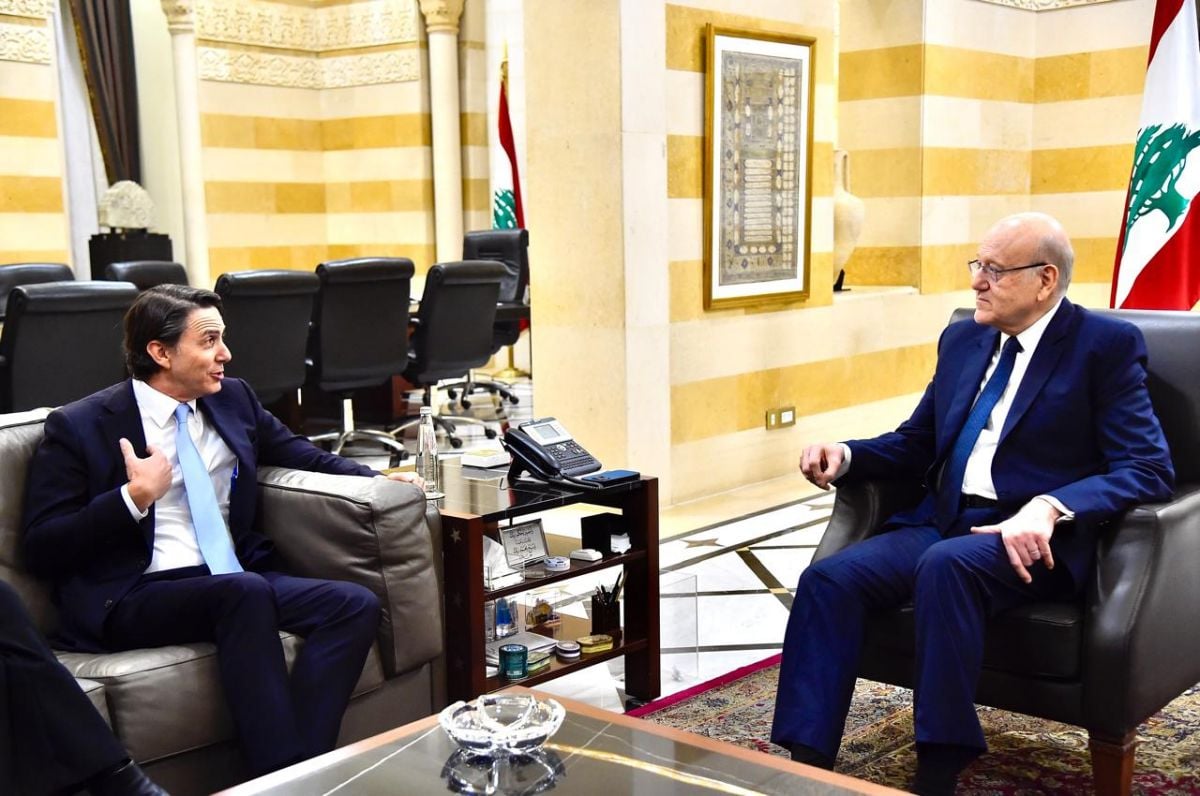
Amos Hochstein (on the left) speaking with the Lebanese Prime Minister at the Grand Serail on Jan. 6, 2025. Photo sent by our correspondent Hoda Chedid.






During the few hours he spent in Lebanon on Monday, American envoy Amos Hochstein met with several Lebanese leaders to discuss the still precarious situation in southern Lebanon and the presidential election, set for Jan. 9.
After his meeting with caretaker Prime Minister Najib Mikati at the Grand Serail on Monday evening, Hochstein reiterated his assurances of a total Israeli withdrawal from southern Lebanon. "With the Prime Minister, we discussed what the government must do to implement this (cease-fire) agreement to ensure the country can benefit from it to regain prosperity and stability," he said.
"These Israeli withdrawals will continue until the Israeli forces have completely left Lebanese territory," he insisted.
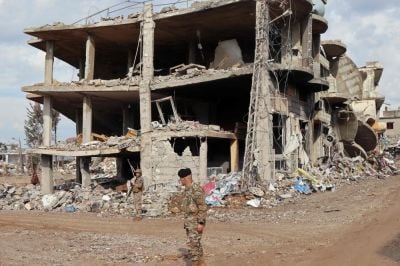
The war between Israel and Hezbollah began on Oct. 8, 2023, until the cease-fire came into effect on Nov. 27, 2024, with a drastic escalation during the last two months. Since the cease-fire, Israeli violations have not stopped. The Israeli army's retreat from Naqoura is their second in southern Lebanon, knowing that the U.N. peacekeepers and Mikati called on the Israeli army at the end of December to accelerate its departure.
The Lebanese Army announced Monday that "military units had taken positions around the locality of Naqoura (...) and began deploying in coordination with the United Nations Interim Force in Lebanon (UNIFIL)," whose HQ is in this village. A deployment "parallel to the withdrawal of the Israeli enemy," according to the Lebanese Army, coincided with "a meeting of the committee of five" responsible for supervising the cease-fire, attended by Hochstein.
The Israeli army told AFP that it "operated according to the directives of the political echelon" and that it is committed to what has been agreed upon concerning the cease-fire conditions.
A "clear timetable" for Israeli withdrawal
For his part, Mikati reiterated on the sidelines of his meeting with Hochstein "the demand for an end to Israeli violations in southern villages, and the systematic destruction of houses and structures, as well as the overflight of Lebanese airspace."
He requested "a clear timetable of the Israeli withdrawal before the end of the 60-day period," and expressed his "firm rejection of any mention of Israel's intention to extend" the period for implementing the cease-fire modalities, particularly concerning its withdrawal.
"I have no reason to think that all parties, truly all, will not remain committed to implementing the agreement," Hochstein affirmed.
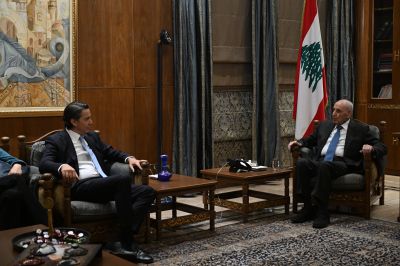
The American envoy also mentioned the Israeli withdrawal from Naqoura during his meeting with Parliament Speaker Nabih Berri. "These withdrawals will continue until all Israeli forces completely leave Lebanon and while the Lebanese Army continues to deploy southward to the Blue Line," he added.
Under the terms of the cease-fire that Hochstein helped negotiate, the Lebanese Army must deploy alongside U.N. peacekeepers in the South, while the Israeli army retreats over a 60-day period. Hezbollah, for its part, must withdraw its forces north of the Litani River, about 30 kilometers from the border, and dismantle any remaining military infrastructure in the South.
However, Israeli Defense Minister Israel Katz accused the party on Sunday of not withdrawing "beyond the Litani River" and not respecting other cease-fire terms after they accused Israel of violations.
Hochstein stated that he co-chaired the third meeting of this committee on Monday alongside the American General Jasper Jeffers, adding that "the mechanism is working well." A committee made up of Israeli, Lebanese, French and American representatives, as well as a delegate from UNIFIL, is responsible for monitoring the cease-fire's implementation and potential violations.
Although the cease-fire's progress "has not been as fast as some would have liked (...), what I heard today in Naqoura gives me hope that we are on the right track," Hochstein stressed after his meeting with Berri.
On Dec. 11, the Lebanese Army announced its deployment around the border town of Khiam in coordination with UNIFIL, also following the withdrawal of Israeli troops from the region. According to the American army, this was the first withdrawal of Israeli forces followed by a Lebanese Army deployment as part of the cease-fire.
Political Consensus
On the occasion of his first visit to Lebanon, since the cease-fire took effect, Hochstein also called for a "political consensus" for the election of a President of the Republic, scheduled for Thursday after two years of stalemate due to deep divisions between Hezbollah and its opponents.
According to information from L'Orient-Le Jour, he stated unequivocally, just like the Saudi envoy before him, that the army commander, General Joseph Aoun, was the preferred candidate of the five powers involved in the Lebanese dossier (France, United States, Saudi Arabia, Qatar and Egypt). He also met with the commander-in-chief.
According to OLJ's information, French envoy Jean-Yves Le Drian is also expected in Beirut on Tuesday.
On Tuesday, Amos Hochstein and the U.S. ambassador met in Maarab with the leader of the Lebanese Forces, Samir Geagea, and his wife, MP Sethrida Geagea. During their discussions, the participants addressed the cease-fire and the need for the Israeli army to withdraw from Lebanese territory, according to the official National News Agency (NNA).
Earlier in the day, Hochstein was hosted at the residence of MP Fouad Makhzoumi, with the attendance of "representatives from most parliamentary groups," the NNA reported. During the breakfast meeting he organized for the U.S. envoy, Makhzoumi emphasized the importance of implementing all provisions of Resolution 1701 "to prevent Lebanon from becoming an arena for regional power struggles at the expense of its people and state."