


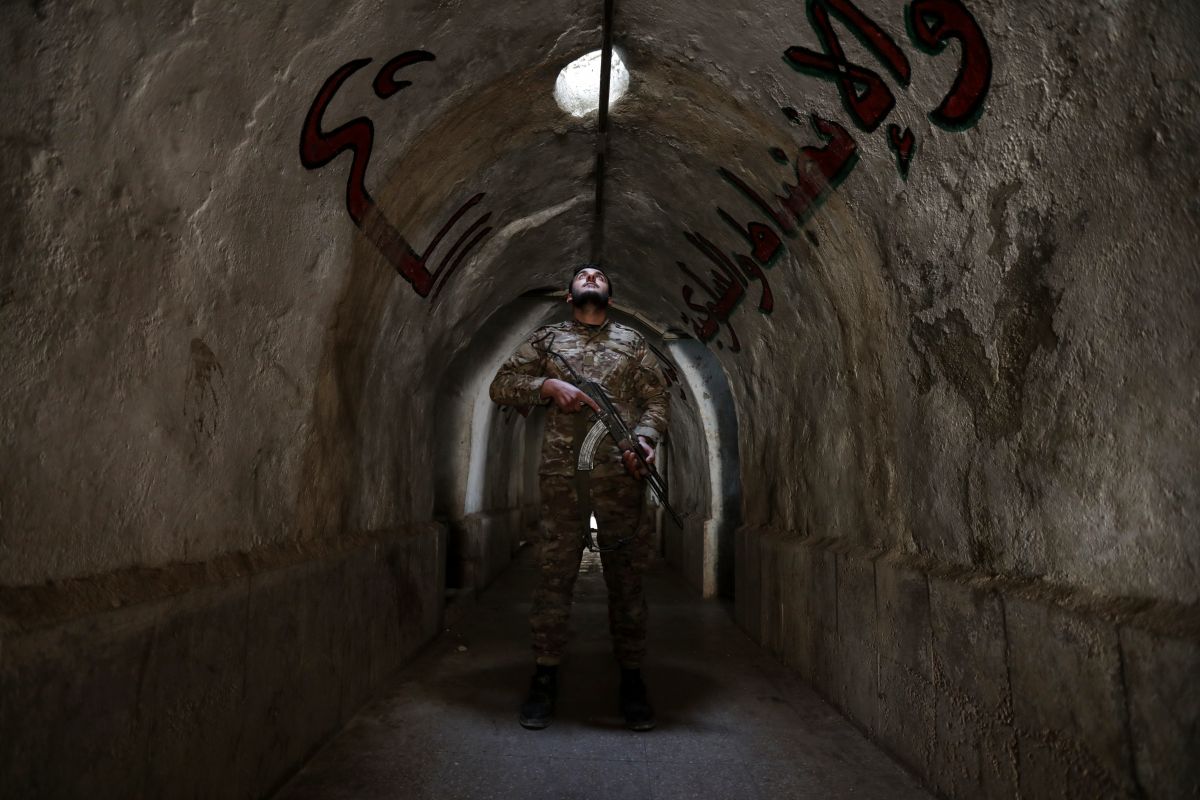
A fighter affiliated with the new Syrian administration stands inside a tunnel at the abandoned Syrian Republican Guard (SRG) base near Damascus on Jan. 4, 2025. (Credit: AFP)






A network of underground tunnels on the slopes of Mount Qasyun, overlooking Damascus, connects the Republican Guard's military complex — tasked with defending the Syrian capital — to the presidential palace, according to an AFP correspondent who entered the camp on Saturday.
"We entered this enormous barracks of the Republican Guard barracks after the liberation" of Damascus on Dec. 8, said Mohammad Abu Salim, a military official of Hay'at Tahrir al-Sham (HTS), the dominant Islamist group in the alliance that ousted President Bashar al-Assad from power. "We found a vast network of tunnels that lead directly to the presidential palace," he added, referring to a nearby hilltop residence.
The AFP correspondent toured two bunkers containing large rooms once used by Guard soldiers, equipped with telecommunications, electricity, a ventilation system and weapons storage. Other, more rudimentary tunnels, carved into the rock, were used to store ammunition.
The Republican Guard was responsible for securing Damascus, but the Syrian army collapsed when the HTS-led coalition launched a swift offensive from its northern stronghold and entered the capital on Dec. 8. Bashar al-Assad fled to Moscow.
A golden statue of Bassel al-Assad, Bashar's late brother, mounted on horseback, was toppled, with its severed head lying nearby. Bassel al-Assad, once considered his father Hafez's heir, died in a car crash in 1994. Hafez al-Assad ruled Syria with an iron fist until his death in 2000, passing power to Bashar.
Inside the vast Republican Guard camp, fighters were seen shooting at portraits of Bashar al-Assad and his father, Hafez. Tanks and artillery are lined up under stone shelters, alongside rows of empty barrels. Further inside, explosives are stored. "The regime used these barrels to bomb civilians in the north of Syria," Abu Salim said.
The UN had previously condemned the use of barrel bombs by Bashar al-Assad’s air force against civilian areas held by opposition forces during the country’s civil war.
This article was originally published in French in L'Orient-Le Jour.

 1 p.m. recap: Salam in Nabatieh; up to 10,000 more US troops heading to Middle East
