






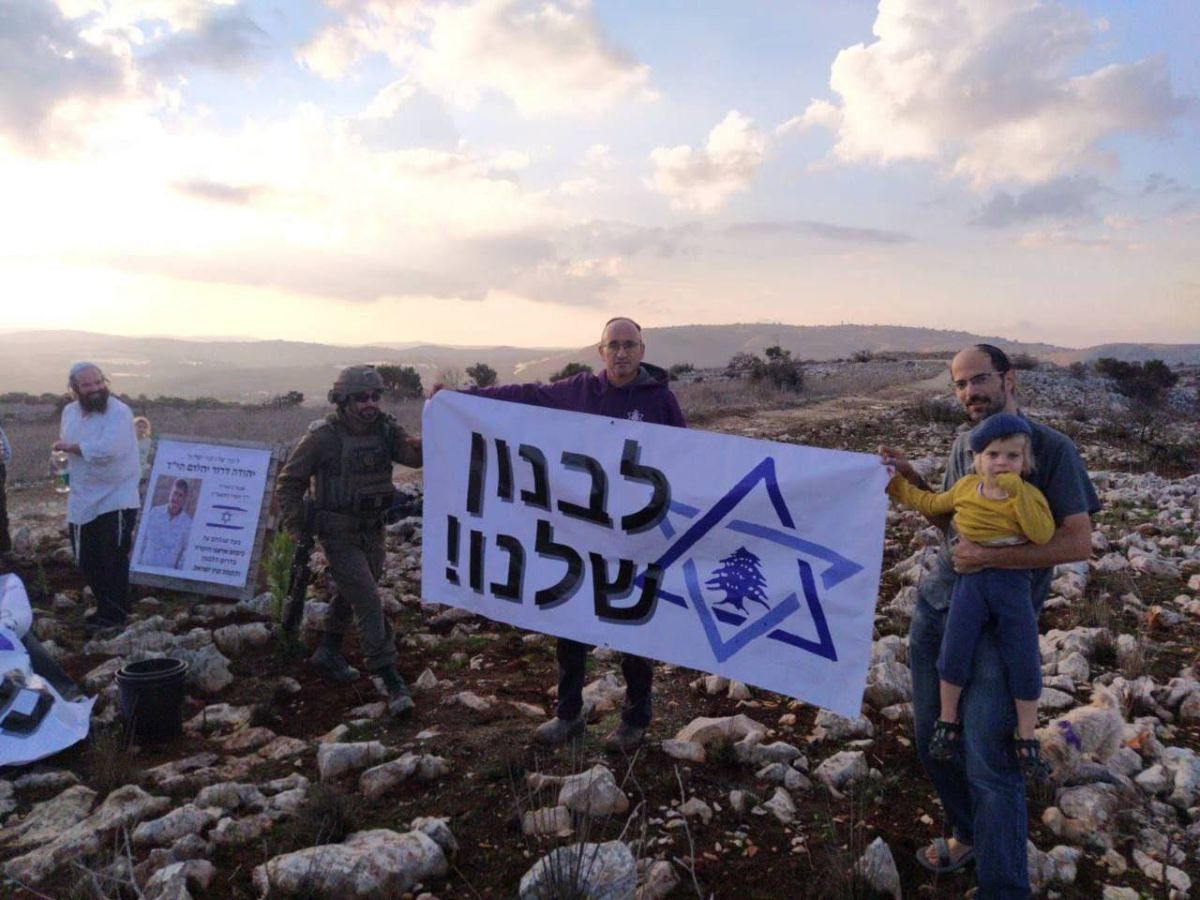
Alleged Israeli settlers in Maroun al-Ras (Bint Jbeil) holding up a sign that reads "Lebanon is ours.) (Credit: @Sourcesfiables/X)






Israeli settlers reportedly entered Lebanese territory without security clearance on Dec.5, according to the Israeli army, as cited by Haaretz Wednesday.
According to an Israeli army spokesperson's statement cited by Haaretz, "After being identified by our forces, they were removed from the area. This is a serious incident that is under investigation."
On Dec. 5, several families from the "Settler Movement in Southern Lebanon" arrived at the border area and crossed several meters over the blue line, according to Haaretz.
"Israeli army forces in southern Lebanese villages were forced to cancel military operations and respond to the event, as the civilians refused to leave the area," Haaretz reported.
Initially, the Israeli army claimed "that the civilians had not crossed the border, but after a thorough investigation, it was confirmed that they had indeed entered Lebanese territory," according to Haaretz.
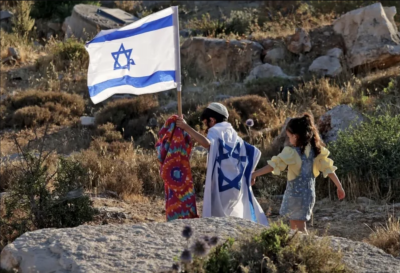
An account on X named "Trusted Sources" shared images allegedly showing settlers setting up tents in the southern Lebanese town of Maroun al-Ras (Bint Jbeil). The settlers were seen carrying flags emblazoned with the words "Lebanon is ours."
The flag comprises a cedar in a Star of David, the emblem of the “Uri Tzafon” organization (“Awakening the North”), founded a few months ago and which has quickly established itself in Israel as the leading voice of a movement advocating for the colonization of southern Lebanon. Although its audience remains limited (a few hundred views on YouTube and 550 followers on Telegram), the movement has gained attention and sparked interest in the media.
The Lebanese army has yet to comment on the matter.
UNIFIL did not respond to L'Orient Today's request for comment at the time of the publication of this article.
The conflict between Hezbollah and Israel, which began with cross-border clashes on Oct. 8, 2023, escalated into full-scale war in Lebanon on Sept. 23. A cease-fire agreement was reached on Nov. 27, but Israeli violations have persisted almost daily, totaling more than 100 incidents to date. Since the cease-fire came into effect, Israeli attacks have killed at least 34 people, according to L'Orient Today's count. Per the cease-fire agreement, a monitoring committee, chaired by a U.S. general, recently began its work.
The Israeli army is set to withdraw from southern Lebanon at the end of Jan.2025, making way for the Lebanese army to take control.
On Tuesday afternoon, at the cabinet meeting at the Grand Serail, caretaker Information Minister Ziad Makary declared that the "unacceptable" Israeli violations of the cease-fire agreement must stop and that the monitoring committee would meet in Naqoura on Wednesday to discuss the issue.
South Lebanon and Greater Israel
Contacted by L'Orient-Le Jour, retired General Khaled Hamadeh stated that “what happened proves that some extremist Israelis believe that southern Lebanon should be part of Greater Israel.”
He added, “Either Benjamin Netanyahu is behind this incident, or he is simply trying to exploit it. By expelling these settlers from Maroun el-Ras, he is showing compliance with Resolution 1701,” said the former military officer, who does not believe the settlers’ expansionist ambitions will go any further.
General Hamadé also warned that “such incidents could recur if Lebanese authorities fail to properly implement Resolution 1701,” especially as Maroun al-Ras and other villages remain occupied.
“The 60-day period outlined for the cease-fire’s implementation is a test for Lebanese authorities. If the Israeli state is dissatisfied, it could provoke further incidents, launch military operations in Lebanon, or even refuse to withdraw from the areas it occupies,” he analyzed.
Neither UNIFIL nor the mayor of Maroun al-Ras were available to comment on the incident.
