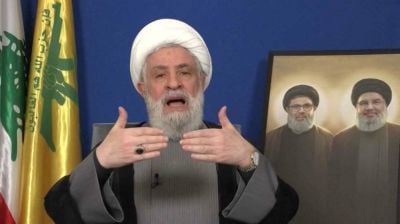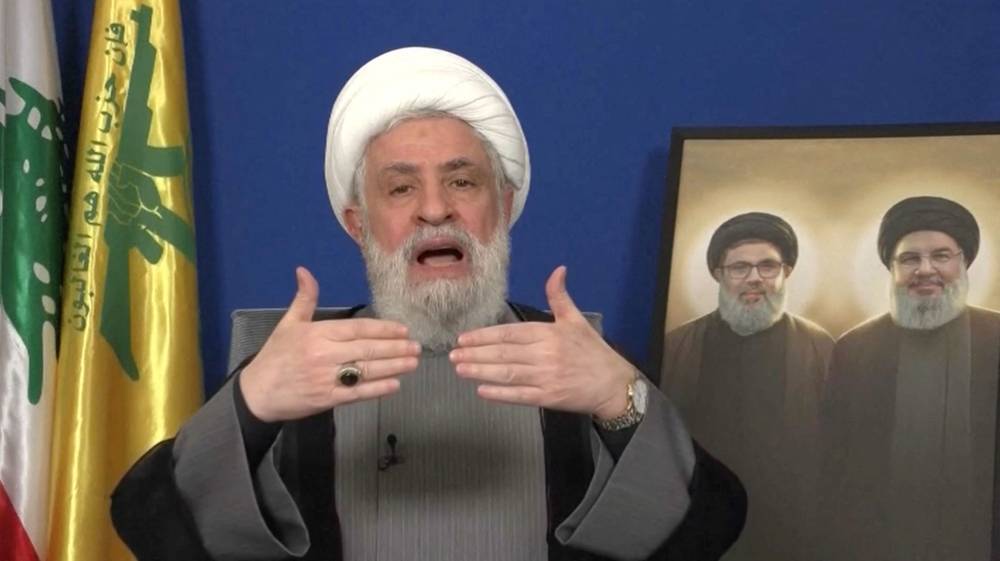
Hezbollah Secretary-General Naim Qassem during his speech on Nov. 20, 2024. (Credit: Screenshot from Al-Manar)






For the first time since the escalation of the war in Lebanon, Hezbollah’s new Secretary-General, Naim Qassem, appeared open to a cease-fire with Israel during his speech on Wednesday.
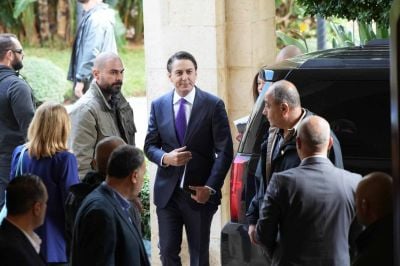
Qassem hinted at progress in negotiations led by U.S. envoy Amos Hochstein, suggesting that the next move was Israel’s responsibility. Hochstein traveled to Israel on Wednesday, signaling a shift from Hezbollah's earlier refusal to engage in talks before a cease-fire. Qassem also delinked the proposed cease-fire from the situation in Gaza, marking a departure from the principle of unified fronts.
Turning to postwar considerations, he discussed the election of a president, asserting Hezbollah's intention to play an “active role” in the process while respecting the Taif Agreement. However, Qassem set two conditions for a deal, one of which could jeopardize its success.
“We received the negotiation document, studied it thoroughly, and provided our feedback. Our remarks, aligned with those of President [Parliament Speaker Nabih] Berri, have been conveyed to the American envoy,” Qassem said, emphasizing, “Israel cannot impose its conditions on us.”
Hochstein struck a positive tone after his latest visit to Beirut, reporting “further progress” in discussions just an hour before Qassem’s address. “We negotiated based on two principles: first, a complete and total cease-fire, and second, the preservation of Lebanese sovereignty,” Qassem said. He stressed, “The occupation [Israel] cannot secure through an agreement what it failed to achieve on the battlefield.”
Qassem also rejected Israel’s demand to retain the right to intervene militarily in southern Lebanon, stating, “The Israeli enemy cannot enter Lebanese territory at will in the event of a cease-fire.” The success of an agreement, he added, depends on “Israel’s response and the seriousness of [Prime Minister Benjamin] Netanyahu.” Qassem emphasized Hezbollah’s readiness for “a prolonged battle” and a “war of attrition” should negotiations fail.
‘Hitting Tel Aviv’
Qassem devoted much of his address to the front lines, countering reports of Israeli army advances in southern Lebanon and defending the group’s strategy. “The resistance strives to eliminate the enemy and prevent the permanence of its occupation. We have demonstrated an exceptional model in this regard and can sustain this effort for as long as needed. Israel cannot defeat us,” he declared.
He attributed Israeli advances, estimated at up to five kilometers into Lebanese territory, to Hezbollah’s unconventional tactics. “The resistance is not a regular army; it fights the enemy wherever it attempts to advance. This is the essence of the resistance’s work and its method of confrontation,” he said.
Qassem acknowledged Hezbollah’s significant losses but said these were inevitable when facing “a brutal enemy.” He claimed the Israeli army was “also under heavy fire,” with over 100 soldiers killed and many more wounded. An AFP tally, based on Israeli acknowledgments, places the number of Israeli soldiers killed in southern Lebanon at 49.
Following the assassination of its former leader, Hassan Nasrallah, Qassem admitted Hezbollah experienced a “10-day period of confusion” but quickly regained its “strength in all areas.” He warned Israel of retaliation for three airstrikes on Beirut, including one that killed Hezbollah’s media chief, Mohammad Afif. “Israel has struck the heart of the capital. Therefore, it should expect a response targeting the center of Tel Aviv,” he said.
‘We are focused on the future’
Toward the end of his speech, Qassem addressed Lebanon’s political future, expressing readiness to help restore institutional operations after the war, including the election of a president. This process has been stalled for over two and a half years due to the Amal-Hezbollah alliance’s backing of Sleiman Frangieh, leader of the Marada Movement.
In what appeared to be a softened stance, Qassem said, “We are thinking about the future of our country. We will actively contribute to the election of a president through Parliament,” emphasizing that these “internal efforts will be conducted within the framework of the Taif Agreement, in cooperation with political forces.”
He concluded with a message of resilience and optimism: “We will rebuild together, with the support of the state and international partners. Lebanon will emerge even more beautiful,” reiterating the triad of “Army, People, Resistance,” which remains central to Hezbollah’s vision despite challenges in its relationship with the military.