


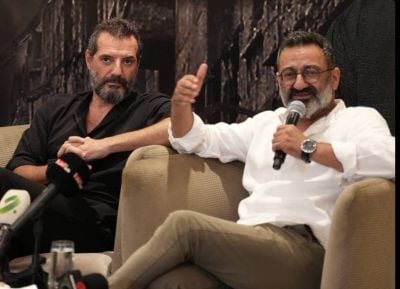
Adel Karam and Georges Khabbaz on stage at the Casino du Liban. (Credit: @casinoduliban instagram)






On Casino du Liban's stage, the set is divided down the middle like a mirror. On either side of this invisible demarcation line, which inevitably evokes the burning green line of the Lebanese civil war, are two black leather seats, similar to those snatched from stolen cars by militiamen of the time to sit and wait for their prey.
Amidst the cement blocks and sand-filled jute sacks that complete this ominous backdrop, Georges Khabbaz and Adel Karam, two of the most talented Lebanese actors of the time, sat on the two leather seats. From then on, screens behind them lit up with newsflash images of a fictitious summit in Cairo where, as usual, foreign powers had succeeded in negotiating a cease-fire in Lebanon for a few days.
After the flash, images of downtown Beirut unfolded on the screens, as barbaric battles tore through the area, turning it into a jungle of ash, weeds and blood.

Pocket theater
“In my opinion, there is no such thing as a cliché subject. Take Hamlet, for example, a play that has been performed 8,000 times in 8,000 different versions. It just goes to show that everything depends on how a theme is treated. I also think we approached the Lebanese Civil War too early, without the necessary hindsight. Today, it seems to me that it's the right time to do it, because we've had time to digest and understand certain things, especially over the last five years, which have enabled us to achieve a great deal,” said Georges Khabbaz, director of the play "Khiyal Sahra" ("A Desert's Shadow") and main character of this play, in which he shares the stage with Adel Karam.
During the Covid-19 lockdown, Khabbaz began to write this play, with a desire to move towards the intimacy of a pocket theater (a small, intimate and interactive form of theater) and driven by just two characters. He explained, “The idea that came to mind was that of two men bound together by both a certain fraternity and a rivalry. Two men who share everything, but also have everything in common. Two men who find themselves on opposite sides of the divide, but who share the same dreams and ambitions."
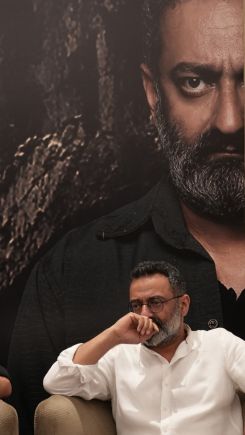
The script laid dormant in Khabbaz's drawer for three years, until he randomly shared it with producer Tarek Karam. The latter was won over by the idea, and together, director and producer saw Adel Karam take on the role of the second maverick. “The script immediately struck a chord with me on first reading, all the more so as I had experienced the subject and the reality of the situation myself during my childhood and adolescence. What's more, it was a real challenge for me to carry such a physically and emotionally taxing, but also technically very demanding play for an hour and a half, with long monologues. I'd never done this kind of theater before, and I thought it was the perfect time to step out of my comfort zone and take the plunge,” confided the actor, whose role of a Christian far right militiaman takes advantage of his shoddy status to "yshabbih" (stunt/show off).
On the other side of the stage, Khabbaz performed the role of a Muslim militiaman from the pro-Palestinian left of the time. His talent, phrasing, repartee and absurdist humor need no mention, as the actor continues to raise the bar for his prowess and deliver every time.
Wars for nothing
What's most interesting is that, from the pocket of this little theater, the two skilled actors Khabbaz and Karam took turns invoking genres that are a priori different, but whose dissonance ended up creating harmony.
Without revealing the twists and turns, "Khiyal Sahra" shifts from a theater of the absurd with the specter of Beckett and Ionesco hovering over it, to musical comedy, experimental and documentary, as the backdrop screens serve throughout the play as a temporal cue that places events in context.
The mix of this genre, coupled with Khabbaz and Karam's stage prowess, brings a smile to the face and a tear to the eye in equal measure. It all adds up to a canvas that reveals the personal landscape of each of the two protagonists, and in particular the roots of the violence they — like most young people of the time — chose to throw themselves into.

The play is about their childhoods, their relationships with their mothers and with their country — which each of them wants to own: “Without us, this country would have sunk,” they said to each other like a hackneyed leitmotif. It is also about their relationship with this piece of power they think will give them access to their dream, with the religion that keeps tearing them apart and with this war in which they both seem to us, more so as the play progresses, like pawns and puppets.
“What I'd like people to remember about this work is its educational aspect, and above all its human aspect. I'd like us to understand that the person who takes up arms and kills is someone who has been killed from the inside,”said Khabbaz. Karam joins him saying, ”Personally, I'd like 'Khiyal Sahra' to speak to the new generation, to make them understand that even if they think they know everything about this war, they will never understand its seriousness and futility.”
Khabbaz chose the word “Fantoche” ("Puppet") for the French title of his play, likely so that we never forget this war for nothing, which served no purpose other than to manipulate poor puppets for the benefit of criminals who couldn't care less.
"Khiyal Sahra” is showing at the Casino du Liban theater until Sunday, Sept. 1.
This article was originally published in L'Orient-Le Jour, translated and edited by Yara Malka.

 7 p.m. recap: Netanyahu seeks mastermind behind Flydubai incident; Washington sanctions 2 French nationals; Ben Gvir's 'I want to kill you' threat