


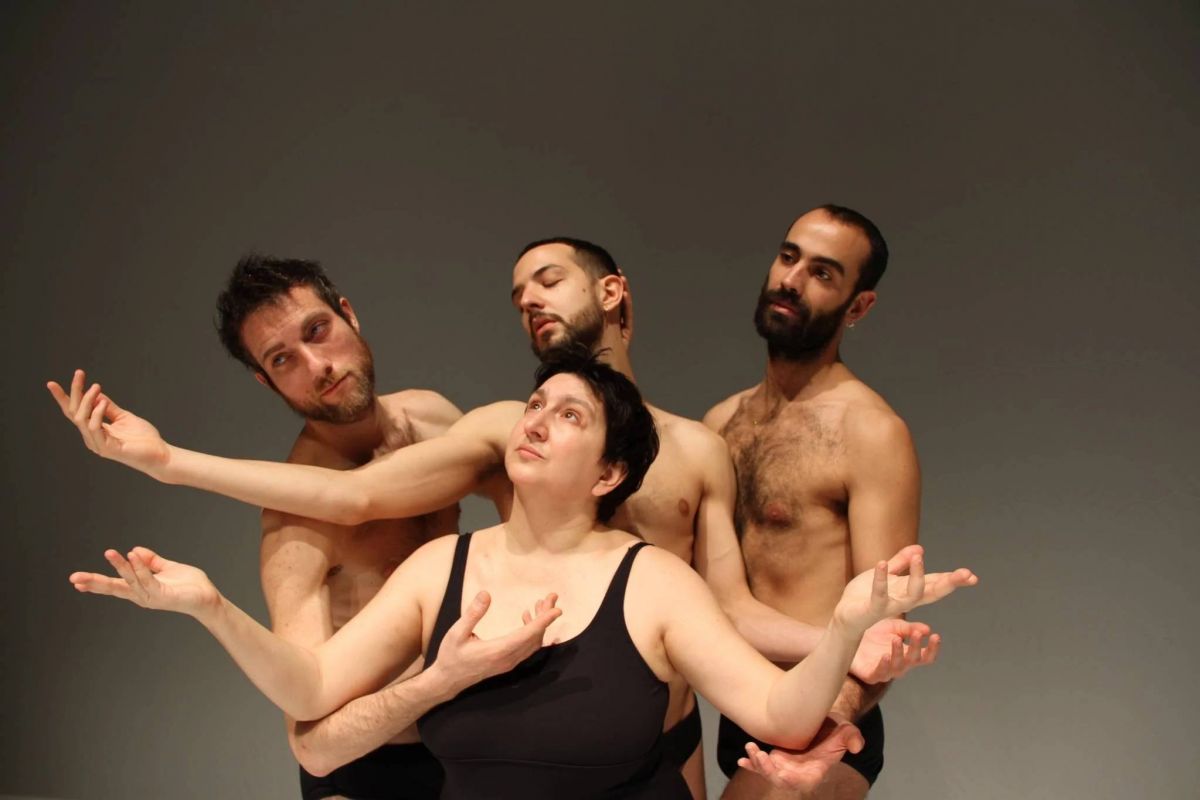
The three “Graces” by (and with) choreographer Sylvia Grabaudi. (Credit: Matteo Maffesanti)






The Lebanese public has a date on July 9 at the al-Madina* theater with the Italian choreographer and performer Silvia Gribaudi, who returns for the third time to Lebanon with "Graces," a contemporary dance show inspired by the famous sculpture The Three Graces by Antonio Canova.
On a proposal from the Beirut Physical Lab, supported by the Italian Cultural Institute, Gribaudi will also run a week of dance technique workshops – including one day open to all – entitled “Free Bodies.”
Beirut Physical Lab is an innovative, open-access center dedicated to contemporary dance founded in 2021 by Bassam Abou Diab, who will later be joined by co-founder Andrea Fahed. The platform aims to train the next generation of artists by providing them with educational and performance opportunities that contribute to the evolution of the performing arts in Lebanon and to multiply the possibilities for creators in this field. The organization believes in the power of movement to overcome barriers of race, socio-economic origins, religion, sexual orientation or gender. This is achieved through a network of exchange and collaboration with local and international artists, including Grabaudi.
The director of the Italian Cultural Center, Angelo Gioe, described her performance as unique, specifying that it was the workshop that also convinced him to finance the project that allowed a seed to be sown in Lebanon. He emphasizes that with Silvia Grabaudi, it is not only about dance but also about theater because her research draws on inclusion as well as on the confrontation with the cultural social fabric in which the show takes place. "Her message is not banal, it induces the public to question age for example and other usual canons of dance in a mixture of alternative beauty and lightness," Gioe told L'Orient-Le Jour.
A non-conformist choreographer
A multi-awarded Italian choreographer and performer, Gribaudi stands out for her exploration of the social impact of bodies. A direction she took by first exposing her own body to its physical possibilities on stage alone or with others. Her company, Silvia Gribaudi Performing Arts, has developed a unique choreographic language by placing humor and interaction between performers and audience at the center of its creations. Winner of numerous awards, Gribaudi adopts an artistic approach that favors dialogue and empathy.
Her works, often presented in international festivals, integrate elements of classical dance along with a touch of irony and poetry. Very focused on societal issues and cultural transformations, she often deconstructs stereotypes in her choreographies. Graces, her creation presented at al-Madina, inspired by Antonio Canova's marble sculpture made between 1812 and 1817 and representing three daughters of Zeus – who embody joy, charm and beauty – is no exception. In many ways, this work was considered a departure, but it is now accepted by many as a model of beauty. Canova's work questioned the Baroque conception of forms: it depicts the Charities (goddesses personifying life in all its fullness and assimilated to the Graces by the Romans), as young, slender and naked goddesses, hugging each other, their heads almost touching, in such a way that some have considered it a work imbued with eroticism. Gribaudi reverses this work and stages three male figures who occupy a space and time suspended between the human and the abstract: a place where masculine and feminine meet without defined roles and dance to the rhythm of nature itself and the echo of the audience.
Three men to break stereotypes
On stage, there are therefore three male performers – Siro Guglielmi, Matteo Marchesi, Andrea Rampazzo – alongside Gribaudi.
“We decided to work with three men to break stereotypes because usually, beauty and grace are associated with the feminine, we wanted to show that men are also capable of harmonious movements,” Grabaudi told L'Orient-Le Jour. “But since I am also on stage, we inevitably question the issue of gender, especially since they are goddesses and so we position ourselves beyond this identity.”
The subjects of beauty and perfection nourish Graces in which Sylvia Grabaudi explores the meaning of perfection in our societies.
“A beauty that perhaps emanates from our imperfections,” she said.
“We ask the audience questions about its definition and invite them to interact, which places dialogue at the center of the work at a time when honest communication with others is becoming increasingly difficult. In Graces, we start from the perfection of the body to reach that of our relationships between imperfect humans. Relationships that can only succeed when we are ready to admit our failures. With each fall, we get back up and create a new bond with the audience, who settle into the curiosity to discover the other rather than to judge them,” the choreographer continued.
“Graces was a pivotal moment in my personal life, a kind of rebirth,” she stated, adding that “We will soon have 200 performances of this show, which, at its core, is a very small production that we have made travel so much and that has made people so happy that I realize that it is actually a source of joy.”
“I don’t really know why, but the audience comes out delighted every time. Perhaps it is due to the complicity that exists between the dancers and the energy that it channels, which goes beyond aesthetics and breathes a wind of freedom,” Grabaudi said. “The lack of absolute control over what happens on stage is for the choreographer another driving force of this energy that breathes prosperity, joy and splendor, themes of this work that essentially tells us that it is possible to return to these qualities to find a peaceful society.” A joy in short which is cultivated, like that of Spinoza.
The show is based on the foundations of classical dance and mainly explores the need to create a framework where the artist can experience personal freedom within a structure, allowing the choreography to evolve according to the dialogue established between the dancers and Grabaudi.
"Given the large number of performances, the choreography is well-oiled, because we defined the structure with the audience, who become stakeholders, and also because it involves humor that we only understand with people, in an action/reaction process that has become clear after all this time," stated the choreographer.
Silvia Grabaudi admits, however, in a little nod to Italy, that it is always more difficult to deconstruct the genre in familiar territory. And when asked to define it, she answers: "For me, the genre is linked to mystery, it is a secret place."
*“Graces” by Silvia Grabaudi at the al-Madina theater on July 9 at 9 p.m.
This article originally appeared in French in L'Orient-Le Jour.